
A costless status symbol convinces no one, so people bring the cost back themselves. That's the iPhone queue.
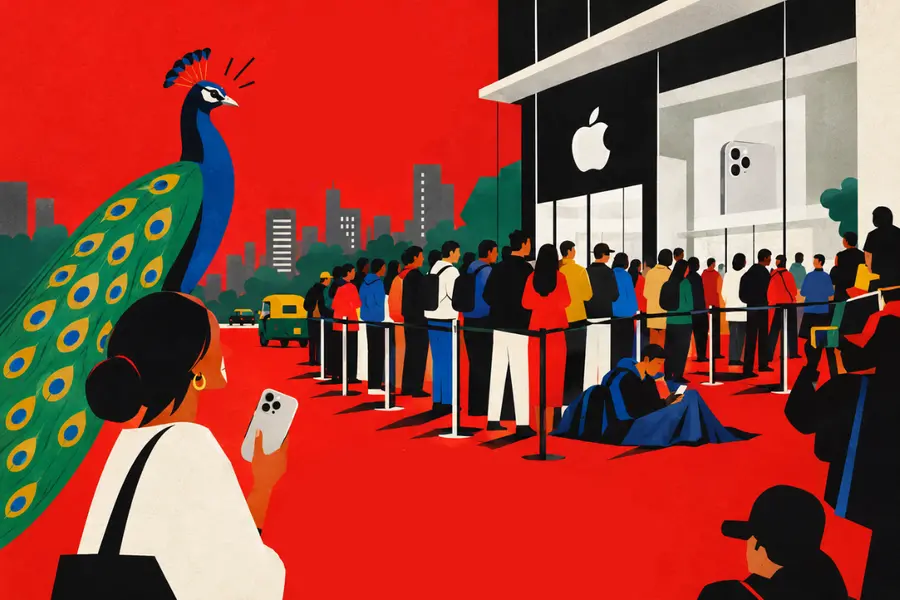
On September 18, a phone that could be delivered to your sofa in 10 minutes was instead fetched by thousands of people who chose to stand outside a store all night to get it.
Every explanation on offer- FOMO, celebrity hype, brand loyalty, ‘Indians love status symbols’ treats this as irrational. It isn't. It's one of the oldest calculations in nature, and once you see it, you can't unsee it in half of what people buy.
Biologists call it the handicap principle. A peacock's tail is a liability, it's heavy, it's bright, it slows the bird down in front of predators. That's exactly why it works as a signal. A weak, sickly peacock could never afford to grow something so wasteful and survive. So a magnificent tail is proof, precisely because it cost something real. A signal that costs nothing convinces no one.
Also Read: iPhone 18 Pro Max goes on sale in India: ₹3.29 lakh model draws long queues
Now look at what quick commerce did to the iPhone. The moment Blinkit could put an iPhone 18 Pro on your doorstep in minutes, it destroyed the phone's value as a signal. If anyone with ₹1.65 lakh and a working thumb can have one by lunchtime, owning it proves nothing except that you tapped ‘buy.’ The device itself, the object in your pocket stopped being able to say "I got here first" or "this mattered enough to me to sacrifice for it."
So people brought the cost back themselves. They manufactured the very friction that same-day delivery had erased, a freezing night on a pavement, a missed day of work, hours with nothing to do but be seen doing it because a costless iPhone can't outrank anyone, and a costly one still can. The queue wasn't a failure to notice the delivery option. It was the point. It's the tail.
The cost has to be real, or the signal is fake too
This is where the story stops being merely interesting and starts being worth worrying about. A peacock's tail costs the peacock calories and camouflage. A queue costs a night's sleep, recoverable. But some buyers this week reportedly paid with something that doesn't grow back, gold sold off, emergency funds raided, EMIs stacked onto salaries that hadn't budgeted for a single extra rupee, let alone the insurance, the case, the eventual out-of-warranty screen repair that can run a third of the phone's price on its own.
That's a very different animal from a rich person queuing for fun. A costly signal only makes evolutionary sense if the cost is proportionate to what you can actually spare. A peacock that grows a tail it can't afford dies before it gets to use it. A buyer who empties a safety net to fund a status object is running the exact same risk in slow motion, the signal succeeds today and the underlying finances fail six months from now, quietly, off camera, where nobody's filming.
Also Read: iPhone 18 Pro Max: What’s different about the Indian and US models?
Why celebrities don't need to say a word
Notice something about how the celebrity angle usually gets explained, "influencers make you feel like you need it." True, but incomplete. What a Vicky Kaushal or a Triptii Dimri posting from the Apple event actually supplies isn't information about the phone. It's proof that the signal still clears at the top of the status ladder, that this handicap is still expensive enough to be worn by people who have nothing left to prove.
The moment the ‘wrong’ crowd starts affording something too easily, in signaling terms it's already dying as a status object. So the visible presence of people who could buy anything, choosing this thing, is what keeps the trick alive for everyone below them.
The question isn’t the usual one here
Every finance expert quoted around this launch offers the same advice, wait 10 days, check your emergency fund, calculate the true cost of ownership. All correct, and all easy to nod at and ignore, because none of it touches the actual engine driving the purchase.
Here's the question that does, would I still want this if no one would ever see me with it?
Not "can I afford it." Not "do I need it." Whether the object would still feel worth having in a world with no queue to photograph, no unboxing to post and no one at the next meeting to notice. If the honest answer is that half the appeal drains out the moment nobody's watching, you're not evaluating a phone. You're pricing a peacock's tail and you should at least know that's the transaction you're making, and make sure it's one you can actually afford to keep affording.
The most expensive thing about the iPhone 18 Pro was never really the ₹1,64,900 on the receipt. It's whatever a person was willing to burn, a night, a safety net, a piece of gold to make sure the receipt wasn't the only proof that mattered.
Published: 20 Sept 2026, 10:47 am IST
ABOUT THE AUTHOR

Related Topics
Disclaimer: Kindly avoid objectionable, derogatory, unlawful and lewd comments, while responding to reports. Such comments are punishable under cyber laws. Please keep away from personal attacks. The opinions expressed here are the personal opinions of readers and not that of Mathrubhumi.