

Behind the celebrations this National Doctors' Day, young medics open up about burnout, emotional strain, sleepless nights and the growing pressures of life in hospitals.
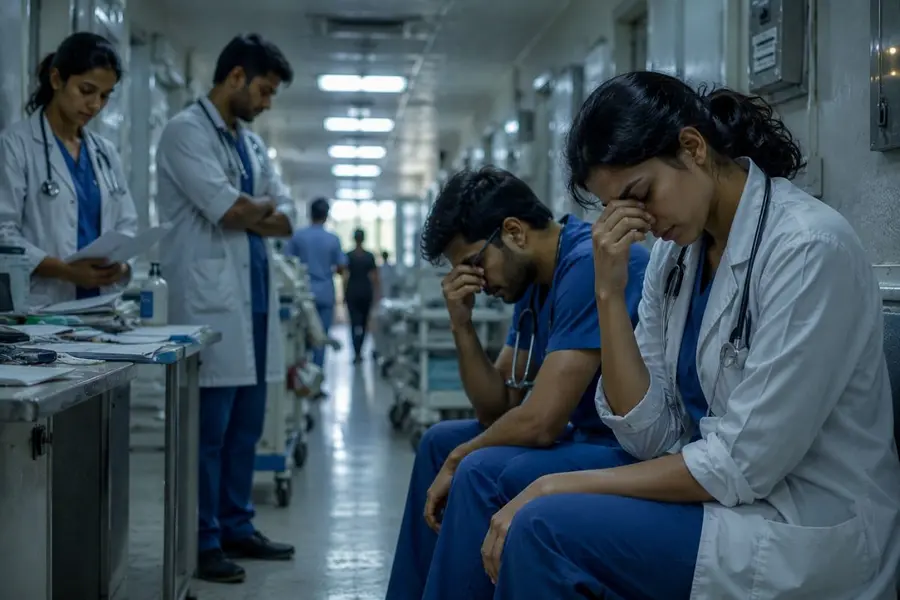
As India celebrates National Doctors' Day on July 1, a familiar concern continues to cast a shadow over the occasion.
From recurring attacks on healthcare workers to relentless work schedules, sleepless nights and deteriorating mental health, many young doctors say the profession they once entered with hope is becoming increasingly difficult to sustain.
Observed every year on July 1, National Doctors' Day commemorates the birth and death anniversaries of legendary physician and former West Bengal Chief Minister Bidhan Chandra Roy.
While the day honours the invaluable service of doctors across the country, it also offers an opportunity to look beyond the white coat and understand the mounting pressures confronting India's next generation of healthcare professionals.
For resident doctors and interns, medicine is often defined by marathon shifts, back-to-back emergencies, skipped meals, sleepless nights, and the emotional burden of making life-altering decisions under constant pressure. The challenges do not end inside hospital wards.
Fear of violence from patients' attendants, mounting academic expectations, and uncertainty about career progression have further intensified the strain.
Several studies have flagged high levels of burnout, anxiety and depression among resident doctors in India, with experts warning that prolonged stress can compromise both doctors' well-being and patient care.
'The emotional burden carried by young doctors is often underestimated,' said Dr Amraja Paranjpe, Gynecologist at Apollo Spectra Hospital, Mumbai.
Young doctors are expected to manage medical emergencies, comfort anxious families, cope with patient deaths, and continue learning, often without adequate emotional support.
Yet many hesitate to seek counselling or speak openly about their struggles, fearing they may be perceived as weak. According to her, normalising conversations around mental health and ensuring access to counselling are essential to help doctors continue providing compassionate care.
The physical toll is equally demanding. Long shifts, overnight duties, and irregular meals gradually wear down even the most committed young doctors. Dr Amit Chakraborty, Head and Neck Surgeon and Surgical Oncologist at SSO Hospital, Mumbai, said these years undoubtedly build resilience and sharpen clinical skills.
Still, without proper rest, mentorship, and institutional support, they can quickly lead to exhaustion.
Creating healthier workplaces where doctors can maintain a reasonable work-life balance, he said, is crucial for both medical professionals and the patients they serve.
The lived experiences of resident doctors paint an even starker picture. 'There are times when I reconsider the profession,' admitted Dr Soumyajyoti Har, an intern at SSKM Hospital, Kolkata.
Endless shifts, toxic workplace hierarchies, career uncertainty and the expectation that interns perform repetitive tasks with little recognition have left many feeling disillusioned.
Despite working tirelessly for patients, he said, even basic respect often feels elusive, while taking leave can become an uphill battle.
That sense of relentless fatigue is echoed by Manas Das, a first-year postgraduate trainee in dermatology at SSKM Hospital, Kolkata.
After spending two consecutive nights awake handling emergencies and surviving on delayed meals, he wonders whether the promise of a secure and respected career is worth the personal cost.
For him, the question is no longer about success, but whether a life built around constant exhaustion can truly be called healthy.
Dr Akhila Bomma Reddy, Surgical Oncologist at TGH Onco-Life Cancer Center, Talegaon Dabhade, recalls experiencing similar moments during her residency.
'There were nights where the sheer volume of patients meant I didn't sit down for twelve hours straight. By early morning, I found myself double-checking routine charts three times, terrified that exhaustion was blurring my judgement,' she said.
The experience, she added, was not merely about physical fatigue but the growing realisation that doctors are often expected to perform at their best while being denied the basic conditions needed to sustain that performance.
Experts say such experiences point to deeper structural issues within the healthcare system.
Dr Nimitt Nagda, an Internal Medicine expert at Zynova Shalby Hospital, Mumbai, noted that many young doctors rethink medicine not because they lack passion, but because of relentless workloads, burnout, lack of personal time, and constant work pressure.
Echoing the concern, Dr Ashok BC, Chief of Medical Services at Aster Whitefield, said burnout among young doctors has become a challenge for the healthcare system itself.
He called for confidential mental health support, mentorship programmes, reasonable duty hours and a workplace culture where seeking help is encouraged rather than stigmatised.
As the nation celebrates its doctors today, many young medics hope the conversation moves beyond gratitude.
For them, the greatest tribute to the profession would be meaningful reforms that protect doctors from violence, prioritise their mental well-being and ensure that those who dedicate their lives to saving others are not forced to sacrifice their own health in the process.
Published: 01 Jul 2026, 01:22 pm IST
ABOUT THE AUTHOR
Related Topics
Disclaimer: Kindly avoid objectionable, derogatory, unlawful and lewd comments, while responding to reports. Such comments are punishable under cyber laws. Please keep away from personal attacks. The opinions expressed here are the personal opinions of readers and not that of Mathrubhumi.