
In a TriBeCa club, a Gen Z Diwali party poured chai-tinis, played 50 Cent and still kept faith with a story that is thousands of years old.
The word comes from Sanskrit, deepa, a lamp, and avali, a row. Diwali, or Deepavali, is a row of lights, and for Avantika Vandanapu it begins with a memory of sound. Growing up in the San Francisco Bay Area, she remembers falling asleep to the laughter of friends and family filling her parents’ house, then waking to find a few candles still flickering from the night before.
At 21, the actress, who stars in Mindy Kaling’s Hulu series ‘Not Suitable for Work’, wanted to hand that feeling to people who might never have stood inside it.
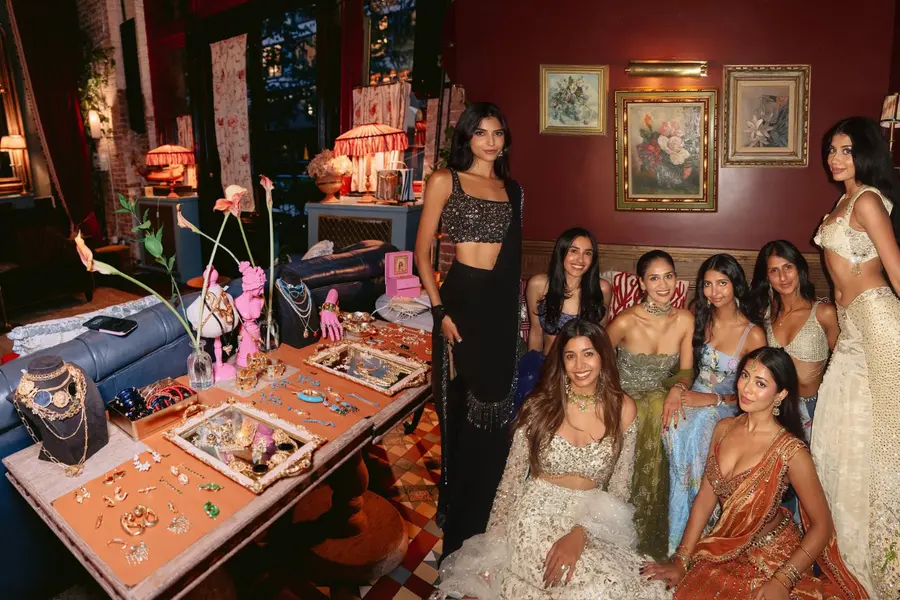
So on Tuesday she co-hosted her own Diwali party at Maxwell Social, a private members club in TriBeCa that holds book clubs, monthly dinners and debate nights for millennials and Gen Z. Her parents once opened their doors to guests this way, and she was doing the same.
Behind the instinct lies an old Sanskrit idea, atithi devo bhava, “the guest is God,” from the Taittiriya Upanishad.
About 200 people came. There were friends from Columbia, fellow actors, reality stars, podcasters and influencers. Her co-hosts were Aryan Simhadri of Percy Jackson and the Olympians, in an outfit by Nazranaa, and the publicist Neerja Patel. Vandanapu wore a sea-blue sari, her hair slicked into a braided bun with a gem-set maangtika running along the parting to her forehead.
Also Read: Less, but chosen, rethinking the festive table
The festival that falls on Nov. 8 this year is a story first, and a party second. In the Ramayana, Rama returns to Ayodhya after fourteen years of exile, having kept his father’s word at enormous cost. The citizens line the streets with lamps to welcome him home. Elsewhere in India the same night belongs to Lakshmi, who rose from the churning of the cosmic ocean, or to Krishna’s victory over the demon Narakasura. Jain and Sikh traditions carry their own Diwali stories.
The thread running through all of them is the Upanishadic prayer tamaso mā jyotirgamaya, lead me from darkness to light.
Every generation has to find its own way of carrying that story. Here, pani puri arrived in shot glasses, chai came as a martini, and Bollywood soundtracks gave way to 50 Cent. Modern cocktail dresses stood beside silk saris, and a sea of phone lights stood in for the diyas.
Guests ate Nepali steamed dumplings, biryani and South Asian-flavored doughnuts, and cooled off with mango ice pops from Malai, the Brooklyn and West Village ice cream brand built on South Asian flavors.
Also Read: Stars never needed a map, Five Indian tables Michelin found before India did
For many guests, the surprise was the age of the host. Hindu households are usually held together by parents and grandparents, and Diwali parties tend to be grown-up affairs with a corner set aside for the children. Hershy Karthikeyan, a 22 year old influencer, who recently moved to New York after graduating, said she usually feels like the youngest person in the room. Not this time. A Diwali hosted by someone her own age, she said, is rare.
Small businesses founded by South Asians set up stalls around the room. Maalicious, which sells handcrafted jewelry from India, made bracelets and hair ornaments from fresh jasmine.
For the stylist AmbiKa Sanjana, who grew up in India, the scent was intoxicating and instantly home. Those garlands, she explained, are traditionally braided by the mothers and grandmothers of a household, a rite of passage handed down through hands rather than words.
Navneet Kaur, founder of the perfume brand Ruhveda, drifted through the crowd offering to bedazzle guests with bindis, the dot between the brows that tradition links to the ajna chakra, the seat of inner sight.
Shreya Navile, the model and actress from Netflix’s ‘Best of the Best’, said yes at once and placed a silver one on her shoulder. At 28, she was wearing a black-and-platinum silk sari she had, in her own words, stolen from her mother. That is also tradition, a sari travels from one woman’s wardrobe to the next, carrying the family’s history in its folds.
Late in the evening, Vandanapu, Simhadri and Patel thanked everyone for coming. Patel said she wanted the night to celebrate the next generation, and hoped the room made everyone feel they belonged.
Also Read: Rashmika Mandanna wore purple sari, chanderi buttas and half of Jaipur’s zardozi
That may be the oldest idea in the festival. Rama’s Ayodhya lit its lamps so that the returning one would find his way home, and in a TriBeCa club, a roomful of people far from their parents’ houses did the same for each other.
(Disclaimer: The Sanskrit and mythological references are traditional and vary by region and community. Images used in this article are credited to Taara Sajnani Das. All rights belong to the respective owner. Mathrubhumi English claims no ownership of the images, which are used for editorial purposes only.)
Published: 16 Oct 2026, 01:35 pm IST
ABOUT THE AUTHOR

Related Topics
Disclaimer: Kindly avoid objectionable, derogatory, unlawful and lewd comments, while responding to reports. Such comments are punishable under cyber laws. Please keep away from personal attacks. The opinions expressed here are the personal opinions of readers and not that of Mathrubhumi.