
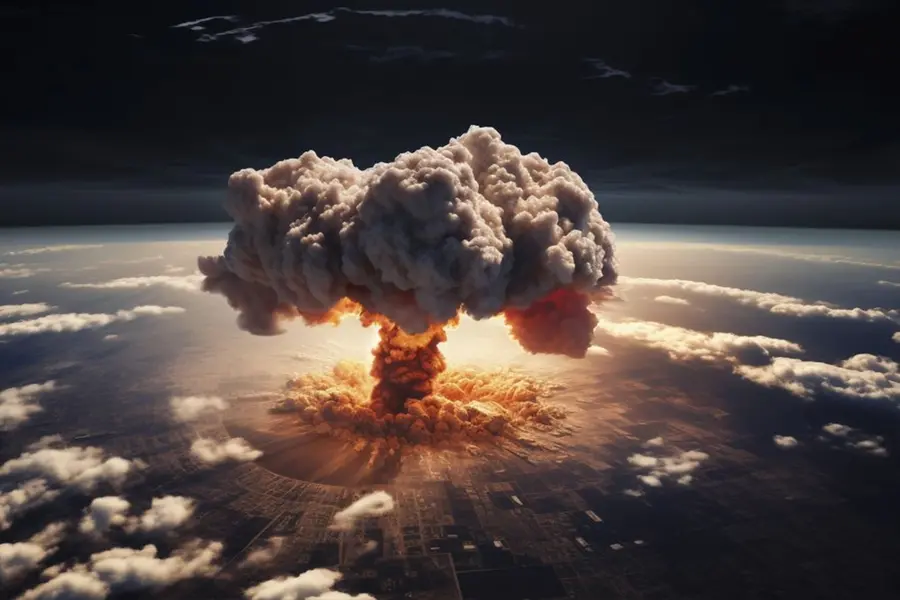
The world is already a tense place, and recent news from the United States has just made it even more concerning. Little over a month ago, on 14 March 2025, the Pentagon issued a directive stating that nuclear weapons must be ready to launch within two minutes of receiving the order.
The news, which has now trickled out into the open, has sparked global alarm. Alongside this, the US is developing a powerful new nuclear bomb called the B61-13, which is 24 times stronger than the bomb dropped on Hiroshima. Set to be ready by 2026, this bomb could destroy entire cities in moments. For people in India and across the globe, these developments signal a growing risk of nuclear conflict that could affect us all.
The Pentagon's new rule comes from a document called the 'Organizational Messaging Service'. It focuses on 'Emergency Action Messages' that control nuclear weapons, demanding they be acted upon in two minutes or less -- a much faster timeline than before. This shows the US is preparing to respond to threats at lightning speed.
While the aim may be to deter countries like Russia or China, such a short window leaves no time for second thoughts or peaceful solutions. Imagine a false alarm, like a radar mistake, triggering a nuclear launch before anyone can double-check. History shows such errors have nearly caused disasters, and a two-minute deadline makes these risks even greater.
The B61-13 bomb adds to these concerns. With a power of 360 kilotons, it is designed to destroy heavily protected targets, like underground bunkers. Experts like Hans Kristensen and Matt Korda say this bomb signals the US is ready to escalate its nuclear capabilities.
Its strength is staggering: the Hiroshima bomb, with a 15-kiloton blast, killed tens of thousands, so the B61-13 could cause unimaginable destruction. For India, a country with its own nuclear weapons and a 'no first use' policy, this is troubling. If the US strengthens its arsenal, other nations, including our neighbour Pakistan, might feel pressured to follow, upsetting the delicate balance in South Asia.

Why is the US taking these steps now? The Pentagon points to "current security threats", likely referring to tensions with Russia over Ukraine and with China over Taiwan. The US wants to show it is prepared for any challenge. But this approach could backfire.
By speeding up nuclear triggers and building bigger bombs, the US might push other countries to do the same, sparking a new arms race. During the Cold War, the US and Soviet Union built thousands of nuclear weapons, each trying to outmatch the other, bringing the world close to disaster.
Today, with more countries holding nuclear weapons, a similar race could be even more dangerous.
For people in India, this news might seem far from daily life. But a nuclear conflict would affect everyone. A single bomb like the B61-13 could kill millions and make entire regions unlivable for years. The two-minute launch rule shrinks the time leaders have to negotiate and avoid war.
A 1983 US war game called 'Proud Prophet' showed how quickly nuclear decisions could lead to catastrophe. With faster triggers, such scenarios are no longer just possibilities -- they are real threats.
There's also a moral issue. The B61-13's massive power could harm countless civilians, not just soldiers. Groups like the International Campaign to Abolish Nuclear Weapons (ICAN) argue that such weapons violate international laws protecting people during conflicts. These laws require attacks to avoid harming innocent lives, but a 360-kiloton bomb cannot distinguish between a bunker and a city.
What can be done? First, the world needs dialogue. Countries like India, with influence in global forums, should push for talks to reduce nuclear risks.
Agreements like the Non-Proliferation Treaty aim to limit nuclear weapons, but they need stronger action. Second, people must speak up. In India, we understand the power of peace from our history of non-violence. Writing to leaders, joining peace campaigns, or spreading awareness can create change.
Finally, the US must rethink its strategy. Deterrence matters, but faster triggers and bigger bombs only invite trouble.
As 2026 nears, when the B61-13 is expected to be ready, the world faces a critical moment. The Pentagon's actions may aim to keep America safe, but they could make everyone less secure. For India, the stakes are high -- an arms race in our region would be disastrous.
Published: 17 Apr 2025, 06:23 pm IST
Related Topics
Disclaimer: Kindly avoid objectionable, derogatory, unlawful and lewd comments, while responding to reports. Such comments are punishable under cyber laws. Please keep away from personal attacks. The opinions expressed here are the personal opinions of readers and not that of Mathrubhumi.