
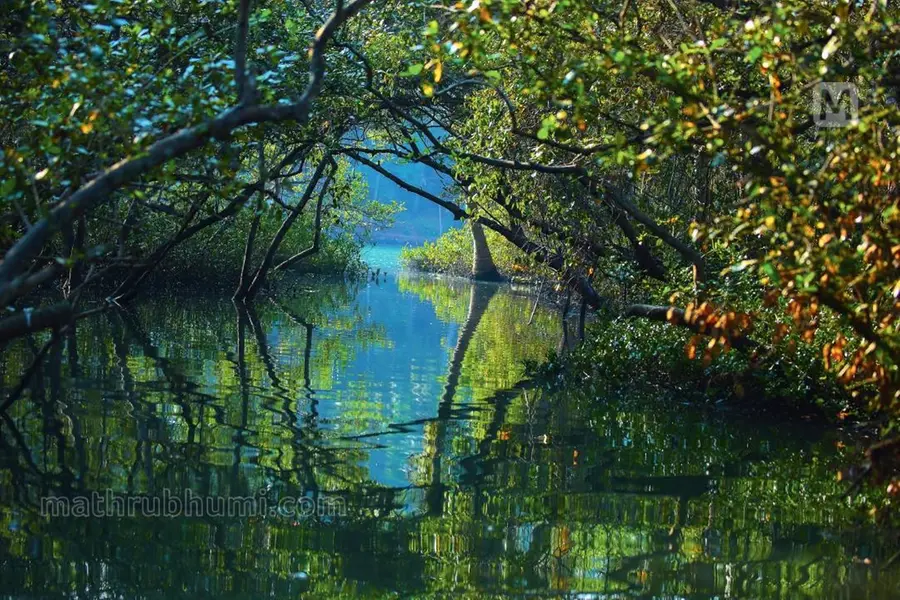
The District Tourism Promotion Council in Kozhikode has set a mission to explore and bring up the tourism potential of Kadalundi, a locale blessed with flourishing flora and fauna. The demand to convert this region into a major tourist spot has been raised by the natives and visitors in the same voice. Initiatives such as responsible tourism are sure to ensure employment and income for the locals here.
What awaits tourists here?
South India’s first community reserve Kadalundi community reserve is located just 750 metre from the Kadalundi railway station. The community reserve spreads across 154-hectare land at the coasts of Kadalundi river and the estuary of the Arabian sea. Over 30 per cent of the community reserve is occupied by the mangrove forest, which is the abode of migratory birds.
Migratory birds from Tibet, China, Siberia, Kazakhstan, and many more flock into the Kadalundi community reserve, mostly after September first week.
A few years back, bird watchers spotted nearly 88 species of migratory birds here. Over 10 birds mentioned by the renowned ornithologist Dr Salim Ali in the book ‘Birds of Kerala’ were recorded from Kadalundi.
Great Knot, Crab-Plover, Black-winged stilt, Common Redshank, Nordmann’s Greenshank, Eurasian Culew, and Kadalundi Tern are some of the unique guests here.

Kerala’s first railway station
Kerala’s first railway station constructed during the colonial period is situated two kilometres away from Kadalundi railway station. The 30-kilometre-long railway track from Tirur to Chaliyam was inaugurated on March 12, 1861. The rail track was used mainly to transport timbers from Nilambur carried via Chaliyar river in rafts. The Chaliyam railway station, which was a two-storeyed building with a tiled roof is now located inside the Chaliyam timber depot under the Department of Forest.
Portuguese fort
The Portuguese built a fort adjacent to the shore of the Arabian sea in Chaliyam to resist the attacks via sea and to establish its authority in Malabar in 1531. Later, the relationship between the Portuguese and the ruler of Malabar Zamorin worsened and the latter destroyed the fort with the help of an army led by warrior Kunjali Marakkar in 1571. The remains of this fort are still preserved in Chaliyam.
Hortus Malabaricus
The project ‘Hortus Malabaricus Sasya Sarvaswam’ was launched to provide awareness regarding medicinal plants mentioned in the work ‘Hortus Malabaricus’. The botanical garden under Kerala’s Forest department conserves 500 plants out of the 742 medicinal plants recounted in Hendrik Van Rheede’s ‘Hortus Malabaricus’.
Van Rheede prepared the elaborate work in 12 volumes on the medicinal plants in Malabar with the guidance of over 20 local physicians, including Itty Achuthan, Vinayaka Pandit, Appu Bhatt and Ranga Bhatt. The book was printed in Latin from Amsterdam in the Netherlands during the period 1678-1693.
Published: 01 Dec 2022, 03:19 pm IST
Related Topics
Disclaimer: Kindly avoid objectionable, derogatory, unlawful and lewd comments, while responding to reports. Such comments are punishable under cyber laws. Please keep away from personal attacks. The opinions expressed here are the personal opinions of readers and not that of Mathrubhumi.