
Muzaffar Ali’s version featuring Rekha in the title role, begins with little Ameeran in Faizabad abducted to Lucknow to be moulded and shaped into a perfect tawaif, and ends with Umrao grown from the little Ameeran, returning to Faizabad
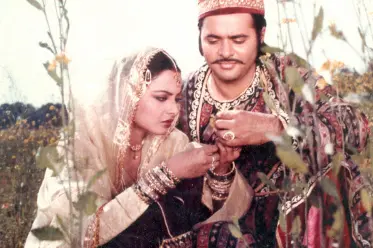
After a gap of 44 years since its release, Muzaffar Ali’s Umraon Jan was screened in a new version restored by the National Film Heritage Mission on June 27 across theatres in India. This digitally restored version is a part of Umrao’s narrative which has a rich cultural and historical backdrop, which includes 19th century Lucknow.
Several have called the work biography; some have also thought it to be an autobiography where Umrao Jan supposedly uses Mirza Hadi Ruswa’s name to speak about her own life. Whatever be the authorship of the work, there is not much doubt that Umrao had a large hand in the characterization of her own life. Either she existed, or she was drawn based on someone who existed. Jawed Siddiqui, who wrote Muzaffar Ali’s Umrao Jan (1981), says that there were controversies about the existence of Umrao Jan. He believes that there has never been an Umrao Jan in reality, while J. P. Dutta, who produced the later 2006 version of Umrao Jan with Aishwarya Rai as Umrao and Abhishek Bachchan as Sultan, the man she fell in love with, believes that she might have existed.
The film has been restored with enhanced visuals to allow audiences to experience the magic once again. Umraon Jaan is not an ordinary film directed by a filmmaker not into direction for a long time. He is a fashion designer, poet, artist, cultural revivalist, and social worker. He made his directorial debut with Gaman in 1978. Umrao Jan has been made in different versions over the years. In 1972 a Pakistani film director Hasan Tariq made Umrao Jaan Ada. In India it was first made as Mehndi in 1958 by S. M. Yusuf. In 1981 Umrao Jaan was directed by Muzaffar Ali and remade once again in 2006 by J. P. Dutta.
The novel Umrao Jan Ada (1885) was authored by Mohammed Hadi Ruswa, which, again, is said to be the second-hand writing by the author on the life and times of a famous courtesan who is named Umraon Jaan Ada in the novel. But, ages later, the question remains about whether there was really a courtesan who narrated her life story to Ruswa or whether it was the product of Ruswa’s creative imagination.
However, in the preface of his translation in English, Khushwant Singh wrote that this courtesan was not a product of Ruswa’s creative imagination. He added that there was indeed a highly regarded courtesan in Lucknow who Ruswa came to know personally and at a point of time, Ruswa asked her to narrate to him the story of her life. The courtesan, whose real name remains a debatable point, narrated the story of her life to Ruswa over several sittings till it finally took the shape of the novel.
The story goes that Ruswa had to show her the manuscript before it was sent for publication. Which underlines the possibility that Umraon was literate and could read and write. In fact, Ali’s film shows that the songs Rekha lip-syncs in the film, specially the first song, dil cheez hai aap meri jaan lijiye are composed by Umraon herself. When the women fled during the Sepoy Mutiny Umrao came back to her original home in Fiazabad only to be refused acceptance by her own brother though her mother wanted her back. Devastated, Umrao Jaan returned to Lucknow once the mutiny is over and finds the kotha looted and deserted.
Nearly 100 years after the novel was published, Muzaffar Ali made this into a film which depicts a bygone era of Lucknow, making use of the multi-dimensional magic called cinema to re-create the novel in the audio-visual medium, enriching and romanticising it with one of the most scintillating of music, lyrics and dance numbers orchestrated with beautiful aesthetics and brilliant cinematography, the recreation of a period in Lucknow with costumes, jewellery, a tragic love story following the kidnap of a little girl, from the safety and love of her parents to be shifted to an uncertain future. The set design, acting, dance, ambience and location, are enchanting enough for the audience not only to watch the film again and again but also to make it a relic in the history of Indian cinema.
According to Sana Fatima (Historicity and Culture in Umrao Jan (Ada): An Analysis of its Reader/Viewer Intermentality), “Umrao’s narrative has a rich cultural and historical backdrop, which includes 19th century Lucknow. Several have called the work biography; some have also thought it to be an autobiography where Umrao Jan supposedly uses Mirza Hadi Ruswa’s name to speak about her own life. But there is scarcely any doubt that Umrao had a large hand in the characterization of her own life. Either she existed, or she was drawn based on someone who existed. Several theories range. Jawed Siddiqui, who scripted Muzaffar Ali’s film, says that there had been controversies on the existence of Umrao Jaan. Yet, he believes that there has never been an Umrao Jaan in reality, while J. P. Dutta, who produced the later 2006 version of Umrao Jaan, believes that she might have existed.”
The “courtesan” genre of films have existed from the very early history of Indian cinema. It is a form of prostitution depicted in films that romanticises the very profession of prostitution and its dynamics as distanced from mainstream prostitution. The life of a tawaif is enriched by rich music, a period flavor, a Muslim ethos and ambience, beautiful poetry and a tragic love story thrown in. The tawaifs are trained perfectly in Urdu poetry, Moghul music like ghazals, thumris, dadras, and tappas, music, Kathak and adakaris. They took Persian influences from the courts of Shia kings and married them with Indian forms, and from them we inherit the Kathak and the dadra and thumri.
Tawaifs , the Awadhi term for highly skilled courtesans, rose to prominence between the 18th and 19th centuries in the royal courts of Awadh, part of present-day Uttar Pradesh. They sang, danced and were the purveyors of all that was considered good taste and high fashion. The romanticisation comes in different colours, shapes and sizes beginning with the genre of the Hindi ‘courtesan’ film like K. Asif’s Mughal-e-Azam, Kamal Amrohi’s Pakeezah(1971) or Girish Karnad’s Utsav(1983) working its way through ‘modern’ interpretations like B.R.Chopra’s Tawaif(1985) and similar mainstream films. But sleeping with the clients is said to have been a matter of choice.
One saw the Muslim identity in courtesan-centric films like Pakeeza, Benazir and Umrao Jan that reflected an unique image of Muslim aristocracy and feudal lifestyles. They featured typical romantic stories often ending in tragedy. Stories that brought out the pathos of Partition among common Muslim families such as M.S. Sathyu’s Garm Hawa and Shyam Benegal’s Mammo were mere drops in the ocean that catered to a niche audience. But courtesan-centric films, even if the dialogue would be in Urdu, chaste or colloquial, fared well with cinema buffs and critics alike.
Muzaffar Ali’s version featuring Rekha in the title role, begins with little Ameeran in Faizabad abducted to Lucknow to be moulded and shaped into a perfect tawaif, and ends with Umrao grown from the little Ameeran, returning to Faizabad. The film, after its credits roll, shows Ameeran, (later the young Umrao), dressed in traditional gotapatta maroon salwar kameez; her ornaments both in gold and silver. Her dress and her ornaments blend with the textual description.

Rekha earned her first National Award for her portrayal of Amiran-Umrao. The film also won the National Award for Best Music Direction, Best Art Direction, and Best Female Playback Singer as well as three Filmfare awards. “I am proud of every moment of the film. From the choice of Rekha to music, everything is kind of memorable. It’s all integrated into one cohesive emotional experience,” says Muzaffar Ali. Rekha had previously portrayed courtesans in films like Suhaag and Mukaddar Ka Sikandar. But Muzaffar Ali wished to explore a different facet of her talent. He aimed to depict her character as a nuanced human being rather than just a glamorous figure. “In Suhaag and Mukaddar Ka Sikandar, she played a kind of traditional courtesan that had become a cliche in Bollywood. In Umrao Jaan, I wanted people to look at her as a human being, as a vulnerable person,” the director said, adding that he simply wanted Rekha to drown herself in the character.
He goes on to add, “This is very emotional for me. My challenge was to present Awadh the way (Satyajit) Ray was presenting his Bengal, and there was nobody to present Awadh in that sense. So I took it upon myself to present a truthful slice of reality of Awadh. It’s a challenge to bring all those elements into the fold of cinematic expression with the same kind of intensity, force and authenticity. We are bridging relations, generations, gaps, and emotions. This is not a new film. It is a film that your mother has already seen. So, it is an emotional allure that people are going to see it as they have not experienced it on any OTT platform. It had lost its sheen before it was restored; now it is coming to life in full flesh and blood. It is an emotional catharsis,” going on to sum up, “Grace Returns in the persona of Rekha as Umrao Jaan.”
“
Published: 28 Jun 2025, 11:08 am IST
Related Topics
Disclaimer: Kindly avoid objectionable, derogatory, unlawful and lewd comments, while responding to reports. Such comments are punishable under cyber laws. Please keep away from personal attacks. The opinions expressed here are the personal opinions of readers and not that of Mathrubhumi.