
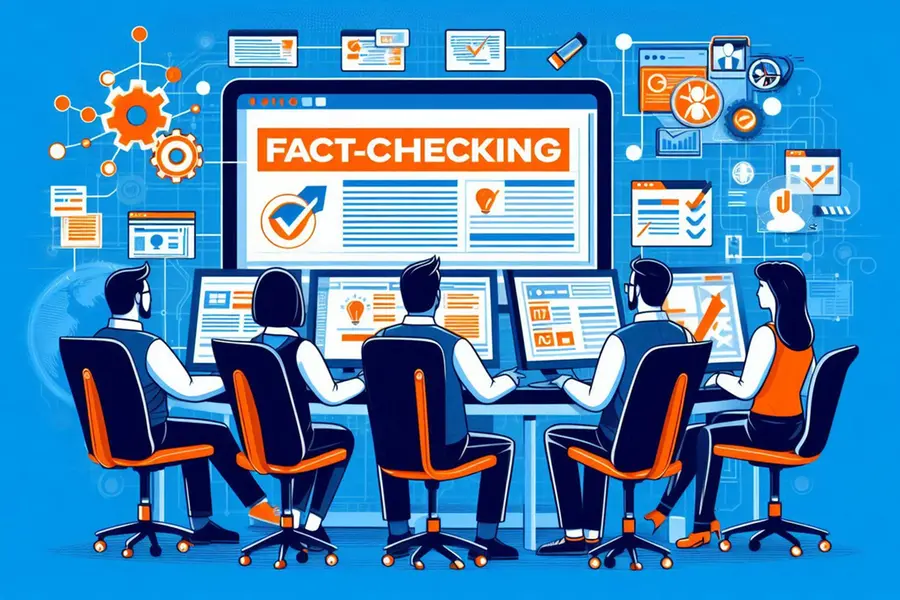
April 2 holds special significance for those who champion truth and accuracy. It is International Fact-Checking Day, a global celebration that underscores the importance of verifying information in an era dominated by misinformation, disinformation, and malinformation. On this day in 2021, the first fact-checking desk of any Malayalam newspaper group was set up at the Kochi edition of Mathrubhumi.
Setting up a fact-checking team was no easy task. While the idea of verifying information and ensuring accuracy seemed noble, many prospective hires hesitated to join. There was a general perception that fact-checking would be monotonous, devoid of the thrill that traditional journalism offers. The challenge was not just to recruit but to find individuals who were genuinely passionate about the truth. After much deliberation, a plan was devised; an online course on fact-checking and verification that would serve as both a training ground and a selection pool for the team.
Mathrubhumi Media School took the lead in launching the one-month online course. The response was overwhelming. Within a week, we received 126 applications, each accompanied by a fee of Rs. 3,000. The sheer volume of interest caught us off guard. Managing such a large crowd in a single class seemed impractical, so we decided to split them into two batches—one for weekdays and another for weekends.
The sessions turned out to be a revelation. Participants came from diverse backgrounds and age groups. The youngest had just completed his higher secondary education, while the oldest was a retired Deputy Director from the Ministry of Agriculture. The discussions were lively, the debates engaging, and the enthusiasm infectious. Those evenings were not just about learning; they were about unlearning misconceptions and rediscovering the power of truth. Participants found joy in the rigor of verification, and their feedback affirmed that fact-checking was far from boring—it was an intellectual adventure.
International Fact-Checking Day is more than just a date on the calendar; it is a call to action. Around the world, media organizations, educational institutions, and advocacy groups conduct activities that promote media literacy and critical thinking. They develop fact-checking resources, publish articles debunking viral misinformation, and conduct lessons aimed at students and the general public.
Fake news does not follow a predictable pattern, and with the advent of deepfake technology, distinguishing fact from fiction has become increasingly challenging. Today, technology has made it possible to create hyper-realistic images, audios, and videos that can deceive even the most discerning eye. Augmented Reality (AR) and Virtual Reality (VR) further complicate the landscape, blurring the lines between the real and the fabricated. The challenge is no longer just about identifying text-based misinformation but about countering sophisticated manipulations that exploit human perception.
To understand misinformation better, it is essential to differentiate between its various forms. Misinformation refers to false information that is spread regardless of intent—it could be an honest mistake or an act of negligence. Disinformation, on the other hand, is the deliberate dissemination of falsehoods with the intent to deceive. Malinformation is perhaps the most insidious, involving the deliberate release of private information or the manipulation of genuine content by altering its context, date, or time for personal or corporate gain.
The tools available to combat fake news have evolved significantly. From reverse image search engines to AI-powered detection algorithms, fact-checkers now have an arsenal of resources at their disposal. However, technology is a double-edged sword. As detection tools improve, so do the tactics of those who spread falsehoods. This cat-and-mouse game demands continuous learning and adaptation.
The fight against misinformation is not just the responsibility of journalists and fact-checkers; it is a collective effort. Every individual who shares news, forwards a message, or engages with online content plays a role in either curbing or exacerbating the spread of falsehoods. Media literacy is more crucial than ever. People must be encouraged to verify sources, question dubious claims, and be skeptical of information that seems too sensational to be true. Critical thinking should be nurtured from a young age, incorporated into educational curricula, and reinforced through continuous public discourse.
Setting up the fact-checking desk at Mathrubhumi was not just about creating a team; it was about fostering a culture of verification. The one-month online course was a testament to the fact that there is a genuine hunger for truth. People want to know how to separate fact from fiction, and when given the right tools and knowledge, they take on the role of fact-checkers in their own circles. The success of our initiative proved that fact-checking is not a mundane task—it is a dynamic, essential, and impactful profession.
As we observe another International Fact-Checking Day, it is important to reaffirm our commitment to truth. The battle against misinformation is ongoing, and the stakes are high. Democracy, social harmony, and informed decision-making all depend on the integrity of information. In an era where falsehoods can be manufactured and amplified within seconds, fact-checking remains one of the most critical defenses against deception.
April 2 is a day for facts, but beyond that, it is a reminder that truth must be defended every day. The responsibility does not rest with a select few; it belongs to all of us. Whether through a well-researched article, a skeptical approach to forwarded messages, or a commitment to media literacy, each effort counts. The truth must prevail, and it is up to us to ensure that it does.
Published: 02 Apr 2025, 10:34 am IST
Related Topics
Disclaimer: Kindly avoid objectionable, derogatory, unlawful and lewd comments, while responding to reports. Such comments are punishable under cyber laws. Please keep away from personal attacks. The opinions expressed here are the personal opinions of readers and not that of Mathrubhumi.
