
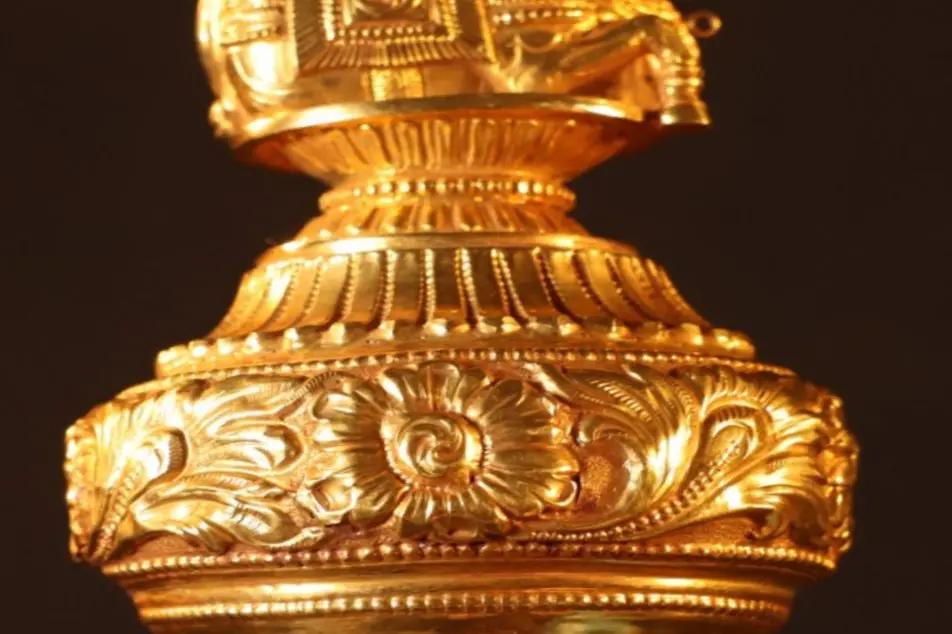
The story of the sengol being handed over to Jawaharlal Nehru as part of the transfer of power is not a little bizarre. According to accounts emanating from the present government, Mountbatten asked Nehru about a ceremony, Nehru turned to Rajaji, Rajaji had a brainwave and unearthed a Chola ritual of kings receiving a sceptre, the chengol, on assuming power. Accordingly, such a sceptre was made by a jeweller in Madras, and it was handed to Nehru by the Thiruvavaduthurai Adheenam, or the head of the math. It has now been claimed that this act “sanctified” and “symbolized” the transfer of power in India.
The only evidence we have so far is that the Adheenam or somebody on his behalf handed Nehru this staff. There is nothing more on it. Nehru received all sorts of gifts from well-wishers, and this was one of them. The Adheenam was not a person with any sort of authority to perform any kind of ceremony symbolizing the transfer of power. Having received it, Nehru relegated it to his heap of gifts, and it made its way to the Allahabad Museum. It has mouldered there these 75 years until the present government had another brainwave and located it after what sounds like a treasure hunt.
Every other aspect of this story is implausible to the point of fiction. If it was in any sense a part of a ceremony or ritual of the transfer of power, it would have been documented in minute detail. There would have been photographs as part of the publicity for an event of such magnitude in the history of both India and Britain. Mountbatten would have ensured the maximum publicity so that it would appear that the British were gifting power to Indians. If Nehru was receiving it from anybody else, it would still have been fully publicized. Instead, there is no record whatsoever. If there is one, it is very strange that nobody has seen it so far and that nobody has spoken about it.
Whoever concocted this story is a poor historian. A sceptre is a symbol of sovereignty, and the various accounts make it out to be so. The sovereign in India in 1947 after the transfer of power was the British monarch, George VI, still the emperor of India. India had become independent as a Dominion, but she became sovereign only on 26 January 1950 as a Republic. In such a situation, George VI would have had to transfer the sengol from one hand to the other to mark the transfer of power! In 1950, when the Republic came into being, this sceptre would have had to be handed to the President, as the head of state, and not to Nehru. In every sense, constitutionally speaking, Nehru could not have received the sceptre as a symbol of sovereignty, since he was only the prime minister.
Nehru would never have accepted such a symbol of power from a colonial authority. That symbolism is wrong. He would have accepted power only from the people of India, in whatever manner the people may have been represented. The transfer of power as a legal process is different, as it was required for domestic and international law, but it was without symbols of this kind.
Nehru would have thrown a fit at the prospect of a symbol of royalty Whoever cooked up this story does not seem to understand the history of modern India, her nationalism, the nature of Indian democracy, the meaning of the Gandhian movement, or the psychology of the national leaders, especially one like Nehru. He was battling not only the British Raj but also the princes. They had been reduced to bejewelled officials of the Raj and they had to go with the Raj. He, and most of the leadership, were clear on this matter. Royal symbols would have been an absurdity and an offence at such a moment as the transfer of power.
This government may want to pick up a few votes in Tamil Nadu, but there are subtler ways of using such moments. A Tamil verse could have been recited and inscribed somewhere, a fine work of art from Tamil Nadu could have been used to embellish the new Parliament building, and so on. Why is a royal symbol accompanied by so much fakery? Democratic power in India is not represented by royal symbols. The Ashoka Lions capital may have been devised by an emperor; but it does not depict royal power and it was not chosen in that spirit. Crafting a symbol that exudes royalty, advertising it as such, and placing it so prominently in Parliament violates democracy to the core. The democracy that was established between 1947 and 1950 is being officially undone.
(The writer, a distinguished historian, is the editor of Selected Works of Jawaharlal Nehru)
(The Malayalam version was published in the weekend edition of the Mathrubhumi on June 4, 2023)
Published: 06 Jun 2023, 07:33 am IST
Related Topics
Disclaimer: Kindly avoid objectionable, derogatory, unlawful and lewd comments, while responding to reports. Such comments are punishable under cyber laws. Please keep away from personal attacks. The opinions expressed here are the personal opinions of readers and not that of Mathrubhumi.
