
Aranyer Din Ratri (Days and Nights in the Forest) directed by Satyajit Ray was released 55 years ago in 1970.
The quote "Life is a journey, not a destination" is often attributed to Ralph Waldo Emerson, an American philosopher and essayist. While he may have been a source of inspiration for the concept, there is no definitive proof that he actually wrote or said it in those exact words. The idea of life as a journey has been expressed by various authors and thinkers throughout history, making it difficult to pinpoint a single originator.
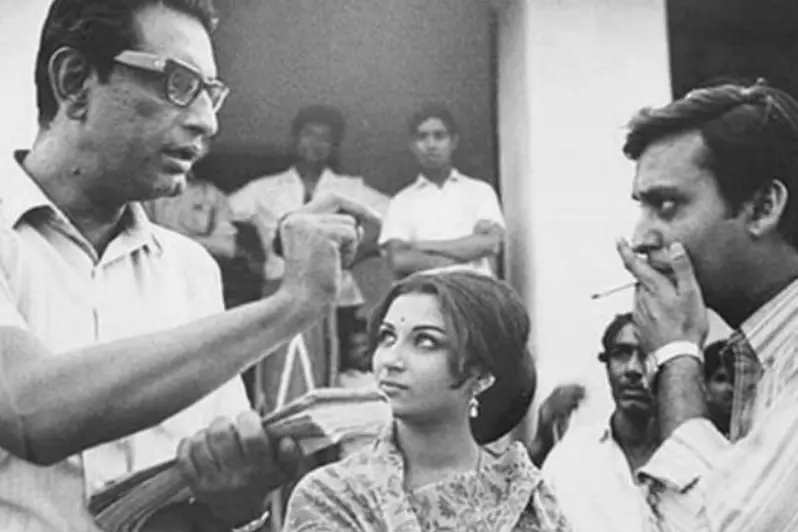
Aranyer Din Ratri (Days and Nights in the Forest) directed by Satyajit Ray was released 55 years ago in 1970. Yet, like all films by Ray, it is timeless and perhaps, also liberated from boundaries defined by geography, language, culture, style and so on. The very idea of voluntary and temporary displacement in the form of an aimless physical journey does not remain merely physical after a point. And Aranyer Din Ratri is a classic example of how cinema can define this, explain this, analyse this and even question this. It was inspired by Sunil Gangopadhyay’s novel of the same name but Ray incorporated his own changes perhaps to suit the shift in the medium from word to picture or, to present his own perspective, or both.
Aranyer Din Ratri, restored by The Film Foundation’s World Cinema Project at L’Immagine Ritrovata in collaboration with the Film Heritage Foundation (FHF), Janus Films, and the Criterion Collection will be screened at the 78th Cannes Film Festival on May 19. The funding was provided by the Golden Globe Foundation.
Aranyer Din Ratri is both a road movie through the framing device to open and end the film with the car journey. But it is also a journey film. The difference between the road movie and the journey film lies in the strong and concrete physicality of the former and the abstract, conceptual and sometimes, ideological themes that dot the latter. Destination, be it a journey or be it the road, is uncertain, undefined and sometimes infinite, reminding one of destiny which makes one’s destination ambivalent.
Aranyer Din Ratri is a ‘journey’ film because the storyline follows its characters as they move in time, space, experience, opportunities, downfalls, failures and triumphs from point to point and from phase to phase. The “journey” is a journey into self-discovery for the four young men who have set out on an aimless holiday from their comfort zone of Calcutta into the forest-rich Santhali-filled small town called Palamou in the Santhali Parganas in Bihar as a random adventure. That is the destination if one may call it so. They are not, in any sense, seeking ‘escape’ from the world they are living in to set out towards redemption on the road.
They bribe the chowkidar for a room in the only forest guest house which is open only to reservations and one can hear Aseem muttering, “thanks to corruption” sending a message across about how these young men are quite casual about their moral principles. When the chowkidar who lives in the outhouse with his wife and baby hesitates to cook for them as his wife, who usually does the cooking, is quite sick, they get hold of a local who agrees to do the marketing while the chowkidaar agrees to cook.
Shekhar burns the newspaper as a symbol of cutting away from the daily routine of the city while they have already thrown away the race-course booklet on the journey. They they collectively decide not to shave for their days in Palamou. But this move is aborted because the foursome meet two young ladies Jaya and Aparna Tripathi who live in a bungalow nearby and are also vacationing with the old head of the family.
The stay is filled with fun moments like getting sozzled on country liquor every night, or, Shekhar beginning an adventure by bathing off the well water followed by the others, Hari feeling pulled towards a dusky, local beauty named Duli (Simi Grewal) who begs the group for a drink or for money but rebukes one of them for asking needless questions. The two women they meet, Jaya and Aparna, nickname Rini, are related to each other by marriage. Jaya is the widow of Aparna’s dead brother. She has a small son who is quite close to his grandfather (Pahari Sanyal) who belts out a beautiful song heard from afar by the four young men.
Aseem, Sanjay, Shekhar and Hari are close friends who, like many friendships one has experienced, have nothing in common. Yet they find comfort in each other’s company distanced though they are in many different ways. Aseem (Soumitra Chatterjee) is the most successful among them all and they travel to Palamou in his car. Sanjay (Subhendu Chatterjee) is a labour officer in a jute mill who desperately wishes to become a writer. He once edited a literary magazine in which Aseem was also active. Shekhar (Robi Ghosh) is the only jobless friend but is chosen because he keeps the rest in high spirits with his antics and jokes. Hari (Samit Bhanja) is a gifted cricketer but is wallowing in the after-effect of his broken relationship with a snobbish girlfriend (Aparna Sen) and grieving over the stinging slap she gave him. He is shocked when he finds that her ‘beauty’ is fake when the decorative wig she is wearing comes off.
Looked at a bit deeply, one may notice a hierarchical relationship with Aseem and Sanjay on one side and the ‘marginal’ Hari and Shekhar on the other. Aseem has an attitude problem he is not aware of while Sanjay does not quite jell with the other two. Shekhar is bold enough to take the first step to bathe in the well in the compound of the guest house. He also takes care of Hari realizing his recent heartbreak. But he enjoys himself at the fair on the gambling table borrowing a ten-rupee note from Aseem and losing each time.
In this character-driven story, the women characters emerge as stronger, more confident and smarter than the four men put together though being women, they are subtle in their speech, behaviour, body language barring a few exceptions. Among these exceptions is the Santhali beauty Duli’s asking for a pint of country liquor or having a roll in the hay with the besotted Hari who finally does not pay her for her ‘services’ and promises her that he will buy her a wig in the city. But during the subtly expressed sex episode, she confesses how her husband died of snake bite three years ago leaving her to fend for herself.
In a weak moment, the sex-starved, yet cheerful and apparently happy Jaya Tripathi confesses to the reticent Sanjay that “it is not just the husband who dies when he does” indicating the desert her physical needs have been reduced to. She does not even know why he committed suicide as he was in England then. Going in to prepare cups of coffee for Sanjay and herself, the mutual attraction quite obvious by now, she comes out adorned in the Santhali jewels she has bought at the village fair and says, invitingly, “you said Santhali jewels look good on Santhali girls only. Don’t I look good in them too?” But quickly goes away and breaks down into tears when the shocked and nervous Sanjay does not respond at all.
The camera pans into Jaya’s face to catch her quick changes of expression from seducing, to smiling, to nervousness, to uncertainty to complete breakdown with the camera holding her face and figure partly in the dark and not catching Sanjay at all. The coffee has turned cold by then.
But the frosting and the cake go straight to Aparna (Rini) who is a very reserved young lady confident enough to purposely lose out to Aseem in the famous Memory Game. She admits later to Aseem that she recalls all the names from beginning to end even then because memory is a special gift she has been born with.
This critic found a 51-page essay by eminent scholar Sibaji Bandopadhyay on the Memory Game (Ray’s Memory Game – Prologue to a Journeywww.jmionline.org) alone. While the paper is just too academic and intellectualized even for research scholars, Soumitra Chatterjee went ga-ga over the novel technology Ray used to cinematograph this particular scene. In his book, The Master and I, Soumitra and Satyajit – translated by Arunava Sinha, he writes,
“During that memory game, he (Ray) took the memorable shot himself, panning the camera 360 degrees, depending entirely on approximations. In other words, the camera spun on an axis, capturing each of our faces in turn as we sat in a circle. The camera was placed at a height corresponding to the height at which the face of a person seated on the ground would be. But it would have been impossible to take this shot while looking through the eyepiece, since the operator would have to move through a 360-degree arc along with the camera. So Manik-da operated the camera using only his experience and guesswork, holding each face in the frame till the person had completed his/her dialogue and then panning to the next face. Perhaps the fact that he was an excellent artist had given him an additional advantage. When it was time to edit Aranyer Din Ratri, I was astonished to see that each of the faces had been captured perfectly in every frame of that 360-degree shot. Every time I’ve watched Aranyer Din Ratri since then, I’ve been amazed at the flawless take of the scene of the memory game.”
The Memory Game has strong sociological implications clear from the names the players begin with such as Rabindranath Tagore quoted by Jaya followed by the others. Hari drops out after one mention as intellectual reading and/or discussion is not his strongest point while everyone else drops off till it becomes a war-like confrontation between Aparna and Aseem. The rest, as the saying goes, is history.
Aparna is reserved, has excellent poise and is intelligent as well. Aseem feels a strange pull towards Aparna though she appears to be much above him in terms of intelligence, wisdom and memory. But she does not wear these on her sleeve. He later discovers that she has deep feelings for fellow humans he does not care about. Is it born from her sad experiences of death at first-hand when she grew up? First, her mother burnt to flamces and second, her brother’s suicide? The film remains silent but the answer is clear.
She walks up to the chowkidaar’s outhouse when she hears the pathetic cries of a baby. Peeping from the small window, she discovers the chowkidaar nursing his very sick wife. Aseem is right behind her, made to feel guilty for his complete indifference to the pains of lesser beings. It makes him realise how less of a human being he is when compared to Aparna.
Aparna is intelligent enough to realise that Aseem is attracted to her even before he confesses this to the young lady. But, in keeping with her reticent nature, she does not give any sign of pull from her side. Yet, relents enough to give him her telephone number scribbled on a 5-rupee currency note because she has no paper. That currency note gives the final twist to the film.
Never mind how the young men wished to free themselves from the noise and bustle and mandatory compulsions of city life, it all boils down to an exchange of money from beginning to end. The bribe to the chowkidar for unauthorized stay in the guest house. The money handed over to Lakaa wrongly accused of theft of Hari’s wallet which had no money at all. Money spent on drinking country liquor. Aseem’s grandiose spending at the village fair when Aparna is with him – a sign of obvious masculinity of paying for everything when a female companion is around. Buying fritters only for Aparna and himself. Handing over a tenner to Shekhar to gamble away. And opening his wallet to shell out currency notes whenever, wherever. So, this magic called money has sustained its powers even in Palamou on an unscheduled visit.
The music composed by Ray himself, draws generously from the mystique of the local drums, flutes and other instruments used by the locals often covered in long-distance shots showing a row of Santhals walking across the horizon towards one more day of their struggle to exist.
When one explores Aranyer Din Ratri today, within the parameters of Indian cinema, the ‘road’ and the ‘journey’ open up a wider horizon for the characters undertaking the journey. It could take a spiritual form, or an ideological form, or function as a philosophical metaphor for the journey of Life, and possibly, Death. In other words, this film can be a symbol of looking deep inside the mindsets of the four young men and the three young women, the conservationist who changes his strict stance the minute the pretty Aparna clears them as her old friends and so on.
But Sharmila Tagore as Aparna is just too clipped, too proper and almost irritating in her stilted, coquettish, dialogue delivery. She is more “Sharmila” than Aditi while Kaberi Bose as Jaya brings in a breath of fresh air wherever she is present. Simi Grewal’s metamorphosis as Duli is almost magical. Characters striking the road on the course of a journey may or may not have a given destination. Even if like the young men, there is a destination, this destination may change and the purpose may take a different meaning, either of their own volition, or due to changing circumstances, climatic factors, accident or Death.
In other words, the road and the journey merge and fuse to become one and evolve into a statement that might sometimes spell out a definite destination while sometimes, it might keep questions hanging in the air. In all these respects, Aranyer Din Ratri enriched by the brilliant performances of all the actors including the Ranger with his stammer, the adivasi servant wrongly thrown out for a theft he was innocent of and the chowkidaar forced to accept a bribe that may cost him his job, are all a part of our life till today. But are we aware of all this?
Published: 19 May 2025, 09:00 am IST
Related Topics
Disclaimer: Kindly avoid objectionable, derogatory, unlawful and lewd comments, while responding to reports. Such comments are punishable under cyber laws. Please keep away from personal attacks. The opinions expressed here are the personal opinions of readers and not that of Mathrubhumi.
