
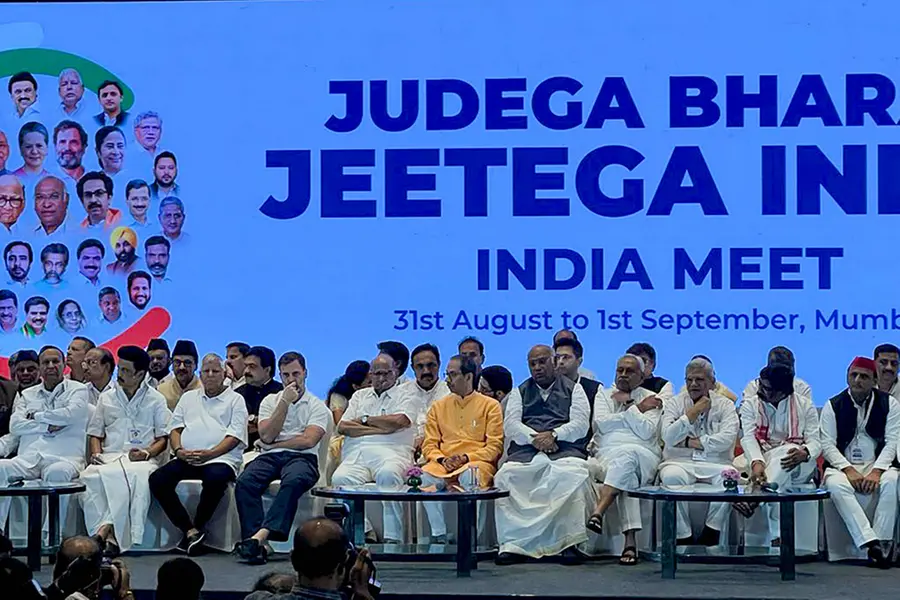
The INDIA coalition has faced criticism on two counts. It is being depicted as a grouping that offers nothing more than a negative message. Critics also believe that it lacks the capacity to work out seat-sharing arrangements between its constituent elements. Such assessments appear to stem from the underlying assumption that there is nothing substantial that unites these parties.
To view INDIA as purely a power-hungry group is to unthinkingly adopt the Bharatiya Janata Party’s propaganda. All, including the BJP are political parties and hence associations of people who want to capture power to achieve their objectives. Capture of power being the essence of their purpose none of them loses or gains moral credit by striving for it or refraining. Questions of morality arise when we move on to looking at the purposes for which parties propose to use that power. In certain contexts, such as the 1977 Lok Sabha polls (the Emergency Election), the true moral purpose might lie in denying power to an ignoble force. When the country is in danger of being taken down a wrongful path, it is the duty of all the right-minded to overlook the differences between them and forge a united resistance.
INDIA could claim that it is resisting regression. Over the last nine years there has been a concerted effort to undermine the ideals, institutions and practices that the people of this country have built over decades. Representative democracy, fair and free elections, democratic control over the civilian and military bureaucracies, non-politicisation of the armed forces, federalism, judicial independence, secularism, women empowerment, concern for the downtrodden, promotion of rationalism and so on are not mere borrowings from the West. These were methods for running a modern state that we chose for ourselves.

Members of our Constituent Assembly did not simply slap together various systems picked at random. They studied methods being used elsewhere, debated their merits and demerits, designed changes where necessary and took some phenomenally bold decisions. Our secularism is not the same as that of France on the one side or of the United States on the other. Despite the multiple disparities in awareness among our people, the Constitution granted universal adult franchise less than thirty years after the far more homogenous United Kingdom allowed its women to vote. The most deprived of our people could cast their ballots more than a decade before most African Americans could do so.
To use current management jargon, the members of our Constituent Assembly adopted “best practices” available in the rest of the world as could be applied feasibly in India and tweaked these. The Directive Principles of State Policy can be cited as an illustration of genius at work. It lists the conditions that should ideally prevail in the country while recognizing that these might not be readily achievable. A case can even be made that the three Lists of the Seventh Schedule, which demarcate our federal structure, were the products of the strategy of protest-and-negotiation that the National Movement followed from the early 1900’s.
Can any free-thinking Indian deny that these institutions are being undermined? The Election Commission has lost much of the credibility that it gained in the Seshan-Lyngdoh periods. Non-BJP parties that have won elections have seen their chances to govern snatched away by “lotus” procedures. It is almost impossible to recall the last time a thorough parliament debate was held on important issues or before the passage of important legislation. Bureaucrats have forgotten that they are servants of the people and not of the party in power. An army chief had to remind his officers that their oath is to the Constitution not the cabinet. Public accountability is reserved for political opponents. Let alone criticism of the government, failure to genuflect before the “visionary leader” is treated as sedition.
Of late even the BJP seems to have stopped denying that all of the above has taken place. Instead it prefers to defend itself by pointing out that the same wrongdoings were committed at other times and places when or where other parties were in power. Several counter arguments can be offered. Firstly, if your behaviour is as bad as that of others, why should we choose you? Secondly, from the time of Vajpayee/Advani you told us that you were a different kind of party and now you say that you are not. As a ruling party with a mammoth majority do you not feel any obligation to promote Raj Dharma?
It is no one’s case that the Congress or any other party has been a paragon of political morality. No party can rightly claim that it was upholding a different standard of political ethics on its own. Over the decades of working the system however, the judiciary, the media and most importantly the people through their electoral behaviour have worked at bringing the processes on track and have some record of success. During the last nine years one party has shown that all this can be negated through a brute majority in parliament and the subjugation of the media.
Retrogressive intentions do not end there. BJP leaders might say that they are for Dalits, Adivasis, OBCs, females and so on. Web sites and internet channels favoured by party adherents tell another story. Reservation/affirmative action is anathema. Dravidian or other non-Brahmanical movements are illegitimate and evil. Needs of corporates take precedence over the rights of forest dwellers. It was only a few decades ago that backers of “beti bachao” slogan mongers were protesting in favour of sati. How many of the social groups clamouring for a Uniform Civil Code have ensured fair shares of property for the daughters of their families? Taken collectively they represent a resurgence of the retrograde movements that opposed the Indian Renaissance every step of the way.
(Writer is a former editor of Mathrubhumi)
Published: 04 Sept 2023, 03:44 pm IST
ABOUT THE AUTHOR
Related Topics
Disclaimer: Kindly avoid objectionable, derogatory, unlawful and lewd comments, while responding to reports. Such comments are punishable under cyber laws. Please keep away from personal attacks. The opinions expressed here are the personal opinions of readers and not that of Mathrubhumi.