
A heartwarming story of a vintage radio repairman in Thrissur, Kerala, who rediscovers his passion and revives the forgotten era of radio.
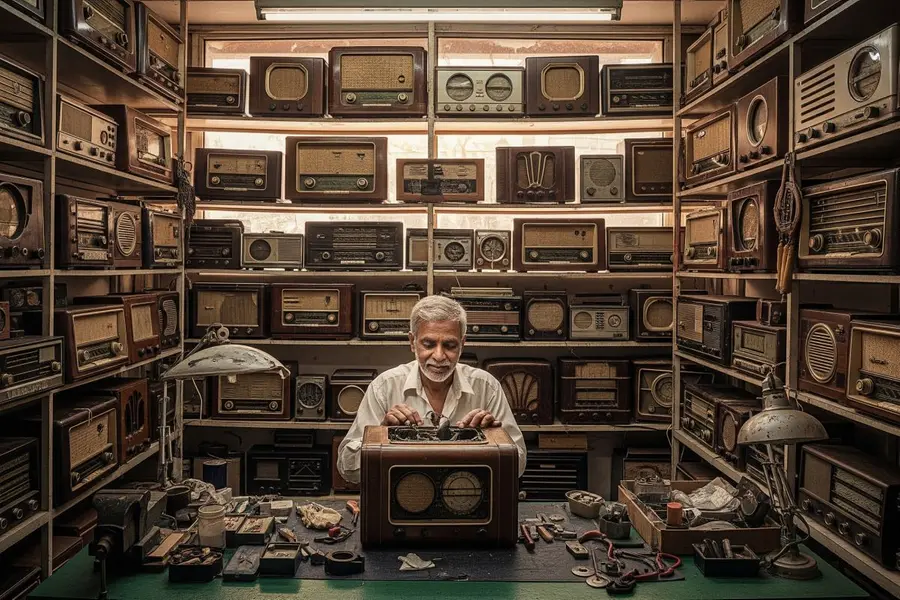
A couple of months back, on a humid afternoon in Thrissur, Kerala, I strolled into an alleyway that I hadn't seen in years. The narrow street corner, hidden behind ancient bookshops and decrepit tea stalls, swept me up in a wave of nostalgia. There, behind the hushed hum of the town, stood a small but once-famous radio repair shop -- weathered, yet full of character. And within, as though he had never been away, stood Raghu.
Raghu is a veteran friend. Not mine alone, but of the town itself. He's from that generation that knew machines through their odor, their whir, their beat within. Radios, particularly. His fingers, as I recall, would forever move across circuit boards with an air of confidence born of adoration. His was not merely a vocation; it was a bloodline-borne passion.
The hundred-year-old shop had been passed down from his great-grandfather to his father, and then to him. As the world went through its transformations around him, Raghu stayed put -- a silent rebel who refused to be caught in the digital wave.
I tried to get the word from friends that the shop was still open, albeit barely so. So I went in, not knowing if Raghu would even recognise me. He did -- his face lit up in a smile. The experience was warm and fuzzy, like turning on an old radio and hearing one's favourite old song.
The shop was like a different universe -- a living museum of the past. Old Murphy radios, '60s Philips models, Japanese transistor sets, wooden-case valve radios, and even some gramophone players. Most of them are in different stages of repair and deterioration. Dusted layers accumulated like a gentle shroud over once-treasured belongings.
"All these," Raghu indicated a very refined Bush radio, "were brought here to be repaired years back and never picked up." I called, I reminded, and then I stopped. People have moved on.
He talked without rancour. But I heard the wear in his voice -- not from labour, but from being forgotten. Raghu had received ITI training when he was young. He could have changed occupations, learned new technology, perhaps even started a mobile repair shop. But he didn't. Radios meant more than appliances to him -- they were storytellers, friends, whispers of a simpler world.
After drinking the tea he had to offer, we chatted for hours -- about change, about life, about what endures and what does not. And then a thought came to mind.
"Let's bring all this back," I said.
He seemed confused.
"I mean, what if we restored all these radios, gathered more if we can, and put on an exhibition? A celebration of the Radio Era. Not only radios, but gramophones, cassette players -- the entire universe of sound before screens dominated."
He didn't answer quickly. For a man who'd watched the world pass him by, hope wasn't easy to come by. "Who will attend?" he said. "People these days just want Spotify.
"But maybe they want memories too," I replied.
He agreed, hesitantly, perhaps just to honour me.
Over the next few weeks, the idea took life. I met with old acquaintances at Akashvani and FM stations, spoke to journalists, music collectors, and even college students. To my surprise, everyone was excited. The nostalgia for radio was still alive -- it just needed the right frequency to be tuned in again.
Raghu, who was initially reluctant, was now fully engaged in his work. The old radios were taken off the shelves, dusted carefully, repaired, tuned fine, and tested. The gentle crackle of static returned to the shop, followed by tunes that had not been played for years. Gradually, the space changed -- from a dusty corner to a humming workshop of promise.
The show was in a humble town hall, but the turnout was anything but. From children standing in awe of how radios could function without Wi-Fi to older couples reliving the music of their youth, the event attracted people of all ages. People took photos with the radios, told their own stories, and even purchased a few of the functional pieces.
There was a very old woman who saw a green transistor set that she had possessed once. Her eyes welled up with tears. "My husband used to play Binaca Geetmala on this," she whispered, tracing her fingers over the knobs.
Another guy brought in his grandson and beamed with pride as he showed him the cassette player on which he used to record love songs. "He doesn't think I ever had one," he chuckled.
Raghu stood silently, observing it all -- the radios singing once more, the individuals smiling, the past residing in the present. He did not speak much, but his eyes gleamed. He had feared that the world had no room for his art. That day, he realised otherwise.
The show was not merely a success -- it was a revelation. Raghu made some decent money, yes, but more than that, he found a renewed purpose. People began approaching him with vintage sets they had hidden in attics or stored away in garages. Some wanted repairs, some just wanted to donate.
And Raghu, now a man on a mission, began dreaming bigger. "We will do another one," he said. "This time with live radio storytelling sessions."
I returned from the exhibition with a heart full of cheer. Not for the success of the event, but because an idea -- simple, genuine, and conceived over a cup of tea -- had been able to revive an old soul.
In an age of algorithms and artificial intelligence, it is tempting to think that ancient tales are worthless. But this story reminds us that everything has its cycle. What passes away can come back. What is forgotten can be found again. It only takes a spark -- and somebody who believes.
Raghu's tale isn't about radios alone. It is about determination. About holding on to one's roots. About how, at times, a look back can prove to be the best way to go forward.
Business does not always have to be about running after the next big thing. At times, it is about tuning in to the forgotten frequencies of the past -- and letting them play once more.
Published: 28 Jul 2025, 01:16 pm IST
Related Topics
Disclaimer: Kindly avoid objectionable, derogatory, unlawful and lewd comments, while responding to reports. Such comments are punishable under cyber laws. Please keep away from personal attacks. The opinions expressed here are the personal opinions of readers and not that of Mathrubhumi.
