
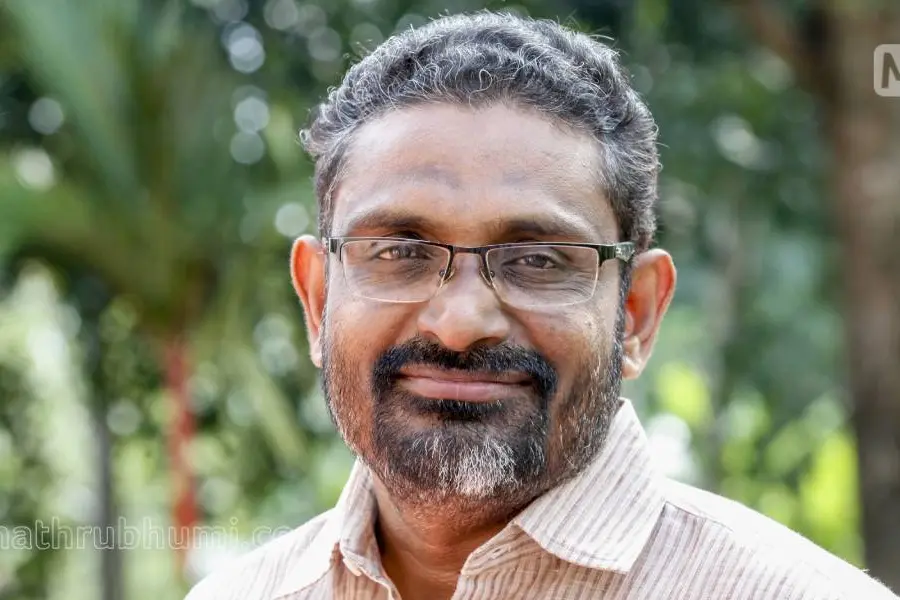
As ‘The Goat Life’, the movie adaptation of ‘Aadujeevitham’ is gearing up for release, Benyamin talks to Mathrubhumi.com, on the evolution of ‘Aadujeevitham’ post publication, his craftsmanship, power of imagination, spirituality beyond religion, and his growth as an artist.
‘Aadujeevitham’, published after ‘Abeeshagin’ and ‘Akkapporinte Irupathu Nasrani Varshangal’ (‘Twenty Years of Christian Quarrels’), was a breakthrough in your writing career. This novel, which never had the backing of the large publishing houses, was taken up by the readers gradually and became a roaring success over the years. How do you look at the trajectory of your novel?
Definitely, the success of ‘Aadujeevitham’ didn't happen in a day. ‘Aadujeevitham’ was printed by an ordinary publication house; it never had any publicity or advertising as well. However, it reached many readers through 'mouth publicity'. Looking at the journey of the novel post publication, it may appear that the novel certainly had a fate of its own and that pathway can be traced from the point where I met Najeeb, by sheer coincidence. So, I myself have often felt that ‘Aadujeevitham’ is very much different from my other works. As mentioned, it was rejected at many places and was neglected by award committees. I believe, as the protagonist of the novel illustrates, the success we deserve will eventually and definitely find us.
‘Abeeshagin’ and ‘Pravachakanmarude Randam Pusthakam’ (‘The Second Book of Prophets’) are based on biblical themes. ‘Akkapporinte Irupathu Nasrani Varshangal’ depicts regional life in a humorous fashion. When it comes to ‘Aadujeevitham’, the novel portrays a third world citizen who arrives, willing to accept the life of a migrant, gets cheated, goes through hell and eventually manages to get back to the love of his country. Is this dissimilarity intentional?
Certainly. Close readings of my individual works may point out that I have tried my best to form the structure and language each of their individual themes demanded. The language of ‘Abeeshagin’ and ‘Pravachakanmarude Randam Pusthakam’ was not employed to write ‘Aadujeevitham’ because the latter demanded a different style of language. It definitely was a conscious decision. Najeeb, a fifth standard pass, should be speaking only the commonest of tongues, I decided. This technique is used in all my novels where I intentionally craft language based on characters, structure, and context of the story. I also try not to imitate myself by using the same style or narrative techniques in more than one novel. This was the same in the case of ‘Aadujeevitham’ as well where a marginalized language is used to depict the life of marginalized characters.
The critics who ignored ‘Aadujeevitham’ opined that it was an artistically inferior creation. However, it was whole-heartedly accepted by the Malayali and non-Malayali readers. In fact, it is not simply narrated chronologically; as in ‘The God of Small Things’, the story moves forward through flashbacks. Critics forever presume that anything popular is least intellectual. This seems to be the villain here as well. What is your opinion?
Every person, including readers and critics, has the right to accept or reject a work after reading it. Naturally, such differences in opinions on ‘Aadujeevitham’ have been heard from different sectors of society. Since the novel was widely read, vast differences in judgements have also been heard. I have welcomed all these responses with a positive mind. However, Malayalam literature has been witnessing the tendency to disdain a literary work entirely because of its popularity. It is not quite easy to attract the attention of a large number of readers today since every single person has her own ways of staying entertained. It is high time we accepted the potential of a literary work to catch the attention of today's readers when myriad options of entertainment are right at their fingertips. The reason behind the popularity of a work must be investigated and literary discussions should follow or try to reach that particular conclusion. Intellectual discussions without acknowledging this is meaningless. I certainly don't agree with the prejudice that popularity equals mediocrity.
Although desert life is portrayed in detail in ‘Aadujeevitham’, it is known that you have seen a desert in real life only later, after writing the novel. One has to be a writer with one hundred percent commitment to take the narrative to such an extraordinary level of imagination. What is your take on this?
I am glad to hear that. I value myself on the fact that I give my best possible effort in writing my works, within the limits of my ability. When I get an idea for a story, I don't just try to write and finish it off as soon as possible. Instead, I look for every probable way to work on the idea, think of how far I can travel to research on the topic, look for all the documents that can be collected, and other conceivable actions in order to enrich the subject. I have put in the same kind of effort in each of my novels. For instance, a large number of books related to the Bible were read for writing ‘Pravachakanmarude Randam Pusthakam’ and extensive research was done on Arabian politics for writing ‘Al Arabian Novel Factory’. Similarly, for the purpose of illustrating desert in ‘Aadujeevitham’, I not only depended on Najeeb's limited accounts of the same, but also learnt more about it through research, studying, listening to experiences of people who have been to deserts, reading books written on desert experiences, and even more. I also profoundly believe that using sources in propriety and incorporating them into the novel without seeming cumbrous is what makes a story creative. I trust that I have been able to do the same in ‘Aadujeevitham’ which is why, I believe, the portrayal of desert in the novel is accepted as quite good.
It is also noteworthy that you have used the name of the real person as the name of the protagonist in the story, and you have actually made Najeeb, who is a non-believer, an advocate of a kind of spirituality which goes beyond religion, in the novel. How do you see this?
A different name could have been assigned to the protagonist of the story, however, since his identity appeared here and there throughout the novel, I decided to go with the name Najeeb. I did not believe in the necessity to hide behind that sort of a lie. Naturally, even in the presence of Najeeb's story, vast areas of imaginations are also present in the novel, as any good reader can identify without great effort. A novelist does not write a story to copy down the life and experiences of a particular person; I did not select Najeeb to do that. I did it to convey my own thoughts, ideologies, experiences, loneliness, pangs, fears, and anxieties to the readers. More than the story of Najeeb's life, ‘Aadujeevitham’ was intended at presenting a vision of life, a vision of hope. If one experiences the struggles of Najeeb, how should they respond to the situations, how hopeful they must remain... The book was penned to point out how courageous one must be in the face of hardships. For the same reason, even in the presence of Najeeb, it is not just the story of Najeeb. It manifests the emotions and thought processes of any and every person. Still, I think it was best to give the protagonist the name Najeeb since his identity plays a major role in the narrative.
By writing this novel, there was a possibility of incurring the wrath of the ultra-nationalist Arab community. But you wrote it sans fear. After its Arabic translation came out, you even received their compliment which said reading the novel was like 'holding a mirror up onto ourselves'. You left your job and became a full-time writer questioning the dictatorship of the Arab nation through ‘Al Arabian Novel Factory’ and ‘Mullappooniramulla Pakalukal’ (‘Jasmine Days’). What makes you fearless?
It comes from thousands of great writers who have written before me. I sincerely believe that if one cannot write what they want most ardently, courageously, and honestly without imposing censorship on oneself, which may be due to fear of society, religion, family, or authority, that particular work can never be authentic and it will always remain mediocre. Many writers before our time have courageously spoken out truths in dire predicaments, sometimes even at the face of death. Their actions have become torch lights for my path forward. They provide energy to write without the fear of being attacked, exiled, criticized, or ridiculed by the society. I believe that a true work of art is born only when it is written fearlessly, in this manner. Only a small attempt of the same has been made through my works. Many great writers with more powerful experiences are still with us presently.
Through ‘Aadujeevitham’, you have portrayed the life of a very ordinary person who is neglected and despised and has only small dreams to fulfill for himself. Cultural signs of this particular life appear throughout the novel. When we talk about literature, we tend to associate it with tradition and elitism, even now. As a BCom graduate who loved playing cricket and lived a relatively uneventful life until becoming a writer, you found your passion for letters after constant reading and letter writing. For you, literature was a self-discovered expression. Is that why you were attracted to such themes?
Certainly. I do not come from a place where I decided to become a writer one day. One might say that a person who lived outside the literary world found his way towards it through his life's journey. Someone in the beginning phases of life, even at the beginning of adulthood, faced rejections and stayed an introvert, finally in an intense desire to find his place and make a mark in some aspect of life and experimented with many spheres only to realize that his real creativity lies in literature. I started putting my time and effort into it since then and the energy to fight was brimming inside me. Most readers have not realized the journey I had to make from a particularly normal persona to that of a relatively known writer. They believe that Benyamin rose as a successful figure in literature one fine morning. On the contrary, I reached this point through constant struggles, hard work, and toil. So, naturally, my characters will also have the same persona since a writer's characters are, in a way, reflections of his life. They are portrayed in different places and in different life conditions, however, the life and experiences of the writer are also etched on them. Only then can the work be authentic, or else it can be written by anyone. Needless to say, I often find myself, my battles, my prayers for revival, which might be why themes like these interest me. For the same reason, I find myself writing about the commonest of all, marginalized, and sidelined characters, who never reach the forefronts of society.
Published: 27 Mar 2024, 12:00 pm IST
ABOUT THE AUTHOR

Related Topics
Disclaimer: Kindly avoid objectionable, derogatory, unlawful and lewd comments, while responding to reports. Such comments are punishable under cyber laws. Please keep away from personal attacks. The opinions expressed here are the personal opinions of readers and not that of Mathrubhumi.