
NATO came into being post World War 2 to counter the USSR and to check the expansion of communism. From 12 countries in 1949, NATO expanded to 30 countries by 2020 by adding to its ranks erstwhile Warsaw countries like Bulgaria, Romania, Hungary, Slovakia, Poland etc. Ukraine was next in line. NATO’s entry into Ukraine would have posed a direct threat to Russia.
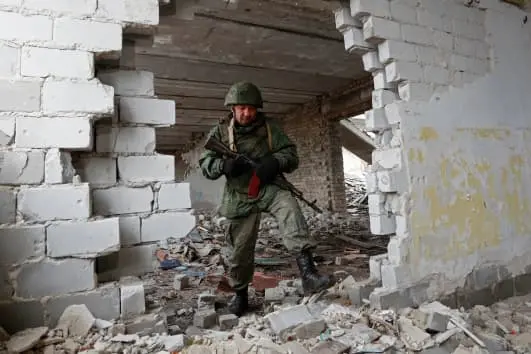
Early this week, Russian President Putin in a surprise move, raised the ante by recognising the Ukrainian breakaway regions of Luhansk and Donetsk as independent states and followed it by sending Russian forces there to “maintain peace”. Despite desperate requests for help from Ukraine, US and NATO forces have maintained a safe physical distance and made it unambiguously clear that their forces will not enter Ukraine.
What is it that Russia wants and will settle for? Having taken a tough stand and come this far, it cannot settle for anything less than a permanent solution to its Ukraine problem. That would probably translate into some sort of an agreement preventing Ukraine from doing anything detrimental to Russia’s interest and a clear position on not joining NATO. Russia would also want a say in Ukraine’s defence capabilities and conduct of foreign policy in future.

Europe imports 30% of its oil and 40% of its gas from Russia. Nord Stream-2 pipeline from Russia to Germany, which is awaiting the final regulatory approval, will further enhance this dependence. Tapping alternate sources to meet its energy demands would imply higher costs and time penalty for Europe. Russia on its part is dependent on its oil revenue and needs the European market. If the US and EU impose sanctions to target Russian energy supply, while both sides will feel the impact, the blow on Russia may be considerably reduced with China stepping in with a quantum increase in its oil and gas intake from Russia.
China finds itself in an advantageous geopolitical position. While it clearly supports the Russian position, it has used the opportunity to assert that the Taiwan situation is different from Ukraine as Taiwan is an integral part of China. China will do everything it can to soften the impact of sanctions on Russia. In the raging tussle for world order supremacy, a new cold war status between Russia and a US-West combine will work in China’s favour.
US continues to be the numero uno global power. But its position is being challenged by China as never before. Every developing reshuffle in global affairs in the recent past seems to give China the best cards and US the worst. US appears desperate to find a raison d’être for continuance of NATO and to find a face saver after its ignominious Afghan exit. Considering that Russia cannot afford to climb down now, US may inadvertently be showing how far it can go in case China precipitates a similar crisis in Taiwan in future.
Europe is stuck between the devil and the deep sea. Although Russia poses no real military threat to them while it offers considerable economic benefits, they are in no position to resist US interests, being part of NATO. Notwithstanding the US-NATO wolf cry to project a Russian invasion threat beyond Ukraine, it is reasonable to assume that Russia’s interest is limited to establishing effective control over Ukraine without having to remain in an occupation mode. UN finds itself a mute perspective spectator with the permanent members of the security council on either side of the problem. We also find the West dominated global media silent on the Russian perspective.
India cannot afford to take sides between Russia and the US. With China looming large and flexing its muscles and a debt-ridden Pakistan at China’s beck and call to play its proxy, India needs its all-weather friend Russia more than it did at any time in the recent past. India also has a considerable inventory of Russian weapons and equipment including the latest S-400. In the recent past, despite its criticality to our foreign relations and economy,
India partially surrendered its interest in Chabahar bowing to US pressure. Russia is far too critical for India; maintaining good rapport with Russia is, therefore, non-negotiable. The jump in oil prices will have its adverse impact on Indian economy. De-escalation is in India’s interest. In fact, India would have been the most acceptable party to be a mediator between US and Russia. But possibly, the opportunity had to be surrendered in the face of compulsions of domestic election demands on India’s political leadership.
All in all, it appears that Russia will raise the ante and go to any length to achieve its objective. The only silver lining is that the objective may be achieved without the armed conflict escalating beyond Ukraine. For the world at large, the Ukraine conflict would result in an economic and supply chain turmoil and make the post-Covid economic recovery even more painful. The world may also witness aftershocks in the form of regional and global alliance resets.
The writer is an alumnus of Sainik School, Kazhakoottam, and was a former Deputy Chief of the Indian Army as well as a former Judge of the Armed Forces Tribunal
{English original of the article published in Malayalam in the opinion page of Mathrubhumi daily dated February 26, 2022}
Published: 26 Feb 2022, 08:57 pm IST
Related Topics
Disclaimer: Kindly avoid objectionable, derogatory, unlawful and lewd comments, while responding to reports. Such comments are punishable under cyber laws. Please keep away from personal attacks. The opinions expressed here are the personal opinions of readers and not that of Mathrubhumi.