
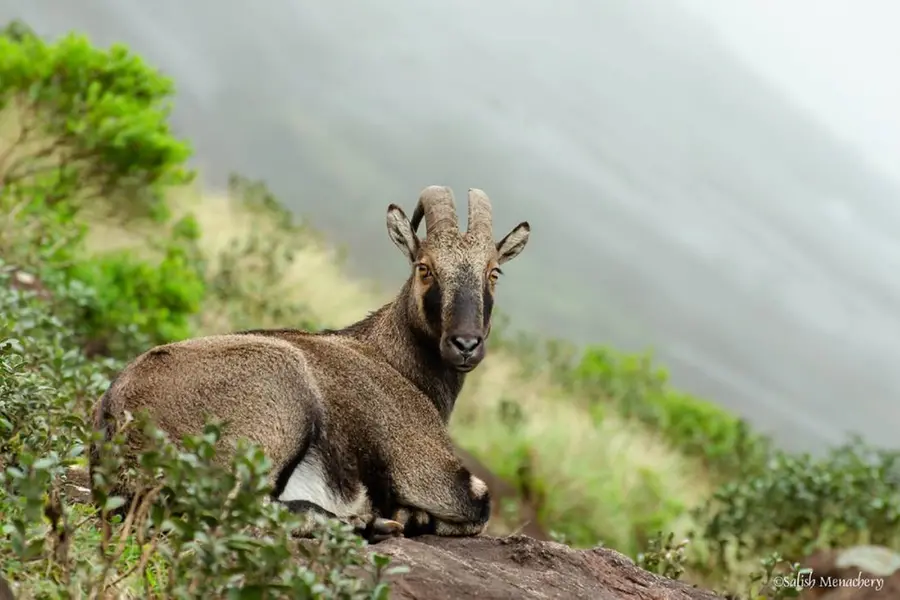
George B Schaller, a legendary American Biologist, to revives half a century old memories of treks in Nilgiri and Munnar Hills, South India. Its scenic beauty was captivating with lush green tea estates. There he followed the Nilgiri Tahr, magnificent wild goats roaming freely in the dramatic landscape to study their ecology and behaviour. He was amazed by the sure footed animals scaling the mountain heights, cliffs and escarpments to get draped with the clouds. In his book he devoted a special chapter to these magnificent beings, “Cloud Goats”.
Schaller, now aged 90 lives in New Hampshire, a quaint city of wilderness away from New York. He took to trekking in mysterious forests from his college days onwards. He crossed many continents over the years. By the time he reached Tibet and China starting from North America, he had a kaleidoscope of countries with different landscapes, wild life, climate, culture, language and inhabitants. He did scientific studies of wild animal ecology in 40 countries and wrote 32 books to be reckoned as one of the formative authorities on wildlife biology. Some of his books on tigers of India, gorillas and lions of Africa, pandas of China and wildlife of Tibet are astounding in their depth of analysis, erudition and insights.
The other day he got a thrilling message from his friend and a leading ecologist, Dr. Ullas Karanth, from Bengaluru. It was about E.R.C Davidar, who was a lawyer in Coonoor as well a legendary naturalist, who guided Schaller in his Tahr studies. Davidar, called Reggie by his friends, was one of the earliest Conservationists of South India at a time when nature and wildlife conservation was unheard of. Despite his busy schedule as a lawyer, he pioneered a movement by building up a network of like minded persons to save the Tahr which was then heavily hunted. Poaching was let loose in Nilgiris and British men during colonial days gunned down wild animals for sport.

As Secretary of Nilgiri Wildlife Association and associated with Nilgiri Game Association and Tamil Nadu Planters Association, his contributions were remarkable in the annals of South Indian wildlife history. When the Wildlife Protection Act was promulgated by the Government of India in 1972, Tahr got legal protection. Today, Tahr is the state animal of Tamil Nadu (TN).
Schaller read the message from Ullas Karath with a glint in his eyes. The Tamil Nadu Government has now bestowed upon Davidar a great honour by celebrating his birthday which falls on October 7 as Nilgiri Tahr day to arouse public opinion and to strengthen protective measures as Tahr is now in the endangered category. The Government proudly declared that Davidar was responsible for pioneering one of the first surveys of Tahr in the State.
This survey had emboldened Tahr protection movements in the State. Now the Government has launched a project for protection at the cost of Rs. 25 Crores and an action plan has been drawn up. A detailed notification in this regard was published by the Government on December 28, 2022. It has been hailed as a unique step by the TN State Government for the first time in India to honour a naturalist with a rare birthday gift as well to honour the species he for cared the most. The only parallel that can be drawn was the decision of the Government of India to celebrate Salim Ali’s birthday on November 12th as National Bird Day of India while Jairam Ramesh was the Forest Minister.
The notification also states that there are multiple references to the Tahr in Tamil Sangam literature written over 2000 years ago. Two great epics of Tamil Nadu, Chilappathikkaram and Civaka Chinthamani have depictions of Tahr. A Tamil Play written by Rasappa Kaviraja described the Tahr as one of the animals that indicates the rich biodiversity of the region. Mesolithic paintings speak about the age-old association between the Tahr and humans. The Tahr was designated as the state animal of Tamil Nadu in recognition of its ecological and cultural significance.
Honour to Davidar and Tahr says Schaller
Schaller expressed happiness over the Government’s decision. He said “Tahr is a natural treasure of the country. It has persisted only because of a few dedicated individuals like Davidar. They have for many decades worked with dedication and passion for its protection. Davidar conducted the first Tahr census and tirelessly monitored the species and its habitats. When I visited him in 1969 to learn about the animal, he generously hosted me and introduced me to the animals”.
“The decision of the Government to designate October 7 as a Tahr day is an appropriate action to honour both the Tahr and those who have fought to retain the beauty of the species,” he remarked.
Schaller read with absorbing interest an article written by Davidar in 1963 in the journal of BNHS (Bombay Natural History Society) headed by India’s birdman Salim Ali. The article was the result of his first survey in Nilgiris and dealt with the sad plight of Tahrs being hunted and their habitats destroyed due to human encroachments. He also issued a warning that the Tahr may become extinct soon.
Schaller pondered. Davidar must be an unusual person. Despite his occupation as a lawyer, he cared more for the Tahr. The moment he read the article, he could not resist meeting Davidar. Salim Ali used to say that Davidar was a very rare naturalist meticulous in his observations of nature. He trekked the forest endowed with immense energy and dedicated himself to protect the rich heritage that was being destroyed.
Davidar opened the vistas of the Nilgiris and Munnar to Schaller to follow and study the Tahr. In his celebrated book, Stones of Silence, Schaller described his first meeting with Davidar in 1969 at his office in Coonoor.There was no need of introduction. Salim Ali had spoken to him and Davidar was expecting Schaller.
“Reggie is one of those unusual persons who openly displayed his enthusiasm for wildlife at a time when few were concerned about natural heritage. He has the appearance of an amiable lawyer. He has especially dedicated himself to the welfare of the Tahr and generously helped me to prepare a visit to their habitats,” Schaller said.
Schaller had met Davidar after necessary homework. He read the history of Nilgiris. He had discussions with tribal people. Also, he collected information about the wild goats of Europe and America. A leading Canadian biologist, Valerius Geist had given him the required data. However, Schaller’s meeting with Davidar was a turning point. After treks and studies both wrote enthralling articles in BNHS journals that captured global attention. By the time Schaller reached Coonoor, his reputation in India had gone up because of his studies of tigers in the Kanha National park in Madhya Pradesh during 1962-1965. It was the first scientific study of tigers in the world. His book The Deer and the Tiger was an astounding one that inspired generations. Before that his studies of the Gorillas of Africa had dispelled the notion that they were cruel. Schaller established that the Gorillas have a human touch and can build up a fine rapport with men, a very revolutionary finding. Just a year before reaching Coonoor, he had been to the Himalayan snowy wilderness to observe goral goats. Before that he had close sittings of the Marco Polo sheep in the rugged terrains of Afghanistan. His other book Mountain Monarchs was about mountain goats of different countries facing harsh climates, disasters, massive snowfall, earthquakes and volcanic eruptions.
Davidar told Schaller as recorded in his book, Whispers in the Wild, “When I first became acquainted with the Tahrs in the 1950s, there were no roads within miles of the Tahr country and only a bridle path. I am not a hill man by birth. My law practice tied me down to a sedentary life. But during my later days, I went for treks in the Tahr country. They were strenuous and exhaustive and moreover, disappointing because I could not penetrate the wilderness deeply”.
He wondered as written in his book “Mystery surrounds the presence of the Tahr in Nilgiris. Its closest relative, the Himalayan Tahr lives 2500 kilometres away in the sections between Kashmir and Bhutan. Many theories have been advanced to explain the presence of their cousins in the south”.
Venkitachalam, a smart guide, accompanied Schaller to Mukurthi Peak, 8380 feet height punctured by clouds. The Toda tribes described the Peak as a gateway to heaven. He had the first sight of nine Tahrs at the edge of an escarpment. He lay on the wet ground, watched and took notes. It was quite a different experience from the Himalayas and Afghanistan. He remembered that during the colonial days, Tahrs were heavily hunted. He wrote “By Jove what a beautiful day. Let us go and kill something”. That is how Englishmen greeted each other in the morning. They then rushed to the jungles with guns and indulged in a killing spree. Many Tahrs were killed in this manner.
After Nilgiris, Schaller left for Munnar and Eravikulam plateau. He trekked the Anamudi, Everest of the south. Eravikulam had the largest single population of the Tahr in the western ghats. Tahr is endemic to the western ghats spread across Kerala and Tamil Nadu. One of the major attractions of Eravikulam was that even in blazing summer, there were gurgling streams. The high altitude emerald grass lands were so captivating.
A British Officer, Douglas Hamilton had been one of the earliest visitors to this area in 1954. He recalled. “The area is surpassingly grand and incomparably beautiful”. Schaller noted that Englishmen were managers of many tea estates in Munnar. The high range game preservation association had protected the Tahrs in 1895. J.C Goulsbury was the manager of the Vagupparai Tea Estate and was a keen naturalist. His father and grandfather have been in the tea business since 1905. Schaller had the opportunity to follow Tahrs here and he studied their social behaviour and breeding biology. K.N. Changappa, then Assistant Manager, who later was officer bearer of high range wildlife preservation association had accompanied Schaller many times for his study. Davidar also visited Munnar and Eravikulam as well as Parmbikulam, Nelliyampathy, Silent Valley and other spots for detailed surveys. Dr. R. Sugathan says that Davidar had keen observation and wanted to explore more. The finding of Tahr was first brought by Davidar in Elivalmala near Palakkad, says Dr. Sugathan, who was a disciple of Salim Ali and a noted Ornithologist.
Dr. Ranjith Singh, former Secretary of Forest, Government of India had close associations with the Tahr. Since he was close to Prime Minister Indira Gandhi, she knew about the Tahrs. In 1973, she wrote a letter to the then Kerala Chief Minister, C. Achutha Menon to declare Eravikulam as the National Park for Tahrs. The entire Eravikulam area and grass lands were owned by Kannan Devan Tea Company. In 1971 the Kerala Government promulgated Forest Vesting Act and the whole land was vested with the Government. It was however declared as a National Park in 1978 for Ranjith Singh, JC Goulsbury and K.K. Nair, then Kerala Chief Conservator of Forests played key roles.
In 2001, Mukurthi in Tamil Nadu was declared as a National Park. There are other fragments of the Tahr population there as in Kerala. Both states may have around 4500 Tahrs. In Eravikulam, there are 840 Tahrs according to the latest census, says S.V Vinod, DFO, Eravikulam. In 2006, Schaller had the opportunity to visit Munnar and Eravikulam in 2006 when IUCN had conducted an international conference on mountain goats. Schaller spoke remembering his association with Davidar.
Davidar in turn pays a glowing tribute to Schaller in his book, Whispers in the Wild. “Schaller was a very hard working field biologist. He was prepared to suffer hardships and discomforts. He faced harsh weather very cheerfully. He is a man of few words and has a remarkable ability to communicate with extreme economy of words. I studied his field notes and was struck by the wealth of data he collected. His classification guided me. I was determined to pursue the surefooted animals to any remote corners of the forest”.
Davidar passed away in 2010. Prof. Priya Davidar, his daughter, recalls that Schaller “had encouraged her father to make a systematic estimate of the Tahr. His power and dedication was remarkable. He stayed with us in Coonoor. He was reticent and quiet. He ate chocolates”.
Dr. Clifford G Rice who studied the ecology of Tahrs in Eravikulam in 1980 and took his Ph.D from Agriculture and Mechanical University, Texas says that though Davidar was not a biologist, he took keen interest in wildlife. His delineations of the Tahr in Eravikulam are a landmark contribution to the history of Indian wildlife.
Dr. P.V. Karunakaran, Principal Scientist, SACON, Coimbatore says that the works of both Schaller and Davidar opened up new horizons in Tahr studies. Dr. Karunakaran did his Ph.D on the grassland ecology of Eravikulam.
Since the formation of the National Park in 1978, the protection for the Tahrs in Eravikulam has been strengthened. A notable feature is that the entire staff of the park at all levels shows keen interest in its keep up and protection. Eravikulam has been adjudged as one of the cleanest National Parks in the country.
Published: 07 Oct 2023, 06:40 am IST
Related Topics
Disclaimer: Kindly avoid objectionable, derogatory, unlawful and lewd comments, while responding to reports. Such comments are punishable under cyber laws. Please keep away from personal attacks. The opinions expressed here are the personal opinions of readers and not that of Mathrubhumi.