

Either the bombing of the school was the result of a grave intelligence failure caused by reliance on outdated databases that did not keep pace with successive changes in the complex’s layout, or it was a deliberate strike based on a linkage that treats the school as part of the military system.
On 12 April 2026, the Iranian Embassy in New Delhi showcased the exhibition (“Angels of Minab”), depicting scenes of hope, birds, and families recovered from beneath the rubble of a school in Minab. The world depicted in them “is still simple, bright, and trustworthy. But the world outside did not remain so.”
Through the exhibition, the embassy sought to draw attention to the human cost of the conflict, presenting the recovered drawings as reflections of a world of children once filled with innocence and hope.
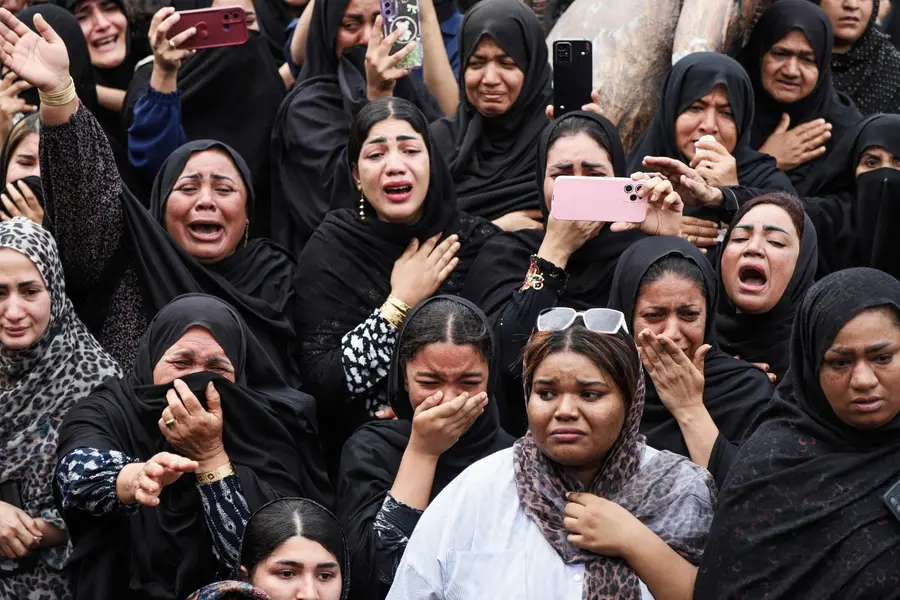
On Saturday morning, February 28, 2026, dozens of girls gathered at the “Shajareh Tayyebeh” (The Good Tree) school in the city of Minab in southern Iran when Israel and the United States began initial strikes on the country. As the students began their studies, missiles struck the school, destroying the building and causing the roof to collapse on top of the children and their teachers.
Iranian authorities have put the final death toll at 165 people, most of them girls aged between 7 and 12. At least 95 other people were wounded in the attack.
Minab is located in Hormozgan in south-eastern Iran, a province of enormous military importance as it directly overlooks the Strait of Hormuz and Gulf waters, making it a key hub for the operations of Iran’s Revolutionary Guard Corps (IRGC) naval forces, NEDSA.
In this context, the “Sayyid al-Shuhada” military complex in Minab stands out; it includes key headquarters, most notably that of the “Asif Brigade”. The Asif missile brigade is considered one of the most important strike arms of the IRGC Navy.
By reviewing open sources and tracking official Iranian records, important details emerge about the school itself: the Shajareh Tayyebeh school in Minab is part of a broad network of schools structurally and administratively affiliated with the IRGC Navy. These schools are classified as non-profit institutions and are primarily intended to provide educational services to the sons and daughters of members of the IRGC Navy.
A US Tomahawk missile hit a military base near a primary school in southern Iran, where Iranian authorities said 168 people, including around 110 children, were killed. The school was struck around the same time as other buildings in the adjacent IRGC complex. The Tomahawk is a type of long-range cruise missile that can be launched from submarines, ships, and aircraft, and has been in the US arsenal for decades.
The Euro-Med Human Rights Monitor has called the bombing of the school a “horrific crime and a consolidation of the collapse of civilian protection”, stressing in a statement that the mere presence of military facilities or bases nearby does not change the school’s civilian character and does not absolve US and Israeli forces of their legal obligation to carefully verify the nature of the target before striking it.
Either the bombing of the school was the result of a grave intelligence failure caused by reliance on outdated databases that did not keep pace with successive changes in the complex’s layout, or it was a deliberate strike based on a linkage that treats the school as part of the military system.
It was the beginning of the week at the Shajareh Tayyebeh Primary School, a two-storey building painted with pink flowers and green leaves in the southern Iranian town of Minab, when the war began. The children were in class, around 10 a.m., when news of the first wave of US-Israeli airstrikes was beginning to trickle through. Parents received panicked phone calls and text messages telling them to pick up their children.
There was not enough time. Less than an hour later, while many parents were at the school and others were still on the way, a missile slammed into the building, reducing it to rubble. Witnesses recounted to Iranian state media a second strike, as survivors of the first sheltered in a hall.
Some 175 people were killed, at least 108 of them children.
The Defense Department describes Tomahawks as “long-range, highly accurate” guided missiles that can fly about 1,000 miles. They are programmed with a specific flight plan before launch, and the missiles steer themselves to their targets. Each Tomahawk is about 20 feet long and has a wingspan of eight and a half feet, according to the Navy. The most commonly used Tomahawks have warheads that contain the explosive power of about 300 pounds of TNT.
An ongoing US military investigation has found that a Tomahawk missile strike on the Shajareh Tayyebeh elementary school building on February 28 happened because of a targeting mistake by the US military.
In a statement released on social media, UNESCO expressed deep alarm at the impact of the military attacks, and noted that pupils in a place dedicated to learning are protected under international humanitarian law, and that “attacks against educational institutions endanger students and teachers and undermine the right to education.”
UNESCO joined a host of bodies from across the United Nations system and senior officials, including Secretary-General António Guterres, to condemn the military attacks.
‘Save the Children’ has strongly condemned the attacks on schools and other civilian infrastructure in the strongest possible terms and has called for the respect of international humanitarian law and the protection of civilians and civilian infrastructure from attack.
“Every war is a war on children, and the world cannot stand by and watch children be killed or injured. When hostilities intensify, children are always the first to suffer as they risk facing displacement, missing out on education, losing access to essential healthcare and protection, or worse, getting injured or killed or losing their loved ones”.
Martin Luther King Jr. wisely said, “We have guided missiles and misguided men”.
The author is former Director General of National Academy of Customs, Indirect Taxes & Narcotics
Published: 16 Apr 2026, 08:43 am IST
ABOUT THE AUTHOR
Disclaimer: Kindly avoid objectionable, derogatory, unlawful and lewd comments, while responding to reports. Such comments are punishable under cyber laws. Please keep away from personal attacks. The opinions expressed here are the personal opinions of readers and not that of Mathrubhumi.