
Vasantha Kumari equaled the Asian high jump record at age 15 in 1957. She was a pioneering female athlete from Kerala long before modern facilities existed. Despite her early success, she transitioned into a successful medical career as an endocrinologist
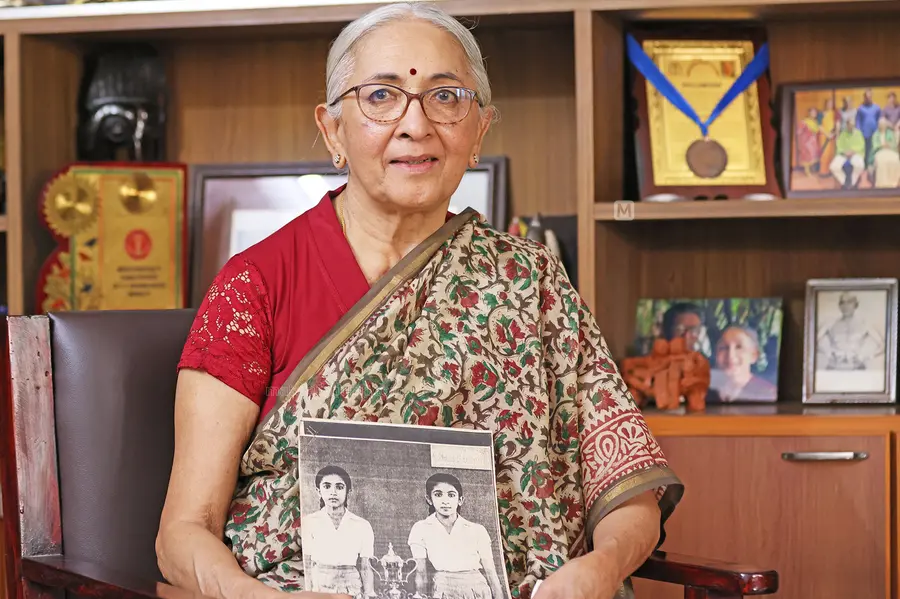
Before the flying Sikh Milkha Singh and before the Payyoli Express PT Usha, there was a sportsperson who performed spectacularly in Indian athletics. A Malayali, G Vasantha Kumari. Milkha's brilliant performances were in 1958 and 60. Even before that, to be precise, on February 10, 1957, Vasantha Kumari's tryst with history was in the women's high jump pit at the National Athletics Meet at the Sri Kanteerava Stadium in Bangalore. Vasantha Kumari, who was only 15 years old, gave a new direction to Indian athletics by equaling the Asian record of 5.1 feet (1.55 meters) set by the Israeli athlete Kross Ahua in 1954.
Even now, at the age of 84, Vasantha Kumari remembers that historic moment as if it were yesterday: “My twin sister Vijaya Kumari was also competing with me (Vijaya Kumari, who cleared 4.8 feet, came third in the event). When Vasantha Kumari cleared 4.11 feet, an announcement was made in the stadium, 'The bar in the women's high jump has now been raised to 5 feet.' Suddenly, the stadium fell silent. If she cleared 5 feet, a new national record would be set. Vasantha Kumari followed the Western roll style aiming for the target.
''Vasantha Kumari is ready for the run-up. Her father, Thampi, is next to the pit, wearing the official tag. Her elder brother, Gopalakrishnan, who is competing in the men's high jump, is also nearby (Gopalakrishnan became the new university record holder by clearing 6.1 feet at the National Inter-Varsity Meet held in Calcutta in the same year). The stadium is roaring with non-stop applause. Now the challenge is 5 feet 1 inch. Vasantha Kumari's attempt is not wasted. A 15-year-old girl can now stake claim to Ahua's record. ''Vasantha Kumari will never forget the tears of pride and joy that filled her father's eyes at that moment. Vasantha could not clear 5 feet 2 inches. Looking back, Vasantha thinks that if the bar had been raised to 5 feet and 1.25 inches that day, she might have set a new Asian record. Ten of the 11 points Kerala got at the Kanteerava Stadium that day belonged to Vasantha's family.
The first Communist ministry led by EMS Namboodiripad came to power two months later, on April 5. Some national newspapers described Vasantha Kumari as the miracle girl from Tirukochi. It was a time when the EMS government and the Communist Party were going through difficult times. Although the Governor and others came with words of encouragement, there was no move to nurture and promote the teenage talent in terms of training facilities at the international level.
Kerala's athletic family
Vasantha and her siblings received a grand welcome in Thiruvananthapuram. State Governor B Ramakrishna Rao, who greeted them at the meeting, and Godavarma Raja, who presided over the meeting, described Vasantha Kumari and her siblings as the athletic family of Kerala. The entire family was behind the success of Vasantha and her siblings. Her father, Adi Narayanan Thampi, who won several medals in shotput, was an assistant accountant general in the Accountant General's Office. Her mother, Gourikutty Amma, was the head mistress at Cottonhill Girls Higher Secondary School.
Vasantha says that her father not only wanted his children to excel in sports, but was also ready to go to any length for it: ''My father ordered books from abroad on track and field events, underlining important points that were then meticulously copied into a notebook. He made sure our diet was proper - I can only imagine how many raw eggs we must have eaten in those days! The only outsider who looked at our training was a Mr Rousseau, an esteemed coach from Bangalore. I remember my father inviting him to stay with us for a few days to supervise our progress.
Father woke us early every morning to change into our uniforms, which he had specially ordered and stitched at Ceylon Tailors in Palayam to our exact specifications. These consisted of pants and long-sleeved jackets, which we wore to go to the main stadium for exercises and running. Afterwards, it was back home for a bath and breakfast before heading to school. When we returned at about 4:00 PM, father would be anxiously awaiting us for evening practice. He had a carpenter take precise measurements to build hurdles for us, and he would draw tracks for running. We even had two pits: one for the high jump and another for the long jump. We lived in a big house then, with a huge yard where our daily practice took place.
My father had a timer and kept strict records of our activities, measuring our running speeds. He even had specially made shoes with sharp nails-or spikes-on the bottom for my high jump. Given my jumping style in those days, I wore the spiked shoe on my left foot only. I used the Western roll style, which was adapted from many successful high jumpers of the time. It seems to have gone completely out of fashion now.''
Vasantha says that she slowly withdrew from the field after getting admission in Thiruvananthapuram Medical College. Vasantha and her siblings (Vasantha had five siblings) excelled in studies as well as in sports. ്Her twin sister Vijaya Kumari had secured the second rank in the state in SSLC. Vijaya had joined Thiruvananthapuram Medical College a year ago. After completing MBBS, Vijaya went to America and taught anatomy at a medical school in California. She retired as the vice-dean from there. The elder sister G Padma Kumari was a well-known social worker in Thiruvananthapuram. Another sister is Dr. Shanta Kumari, who was the Director of Medical Education. The youngest, Dr. Girija, served in the health sector for a long time in England.
Her only brother, Dr A Gopalakrishnan, was the chairman of Atomic Energy Regulatory Board. AGK, who graduated from Thiruvananthapuram Engineering College, first joined the Baba Atomic Research Center. AGK, who earned a doctorate in nuclear engineering from the California Institute of Technology, built the famous research and development department of Bharat Heavy Electricals. AGK often had to clash with the government for taking a strict stance that India's nuclear energy sector should not be ready for any compromise on safety. AGK was a guide to Vasantha Kumari in every sense, both in high jump and in life.
The Lost Jewel
Kerala and India slowly forgot the girl who equalled the Asian record in 1957. There was no government-level inquiry into what happened to Vasantha after her reception in Thiruvananthapuram. The society of that time, which was generally averse to girls participating in sports events wearing shorts, also conveniently pushed Vasantha into oblivion. The question of why the woman who gave Kerala its first address on the Indian sports map had left the field never arose from anywhere.
In 1953, when she was 10 years old, Vasantha had set a new record in the high jump at the state school level by clearing 4.2 feet. Following this, Vasantha got the opportunity to represent Kerala in the Delhi meet in 1954. In the state meet in 1955, Vasantha broke her own record by clearing 4.9 feet. In the following three years, Vasantha won the women's high jump in the national meets - in 1956 in Patiala, in 1957 in Bangalore, and in 1958 in Cuttack. In the inter-varsity meet held in Pune in 1957, Vasantha won first place in the high jump and third place in the long jump. In the 1958 Cuttack meet, Milkha Singh, 29, achieved new speeds in the 200 meters and 400 meters. Milkha missed out on the bronze medal by 0.1 seconds at the 1960 Rome Olympics. While Milkha rose to immortality on the Indian sports map, Vasantha's sports career came to an end in 1958.
Vasantha recalls that her father was the one who was hurt the most when she retired from the field. Perhaps, if she had received significant encouragement at the national level, she could have participated in the 1960 Rome Olympics. After completing her MBBS, Vasantha worked as a doctor in Tanzania and later in the United States. Vasantha, who specialises in endocrinology, has her focus now on thyroid treatment. She serves currently as a senior consultant at Mata Amrita Medical Institute, Kochi.
Looking back, Vasantha has a sense of loss somewhere deep down at the bottom of her heart. The untimely exit of a talent who should have shone brighter on India's sporting horizon now lingers within Vasantha. 'I had a deep desire to progress in sports. But for some reason, that didn't happen.' Vasantha never stepped onto the field when she was studying at Thiruvananthapuram Medical College. 'I feel a great sense of loss now,' said Vasantha Kumari, sitting in her house on Deshabhimani Road in Kaloor, looking through old photos.
Balamaniyamma's DIL, Madhavikutty's SIL
Vasantha Kumari married Dr Shyam Sundar Nair, son of Mathrubhumi managing editor VM Nair and poet Balamani Amma. She is the sister-in-law of writer Madhavikutty. Vasantha remembers Balamani Amma, who was extremely gentle, writing poetry lying in bed. “I have met Madhavikutty many times in Ernakulam and elsewhere. It was a special pleasure to listen to Madhavikutty's stories. I can't count the number of times I laughed at the adventures Madhavikutty used to narratel. She was a woman on a different level.”
Vasantha and Dr Shyam were in New Jersey in the United States. Shyam's field of work was psychiatry. They both came to Kochi in 1986. Shyam said goodbye to this world in 2009. Dr. Vasantha goes to the Amrita hospital four days a week.
What life taught
Dr Vasantha Kumari says that the lesson from the high jump pit laid the foundation of herperspective on life : “The bar falling isn't failure. It's an invitation to persevere. That lesson has stayed with me through everything-if the bar drops, I just work harder for the next jump. This approach leaves little scope for pessimism!''
Published: 10 Mar 2026, 12:40 pm IST
ABOUT THE AUTHOR

Related Topics
Disclaimer: Kindly avoid objectionable, derogatory, unlawful and lewd comments, while responding to reports. Such comments are punishable under cyber laws. Please keep away from personal attacks. The opinions expressed here are the personal opinions of readers and not that of Mathrubhumi.