
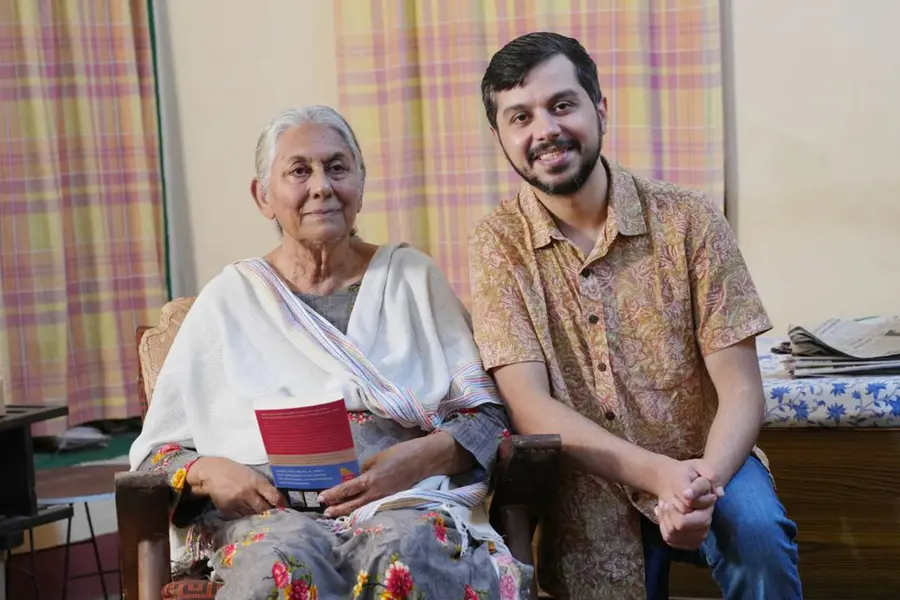
India's Bird Man Salim Ali knew her well. She is India's first female bird watcher and ornithologist. But not many know of her. She was lost somewhere in the folds of history, forgotten until a young scientist and biology researcher, Raza Kasmi, brought her to the forefront.
Bird lovers throughout the country are in awe of the work and dedication shown by Kasmi. “Amidst the galaxy of pioneering birdmen, there was a lone and distinct star from Chota Nagpur, Jamal Ara. The first bird woman of India,” says Kasmi.
One can find Ara prominently depicted in ‘Women in Wild’: a book about India’s most brilliant female wildlife biologists edited by Anitha Mani. Kasmi has written a brilliant article about Ara in this book. Once he learned about her, Kasmi could not resist the temptation to know more about this intriguing personality.
Jamal Ara
He took up a pilgrimage of sorts to find Jamal Ara and ultimately succeeded in finding her. The dynamic woman wrote prolifically about birds between 1949 and 1988 while she toured and trekked forest areas. She was held in high esteem by Salim Ali and Zafar Futehally, among many others. Her works inspired Kasmi greatly.
But in 1988, she suddenly vanished from the scene. Nothing was known about her except that she lived in Ranchi and that she was born in 1023 and passed away in 1995. After a long search, Kasmi stumbled upon Madhuca Singh, Jamal Ara’s daughter, who was a teacher in Ranchi.
Kasmi’s joy knew no bounds, and Madhuca was equally thrilled to know that someone had great admiration for her mother, who was long forgotten. She told Kasmi that her mother had formal education until the tenth standard. She was a self-taught ornithologist.
In an interview with Mathrubhumi.com, Kasmi said: “Jamal Ara was extremely gifted. She wrote a number of scientific papers on birds that appeared in various publications. Her surveys remain the only one conducted in those areas in the past 70 years. She has commendable insights and wrote about conservation when not much was being said about it.
Despite such contributions, Jamal Ara remained relatively unknown because she was a fiercely private individual and seldom remained in contact with people. Madhuca was kind enough to help Kasmi knit together facts pertaining to Ara’s contributions to the field of ornithology.
Raza Kasmi first heard about Jamal Ara about a decade ago when he was a college student. When Anitha Mani was planning the book on ‘Women in the Wild’, it thrilled Raza, for he had already collected much information about Jamal Ara.
Apart from writing for newspapers and journals, Ara had a new audience through AIR. Her talks were appreciated by the audience. She was the only spokesperson for Bihar's imperilled wilderness. She always battled for conservation.
But later, confronted by personal tragedies, Jamal Ara faded into oblivion. She withdrew into silence and was forgotten. When she passed away in 1995, no obituaries appeared except for a small one in a bird-watching journal. Raza says, grief-stricken, that no memorial ceremonies were held. None of her former colleagues or publishing platforms acknowledged her passing.
She was not born in purple as many other stalwarts in the field. She struggled very much to come to the limelight, says Raza.
Published: 15 Dec 2023, 02:12 pm IST
Related Topics
Disclaimer: Kindly avoid objectionable, derogatory, unlawful and lewd comments, while responding to reports. Such comments are punishable under cyber laws. Please keep away from personal attacks. The opinions expressed here are the personal opinions of readers and not that of Mathrubhumi.
