
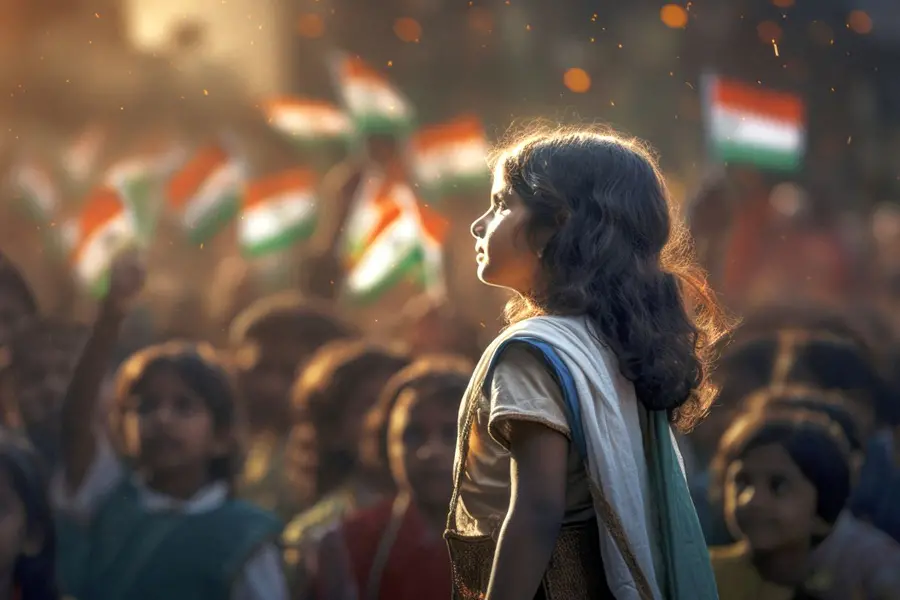
Today, the world marks the first-ever International Day of Hope, which was declared by the United Nations General Assembly via resolution 79/270. India is one nation where the worth of hope is both intensely personal as well as desperately political.
In a country of 1.4 billion people struggling with huge issues -- from poverty and unemployment to climate change and communal tensions -- hope is not an emotion. It is a daily survival act, an unspoken prayer in slums, a refusal to give up a smile during job losses, and the driving force of millions looking for a better future.
The United Nations, by passing this resolution, has reminded all humanity that hope is a shared objective, as important as peace and prosperity. The declaration of July 12 as the International Day of Hope invites every member state to advocate for messages of peace, tolerance, social stability, and mental well-being. This is not an abstract concept. In India, it's a clarion call to revive the spirit of millions of citizens whose daily existence is marked by both adversity and resilience.
Hope in India is multidimensional and multifaceted. For the Vidarbha farmer, who still plants seeds in the face of drought, hope rests with the rains. For the young graduates posting job applications daily without feedback, hope rests with the next call for an interview.
For the trans activist in Kerala protesting in Pride parades, hope is in equality and acceptance. For the migrant worker coming back to the city after the trauma of the COVID lockdowns, hope is in being able to start again. In a nation as divided and multicultural as India, hope spans not just geography, but identity and despair.
Hope, as per the UN resolution, cannot be placed in isolation from sustainable development and just economic growth. It calls for countries to engage with communities and individuals by "reconciliatory measures, acts of service, and by encouraging forgiveness and compassion."
These concepts are of pivotal importance in present-day India, where differences on caste, religion, class and language frequently result in conflict. How more necessary is healing? What more potent force than the conviction that peace can still be achieved?
Even within politics, hope is a quiet but powerful force in the Indian democratic landscape. Each election becomes a vehicle for hope -- a hope that there will be change under the new government, that corruption will decrease, that employment will increase, that education will be upgraded.
Either fulfilled or betrayed, hope continues to propel individuals to vote, protest, argue, and have faith in the democratic process. Cynicism exists along with optimism in India's public space, but hope's long-term influence usually triumphs.
Consider India's youth -- its brightest but stressed generation. For many, hope is tested every day. The fierce rivalry of entrance exams, the fear of unemployment, and the suffocating weight of family expectations can at times breed hopelessness and even psychiatric crises. But programs like mental health campaigns, peer counselling for colleges, and online therapy apps reflect an emerging awareness that hope needs to be guarded and tended to. The government's renewed focus on mental health in the National Education Policy is also a promising step in the right direction.
The significance of storytelling, too, needs to be highlighted. Throughout India, tales of resilience keep emerging from the unlikeliest of places. In Assam's flood-affected regions, youth volunteers construct bamboo bridges and distribute rations, even as their own homes are under water.
In the dry tracts of Rajasthan, women organise self-help groups to market handicrafts and give education to their daughters. In the densely populated chawls of Mumbai, children go to night schools after working in the daytime to sustain their families. Each of these is a statement of hope -- not by words, but by deeds.
It is not merely the poor who pin their hopes. The middle class holds on to it equally hard -- families pinning their hopes on their children surviving overseas, small businesspeople pinning their hopes on their next venture succeeding, and office workers pinning their hopes on promotions. And even at the opposite end of the scale, the super-rich find themselves hoping for peace, for stability, for a future their money can't bequeath.
The UN also emphasises how forgiveness and compassion can contribute to a positive society. It is particularly relevant in India, where communal strife usually teeters at the edge of peace. There have been interfaith meetings, people's peace movements, and communal harmony movements initiated by civil society groups across the nation. They may not always find mention in national media, but they are real and functioning. They show that even when political and institutional systems fail, communities can still make the choice of compassion and understanding.
Culture and art are strong tools of hope. India's cinema, literature, and folk arts are filled with tales of survival, of love, of resistance, of dreams. Whether it's a Bollywood hit depicting the success of a common man or a regional ballad of transcending the evil of caste discrimination, these art forms energise the imagination and comfort. Even amidst the blackest of days, India's artists have shed light -- be it protest art, theatre, or street music.
The COVID-19 pandemic offered a brutal reminder of how fragile life is -- and how essential hope is for recovery. During lockdowns, countless Indians displayed acts of extraordinary kindness and solidarity, from feeding the hungry to setting up oxygen banks. The second wave was especially devastating, but people didn’t give up. Doctors, delivery workers, sanitation staff, and crematorium volunteers all worked relentlessly. If there was one thing stronger than the virus, it was hope.
In city India, hope exists in the form of aspiration -- to rise up the social ladder, to own that first car, to have children educated in English-medium schools. It's both promise and strain. In rural India, it's access -- to water, electricity, mobile phones, and medical care. Everywhere, inequality is a big hurdle to maintaining hope. When resources are limited, when justice is late, when the system seems stacked against the poor, hope starts to fade. That is why policy initiatives need to move beyond rhetoric. They need to yield dignity, justice, and opportunity.
The International Day of Hope also urges people everywhere to share and magnify stories of hope. For India, this may involve showcasing rural innovation, celebrating changemakers at the grassroots level, supporting environmentally conscious entrepreneurship, and increasing access to education and healthcare. Social media, which is commonly accused of fomenting hate and fake news, can be redesigned to promote hope, too. Already, digital platforms are being leveraged by influencers, NGOs, and teachers to crowdsource funds, provide mental health resources, and give visibility to positive change.
Hope is not passive. It is active. It requires us to think and to do. From climate activists in Bengaluru who are struggling to preserve lakes, to forest protectors among Chhattisgarh's tribal groups, to whistleblowers revealing graft in public offices -- these are the guardians of hope. They do not wait for perfect conditions. They generate them.
Even in the judicial system, hope comes into play. Victims of violence, discrimination, and abuse have to wait years for justice. But the fact that they are seeking justice itself is a victory of hope. Whether it is the parents of Nirbhaya, or victims of atrocities based on caste, or citizens who are struggling for RTI access -- each fight points out that hope, however bruised, is not vanquished.
Children perhaps represent hope at its most unadulterated. Each child who attends school in spite of challenges, each girl who holds out for her right to learning, each boy who aspires to be a scientist or a singer or a warrior, contributes to the national hope bank. Initiatives such as Beti Bachao Beti Padhao, midday meal schemes, and Anganwadis are not merely policies. They are hopeful architecture.
But hope, too, has to be safeguarded. The increasing incidence of hate speech, cyberbullying, and political polarisation is undermining trust in society. When discourse turns nasty in public life, when there is compromised media, when dissent is outlawed, the very atmosphere of hope starts to dissipate. A hope-valuing democracy like ours has to also cherish truth, diversity, and dialogue. That is India's challenge today.
On this inaugural International Day of Hope, let us not forget: Hope is not reserved for the pleasant moments. It is most necessary in the dark. It sustains a family that is still searching for a vanished loved one. It fuels the aspirations of a village girl who has no limbs but wishes to become a lawyer. It marches with the worker who takes a bus to an unfamiliar city for survival. It is carved into the minds of minorities, the marginalised, and refugees.
India has never had a close connection with hope. Our epics, our struggle for freedom, our scientific accomplishments -- all were tales of courage and faith. Going ahead, as problems become more intricate, stakes greater, we should not lose the one thing that makes us human --hope. Perhaps it won't fix everything. Without it, however, nothing can be fixed.
So today, let us not merely celebrate this day with slogans and seminars. Let us act on hope -- in our policies, in our streets, in our homes, in our hearts. Let us be the nation where hope is not a luxury, but a right. Because ultimately, what is India without hope? It is hope that built us. It is hope that will move us ahead.
Published: 12 Jul 2025, 02:24 pm IST
Disclaimer: Kindly avoid objectionable, derogatory, unlawful and lewd comments, while responding to reports. Such comments are punishable under cyber laws. Please keep away from personal attacks. The opinions expressed here are the personal opinions of readers and not that of Mathrubhumi.
