
The volume of wickets taken by spinners of the visiting teams from January 1, 2001 - 746 at 41.21 - is a reflection on the home team batters' inadequacy against slow spin - conventional finger spin.
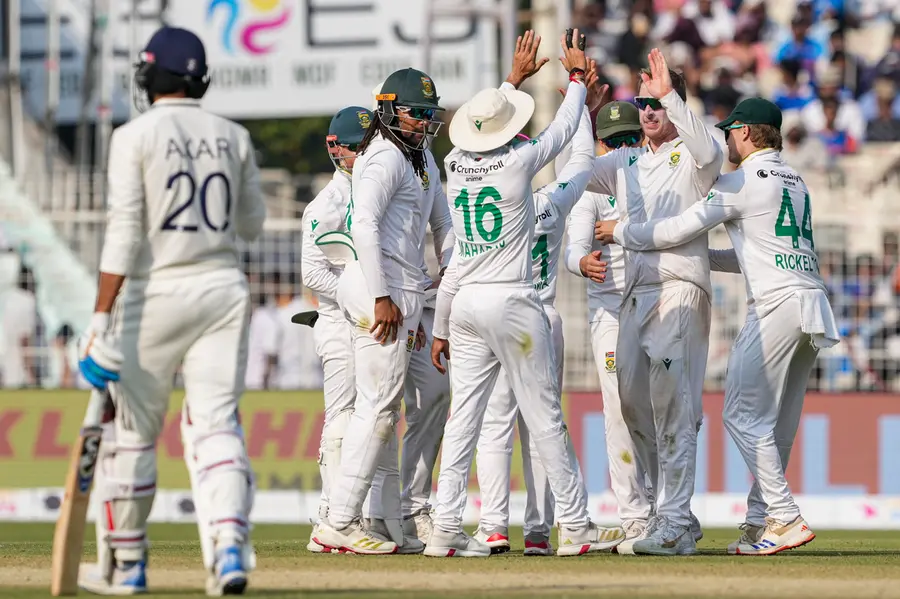
For the third time in a year's time, the Indian team's think tank - with Head Coach Gautam Gambhir in the vanguard of it - asked for a 'dubious' pitch supposed to offer copious turn and uneven bounce in order to gain advantage against the visiting South African batters at the famous Eden Gardens in Kolkata.
And what transpired over eight sessions of two hours each told a story of the home team batters' inadequacy to deal with the off-breaks of Simon Harmer, who in ten years of Test cricket had a tally of 52 wickets. Just that much going into the Test match.
But in a single Test at the grand Eden Gardens, he took the centre stage with eight wickets distributed over two innings to bring down the so-called mighty Indian batting line-up. India's batters fell like nine pins on the designer rank turner and presented the first Test on a platter to South Africa.
After the two-Test series against the West Indies - Shubman Gill's team won it 2-0 - India was behind Australia and Sri Lanka in the World Championship table, and after the embarrassing defeat at Eden, India has dropped to fourth, with South Africa dislodging Sri Lanka from second place.
The volume of wickets taken by spinners of the visiting teams from January 1, 2001 - 746 at 41.21 - is a reflection on the home team batters' inadequacy against slow spin - conventional finger spin. This number is staggering because the spinners who have travelled to India from the first Test at the Bombay Gymkhana in December 1933 have taken in all 1745 wickets at 38.08 apiece. In the last fifteen years, the numbers are 349 by right-hand finger spinners (off spinners) and 285 by slow left-arm spinners.

Harmer took eight at the Eden to take his tally to 60. The 36 year old from Pretoria has a whopping 1000 plus first class wickets playing for seven first class teams including Eastern Province and Essex in the English County Championship. He was a delight to watch bowling over the wicket to right handers and round the wicket to left handers.
His plan was to bring the batters into a forward press with the aim of finding the inner or outer edge and hitting the pads straight. He bowled a lot from close to the return crease - wide of the umpire - when choosing the round the wicket option.
The point in question after India's third defeat - two against New Zealand in Pune and Mumbai in 2024 - is whether designer pitches that behave alarmingly and enhance the spinners' role and potency are the only option? Time and again, the visiting teams' slow bowlers have exposed the Indian batters' incompetence on the skill count.
The Indian batters are deemed good against the turning ball, but that's only on a flat track or a normal wearing surface on the fourth and fifth days. But they have been found wanting on rank turners. They lack trust on the count of bounce.
Only the South Africa skipper, Themba Bavuma, and India's Washington Sundar showed the good old ways of grinding it out to deal with the uncertain surface. Harmer played in India ten years ago, but during the course of the first Test, he looked like a mature spinner, never fearing to flight the ball.
Gambhir backed the Eden curator for creating a pitch that the team wanted. He also named and Sundar for the way they applied themselves to a task and won admirers. In fact, Bavuma's half-century was a master class knock against the spinners used by India; Chinaman bowler Kuldeep Yadav, the left-arm finger spinners Ravindra Jadeja and Axar Patel. Gambhir made it a point to say that pressure and the ability to overcome it matter more than the soft skills with hands to deal with the spinners.
The second and final Test starts at a new venue in Guwahati from November 22. South Africa has found ways to mount pressure on the Indian batters and make them vulnerable. South Africa had threatened to play three spinners, but eventually chose to leave out left-hand spinner Senuran Muthusamy. The visitor is bound to have selection issues at Guwahati with the potential return of fast bowler Kagiso Rabada, who had to be benched in Kolkata because of a bruised rib cage.
India's troubles, chasing 124 for a win, began when left-hand fast bowler Marco Jansen sent down a good delivery to evoke an edge from left-hander Yashasvi Jaiswal and then dug in short and wide to force K. L. Rahul to attempt a fatal shot. Thereafter, Harmer took charge, getting rid of Dhruv Jurel and acting captain ( for the indisposed Shubman Gill), Rishabh Pant, and Ravindra Jadeja.
Rahul had faced 119 balls in three hours and four minutes in the first innings, Sundar 82 in two hours and two minutes, and 92 balls in the same time in the second innings. But Bavuma gritted it out in the middle for three hours and three minutes to make an unbeaten 55, which won his side the match by 30 runs. India will find it an uphill task at Guwahati.
Fast bowlers Jasprit Bumrah emerged with flying colours, and the spinners bowled well in patches, but none posed a threat as much as Harmer did on a pitch that was tailor-made for the slow men.
The Indian team would have conveyed to the curator the kind of pitch it would like to have at Guwahati. Another loss would make India's objective to qualify for the WTC final very doubtful. But what was established in the first Test at the Eden was that India's batters do not have the wherewithal to deal with ace spinners.
Published: 17 Nov 2025, 12:58 pm IST
Related Topics
Disclaimer: Kindly avoid objectionable, derogatory, unlawful and lewd comments, while responding to reports. Such comments are punishable under cyber laws. Please keep away from personal attacks. The opinions expressed here are the personal opinions of readers and not that of Mathrubhumi.
