
Booker Prize-winner Banu Mushtaq’s story inspires Hasina, a film exposing patriarchy in Karnataka's Muslim society. Girish Kasaravalli's direction brings her vision alive.
“I would also like to say that despite all my work as a writer and a social activist I find that, in general, Muslim organizations, with notable exceptions, do not respect or even acknowledge my contributions. I think this is because of a deep gender bias, a deep-rooted notion that the more a Muslim woman is restricted to her home, the more pious she is seen as. I do not, however, think this is what the Quran teaches……... Every time I have voiced my views against patriarchy wrongly parading in the guise of Islam, misinterpreting Islam to bolster patriarchy and the subjugation of women, I have been told that I have no right to speak on Islam, to interpret my religion on my own. I have been told that because I do not have a madrasa education I have no right to do so. But this is my right, as a believing and practicing Muslim woman, and the maulvis cannot take it away from me.”
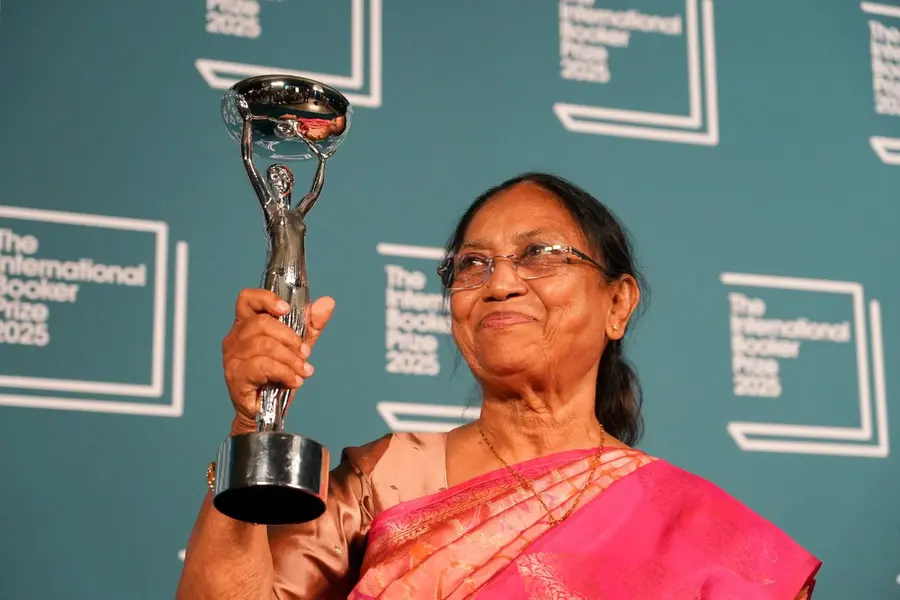
Syeda Khushtara Banu, more popularly known as Banu Mushtaq, is a well-known Kannada writer and a leading social activist from Karnataka, a rare breed of women that too Muslim writer who won the prestigious Booker prize last week told an interviewer of the journal New Age Islam in 2010. Going by the response of the Hindutva establishment or Sangh Parivar politics has not yet congratulated her for bringing this international honour to India indicating not just patriarchy but a certain kind of narrow politics.
Seeing the national award-winning film Hasina, (2004) based on the Booker Prize winner's short story by Girish Kasaravalli, one can get deeper into the creative world of the author. Her world is full of rage against patriarchy in the Muslim community which makes women and children in the community suffer numerous hurdles and biases. As narrated in the long interview Banu Mushtaq had gone through fire combating the patriarchy in her community with the support of her father and husband, but she too had to pay the price, sometimes social and personal for her bold stand against patriarchy.
One of the few Indian Muslim women writers of her sort Banu Mushtaq has won numerous awards for her literary works and social activism, including the International Women’s Award for Radio and Television (1999), the Karnataka Women Writers’ Association’s Gudibande Poornima Best Poetess Award (1999), the Karnataka Women’s Writers’ Association’s H.V. Savitramma Dattinidhi Award(2000), the Karnataka Government’s Rajyotsava Award for literature (2002), the Karnataka Sahitya Academy Award (2004), and the Akhil Bharatiya Jain Women’s Mahastambhshekha Award (2004).
In a way the film Hasina made in 2004 and directed by Girish Kasaravalli, one of the strong pillars among India’s meaningful filmmakers from Karnataka sums up Banu Mushtaq’s creative world. The film was based on the Kannada short story Kari Nagaragalu (Black Cobra) by this writer and won the national award for the lead character actress Taara. The film with a protagonist challenges patriarchy just like the author and has won numerous national and State awards. It was screened and appreciated in several international film festivals for delving deep into the world of patriarchy and the plight of women among Muslims.
Hasina, the film’s protagonist, is the wife of “Auto Yakub”, who married her against the wishes of his mother. Yakub makes a livelihood in the small town driving an auto rickshaw, leading a happy family life till he finds that his fourth child is also going to be a girl, against the prediction of his mother. The gender recognition of the fetus rattles him and he leaves Hasina and the kids in frustration. The elder blind kid injures herself in a fall searching for the key to the locked house which Yakub threw out while deserting the family. At the hospital, Hasina is advised that the blind kid can gain sight if treated in three months which will cost her about 20,000 rupees. Hasina’s life gets charged despite the desertion of her husband and she works in a rich rebel Muslim lady's house and makes even the three little kids work in making agarbathis(incense sticks) to collect money for the treatment. She also represents the local Mosque against Yakub for deserting her, but the vile man influences the Muthavalli(headman) of the mosque who refuses to intervene.
The film starts with the “sit in“of a desperate Hasina on the steps of the local Mosque to make the Jamaat act against Yakub and also ends when a drunken Yakub who arrived in a fit of anger repeatedly steps on the pregnant Haseena, only to be saved by her elder daughter, as she received blows of her own father to save her mother. That rattles the entire community, especially the women to the extent that the film ends not just when the Muthavalli( headman) apologises to Hasina for his inaction to prevent the tragedy, but when the headman’s own wife deserts him allegedly for medical reasons.
The film is totally centred on the women characters and the children. Be it Hasina or her separated rich employer of the house or the Muthavalli’s wife who is tired of bearing his numerous kids every year, or the new bride of Yakub whom Hasina reaches out to get a Talaq from her husband to ensure the Rs 20,000 for her daughter's eyesight. The meher(dowry) money and her own savings of Rs 5000 will ensure the elder daughter has eyesight, Hasina pleads. In the heart-touching sequence the new bride never utters a word, but extends her hands to Hasina, almost united in their sad plight under the overarching patriarchy. The extreme close up of the united hands of the two ladies in that sequence is one of the rare moments in the film.
Yakub finds Hasina returning from his new bride’s home. Realizing that his new marriage will not happen, he beats up Hasina in a range, robs of her money and she is left with no option but to sit in the gates of the Mosque to force the Jamaat to take action. The action takes the life of the daughter and deprives her sole obsession of ensuring the sight of the daughter, despite her failed marriage.
One has to describe the story of Banu Mushtaq to understand the film which has been crafted as a touching human document by the master director Girish Kasaravalli. One can say Girish has got the essence of the writers’ narrative and went about it with all its physical details. The scenes with Hasina and her kids who stood with her in her fight for getting eyesight for her elder kid are so touching that one cannot but go moist in the eyes. In one scene the second daughter says after they began to make agarbathis(incense sticks), the house started smelling good and later she also fetches water from the nearby tap before it goes dry and waits for her mother to come back from her endless travails in pursuit of moving the patriarchal establishment. As Hasina faints due to her hard work in her advancing pregnancy days, her elder daughter reveals she also faints occasionally after the fall she had while searching for the house key which her father threw outside. Hasina realizes the gravity of the situation and hugs her. Indeed, the women and child characters of the film are united in their sufferings under the brutal patriarchs of the community.
There are so many touching humane situations in the film, involving the employer of the protagonist and Muthavalli’s wife. The filmmaker leaves no room for his view of the situations but puts everything on the protagonist’s relentless fight to save not only her failed marriage but also her child’s eyesight. The asaans( Mulsim prayers) in the film from the Mosque almost come off as a loud cry of Hasina to the almighty in many moments in the film. Towards the last sequences, the aasans are repeatedly heard indicating the tragedy ahead. The fight for the blind child’s new vision becomes the failed fight of Hasina against the patriarchy around them. Her only hope in a desperate situation about a bright life for her child is lost in the fight that too by the brutal act of the child’s own father. This is indeed one of the best and unique examples of physical reality merging with the wider narrative of the film, a rare feat even among the meaningful films of India.
Girish, the filmmaker could have ended the film with the individual plight of the character Hasina. But he does not undertake that and brings in the peeping eyes of Muslim women around when the men “handle” Hasina’s “sit down” at the Mosque. Finally, after the death of the kid, the filmmaker brings in the burqa-clad women in groups in light and shades of long shots, as if they are suffering in the shadows around the Jamaat. Asked in an interview later, Banu Mushtaq said Girish could have ended the film with the tragic plight of Hasina, but he went ahead and made a statement about Muslim women in general just as the writer wanted.
The film is indeed a genuine human document of Muslim women in a small town in Karnataka, which has been the recurring focus of the narratives of the Booker Prize winner’s creative world. Girish being a master craftsman of his times has been able to capture this creative narrative of the tragic world of Muslim women as seen in Banu Mushtaq’s writings in his film Hasina. Indeed, it is a film that touches both your heart and mind and makes you lament about the plight of those women caught in the web of patriarchy.
(V K Cherian is the author of the books, “"Noon Films and Magical Renaissance of Malayalam Cinema” and “Celluloid to Digital: India's Film Society Movement ”)
Published: 26 May 2025, 08:57 pm IST
Related Topics
Disclaimer: Kindly avoid objectionable, derogatory, unlawful and lewd comments, while responding to reports. Such comments are punishable under cyber laws. Please keep away from personal attacks. The opinions expressed here are the personal opinions of readers and not that of Mathrubhumi.
