
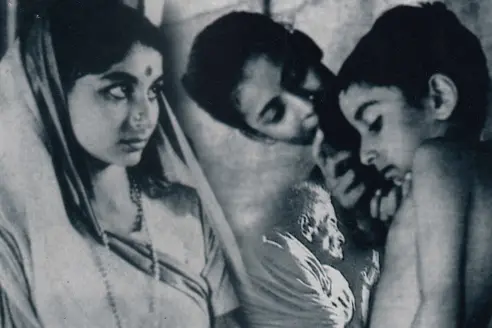
Today marks 70 years of release of Pather Panchali by Satyajit Ray
The British Film Institute and its legendary film journal Sight and Sound in 2022 requested its panel of 1,600 plus influential international film critics, academics, distributors, writers, curators, archivists, and programmers, almost double the number of participants in 2012, to select the best film ever made. The decadal voting, which BFI started from 1952, saw the selection of Austrian female filmmaker Chantal Akerman’s film Jeanne Dielman, 23 quai du Commerce, 1080 Bruxelles,in 2022, as the best film ever made.
For Indians, however, there is one film which remains at the pinnacle of top 50--Satyajit Ray’s timeless classic Pather Panchali. With its human document touching the hearts of millions of people across the continents over generations, the 1955 film still adorns the celebrated annals of world’s top list as the 35th best film ever produced.
“I dunno anymore what a good film is, even less what the best is, but I know which ones I like best, depending on the days, in no particular order. This one for the boy, for his grandma who waters the weeds by the house, for Ravi Shankar’s music, for the spotting of his complaint after his big loss, for the photography, for the sensuality of the countryside, for the sadness of childhood and all the hope of it,” wrote German director, Volker Schlöndorff, while voting for the Ray film as his first choice of best-ever film.
Reams of analysis have been written about the film over the years. Indian and foreign critics have looked at the film from all perspectives and adjudged it as one of the best from India. Some have ridiculed it as a depiction of India’s poverty and misery before the entire world. Ray’s contemporary, Mrinal Sen recalled, “Certain Friday in 1956, came as a surprise, the biggest of all big surprises - a coup d’etat, so to speak, conceived and staged almost conspiratorially.” For the country the advent of Pather Panchali was a watershed in the history of the Indian films dividing it as the period before and after Pather Panchal. A film which is still rated as one of the best among the top 50, having bagged national and international awards in a row and breaking all box office records as far as earnings are concerned. The film, made with a mere Rs 1.50 lakh budget, earned over $50,000 from USA alone, as per estimates.
Unquestionably, this film was the first to put India on the world map. Although, films were being shown and even produced in India since colonial times after the Lumiere Brothers invented the medium, no other film has made it into the history of global films the way Ray’s first film has. The fact that the film is made by the founder of the first major Indian Film Society of independent India, the Calcutta Film Society (CFS), makes it even more historic. It also highlights the contribution of new Indian films by the Film Society Movement, which flourished following the national and international honours bagged by Pather Panchali.
“The international interest in Indian cinema which Pather Panchali had created continues to grow. Indian films are now eagerly invited by major international film festivals,” noted report of the working group on a National Policy for films, headed by Dr Shivarama Karanth in1980, affixing the government committee’s stamp of approval for the film “as watershed among Indian films”.
Search for New Idiom in Films
Independent India energized the Indians with artistic lineages, and the film buff into forming film societies to study and contribute to the field in a meaningful way. The first of the group was the Calcutta Film Society (CFS) which was founded on October 5, 1947, when the 19 founding members met in a garret in South Calcutta. Prominent among the founders were Satyajit Ray, Chidananda Das Gupta, Hari S Das Gupta, Hiran Sanyal and Radha Mohan Bhattacharya.
The founding fathers of the film society wanted to create an ambience for “intelligent film making.” Their activities included screening of outstanding feature films and documentary, which are generally outside the commercial circuits. They also held discussions on such films and planned to bring out a journal on them. They even wanted to make 16 mm documentaries. “It was a period of discovery. Suddenly we saw what cinema could mean and how different it could be from what it went under its name,” wrote late Chidananda Das Gupta, in whose garret the first meeting of CFS happened.
Satyajit Ray, a commercial artist with a British advertising firm and a Tagorian-family background, was bitten by the film bug. He was experimenting with his scripts and conventional producers in Tollywood, of the then Calcutta. “Following the cancellation of the contract for the script of Home and the World, Ray’s interest in cinema increased rather than diminished. It was stimulated by the return of Hari Das Gupta from Hollywood, who was to become known as a maker of documentary films and for the formation of the Calcutta Film Society,” noted Marie Seton, in her official biography of the filmmaker.
Nation building in all spheres, including culture, was weighing heavily on the film industry, and a quest for an Indian idiom in films began earnestly after the country attained its freedom from the British Raj in 1947. Prime Minister Jawaharlal Nehru, an Oxford scholar, freedom fighter and writer of many insightful books on India and its history, had already initiated many steps to build institutions in various cultural fields, including films. The government had constituted an expert committee on films with SK Patil as the Chairman, ably assisted by the likes of V Shantaram and BN Sircar. As against the earlier Rangachariar Committee, during the British Raj, which deliberated only on film censorship, this committee under Patil had the mandate to explore the development of the film industry as a whole.
In its recommendation, the Patil Committee observed: “In our view remedy lies neither in Laissez-faire, nor in regimentation, but curing all the various elements of their defects and deficiencies and ensuring, that they combine and cooperate in a joint endeavor to make this valuable medium a useful and healthy instrument of both entertainment and education, as well as a means of upliftment and progress, rather than degeneration and decay.” The year was 1951, and the Indian film industry owes its further development to Patil’s insightful and futuristic recommendations.
As Ray was running around to complete the making of Pather Panchali, Jean Bhownagary was planning to make India the first Asian country to have its own International Film Festival. Bhownagary and Asok Mitra, the then Secretary of Information and Broadcasting Ministry, are credited with the actual implementation of SK Patil’s committee report on promotion of films and film-based institutions like Film and Television Institute of India (FTII), National Film Archives of India (NFAI), Film Finance Corporation (FFC) and International Film Festival of India (IFFI), which have contributed to tectonic changes in Indian cinema over 75 years.
Arrival of Marie Seton --the Guru of Film Appreciation
As Satyajit Ray, having flagged off the Calcutta Film Society with his friends, was busy shooting and running around to complete his first film Pather Panchali, in 1955, Pamela Cullen, (secretary of Indian High commissioner in London) was finalising an old India League (28) associate of Krishna Menon and a British Film Institute scholar, Marie Seton, for Nehru’s film assignment. She had just come back from the erstwhile Soviet Union, after a couple of years’ association with the legendary Soviet filmmaker Sergie Eisenstein, and was invited for a lecture tour in India on film appreciation. The tour was to be conducted by the Ministry of Education in association with the British Film Institute (BFI).
Marie Seton and her friends from the BFI later played a major role in promoting Pather Panchali in the Western world, not that Ray was a greenhorn to the London film scene. Marie had arrived in India soon after the Seminar of 1955 to become a lifelong family friend of the Nehrus (both father and daughter). With the International Film Festival in 1952, Seminar of 1955 and arrival of Marie Seton, Prime Minister Nehru earnestly took up the effort to give Indian cinema the new directions it needed, as recommended by the SK Patil committee.
Marie Seton remained an Indophile all her life till her demise in 1985. She was single-handedly responsible for drumming up and giving the sporadic flicker of film societies, across few centres, the shape of a national movement. Her multi-city lectures and the excitement created by the success of Pather Panchali resulted in the formation of The Federation of Film Societies of India (FFSI) in 1959. Pather Panchali, the film which ensured India a place on the world film map, just about the time when Rashomon of Akira Kurosawa (Japan) took the world of films by surprise. Both Ray and Kurosawa became the torch bearers of new Asian cinema of those days.
Pather Panchali - Defining India’s Idiom in Films!
In short, just as India awaited the film Raja Harishchandra to join the new medium of the industrial revolution during the British Raj, the new democratic republic was preparing itself for the arrival of a film like Pather Panchali in its cultural horizon and to have its own idiom in the world of films. The first show of Ray’s film in New York organised by the Indian Embassy was after a sitar recital, sending out the message of the film as a true cultural product from India.
Though, skeptics tried to deride the film as selling Indian poverty abroad, Prime Minister Nehru himself defended Pather Panchali. “What is wrong about showing India’s poverty? Everyone knows that we are a poor country. The question is; are we Indians sensitive to our poverty or insensitive to it? Ray has shown it with an extraordinary sense of beauty and sensitiveness,” Nehru explained about the film. (33)
Needless to say, the Prime Minister and his daughter, Indira Gandhi, became lifelong connoisseurs of such films and always promoted filmmakers making films like Pather Panchali. Ray’s first film won the best Human Document award at Cannes Film Festival and several national and international awards, making the CFS founder a global celebrity in films.
The nation and the Calcutta Film Society celebrate Pather Panchali and the anniversary of its public screening, every year. Film enthusiasts of the country realised that Ray’s first film was not just a Song of the Road, but was indeed a song of the times. The film gave a new face to Indian cinema and sparked off a tremendous interest in not just Pather Panchali, but in a whole new genre of meaningful films. The entire Film Society Movement got a jumpstart in many places with the screening of the first film of Ray. The world began to acknowledge Ray’s film as the advent of New Indian Cinema. The film and the director of the film were historically identified as pioneers of meaningful cinema movement in India. Satyajit Ray continued to be not just the lifelong President of the Federation of Film Societies of India, but remains the sole stalwart of the new Indian films.
“Where there is such a response to discussion of cinema and an interest in films which are not in accord with the conventional entertainment film, it is reasonable to suppose that there is growing public of a higher and more cultural character. The success of the Bengali film, PatherPanchali, is also indicative of this trend,” wrote Marie Seton. .
“Pather Panchali introduced Indian cinema to the West as cataclysmically as Kurosawa’s Rashomon had done for Japanese films. A human document of timeless simplicity and exquisite beauty.” wrote Ephraim Katz.
Malayalam film maker Adoor Gopalakrishan, who dedicated an entire chapter on PatherPanchali in his first collection of articles on films, stated, “No one ever thought, there will be a narrative on the folklore of life and a celebration of life itself, this way on the celluloid and that is why Pather Panchali will be remembered as the harbinger of change in Indian cinema.” Adoor, incidentally was also a harbinger of the new film culture with his Chitralekha Film Society/ Co-operative and is considered as a worthy successor of Ray and his genre of films.
The experience of Shyam Benegal, Adoor’s contemporary, was no different. Benegal recalled his first experience of Pather Panchali: “The experience was indescribable. As the expression goes, ‘it simply blew my mind’.” Benegal had seen Pather Panchali during a visit to Calcutta in 1955. He saw it over and over again, after the first show, by buying tickets continuously after each show. Such was his excitement!
Years later, Ray’s own film society colleague, Das Gupta explained the excitement which PatherPanchali created in India and abroad. “Political independence and the beginnings of film appreciation are thus fused in my memory. Indeed, there was more than a trace of messianic fervour in our attitude to film. A new cinema, we thought, would emerge as an art and social force. A country like India, with its honeycomb of identities defined by language, religion and a host of other criteria, would need social engineering of some scale to wield itself into a nation, and cinema would be an ideal force to supply the motivation.”
Looking back, Das Gupta, who was the prime mover behind the CFS and FFSI, remains prophetic even today. Das Gupta walked his talk all his life, leading the Film Society Movement and quest of India’s idiom in films though his writings and films, entering the hall of fame of the builders of modern India.For the Government, looking to mould the taste of Indian films and filmgoers to a higher plane, Pather Panchali was manna from heaven. The world began to see the new wave in Indian films, rather Indian films firmly perched itself on the global map with the Ray’s first film.
For Ray, but for the screenings of CFS, visit of Jean Renoir, for the shooting of the film River, and films like Battleship Potemkin, by Russian legendary filmmaker Sergei Eisenstein, and the Italian neo-realist film, Bicycle Thieves, by Vittorio De Sica (1948), which he saw in post-World War -II London, PatherPanchali would not have found its place in history. Ray, who was in London for six months in 1950, saw 99 films as member of London Film Club, which changed his outlook on films entirely.
The first film of the first film society organiser independent India also became the first film to make into world film history for its new path-breaking approach to filmmaking. Hence, the film became the song and toast of the times, just as its title indicates-Song of the Road-Pather Panchali -- for the Indian film society movement too.
(This is the edited and abridged chapter of the book-Celluloid to Digital-India’s film society movement, by the author)
Published: 26 Aug 2025, 11:54 am IST
Disclaimer: Kindly avoid objectionable, derogatory, unlawful and lewd comments, while responding to reports. Such comments are punishable under cyber laws. Please keep away from personal attacks. The opinions expressed here are the personal opinions of readers and not that of Mathrubhumi.
