

Discover Brahmanippattu, Kerala’s rare ritual song tradition, as singer Saritha Krishnakumar explains its spiritual power and temple rituals.
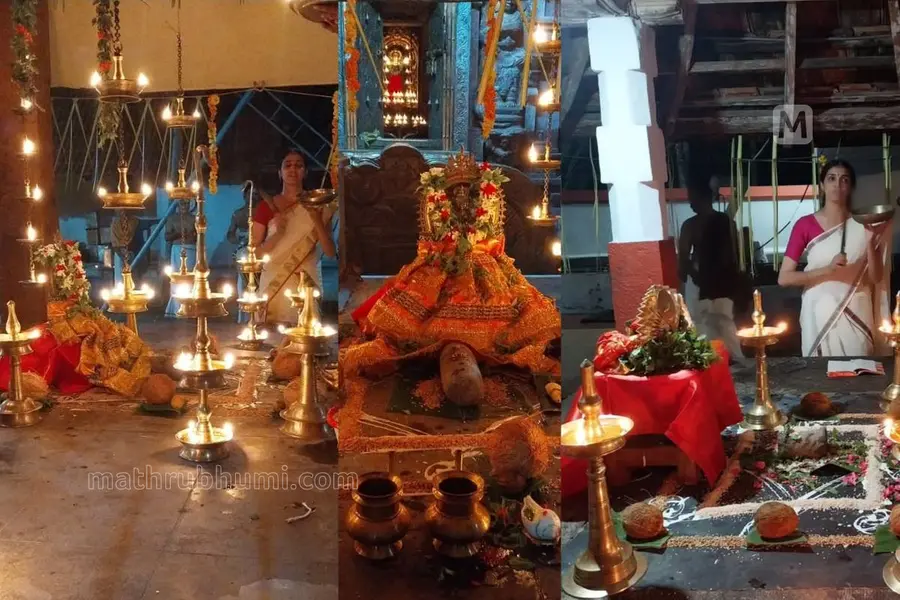
Deep inside Kerala’s temples, there is a sound that often goes unnoticed — a song that resembles chanting, yet carries a deeply ritualistic power. This is Brahmanippattu, a rare sacred art form that survives in only a handful of temples. More than music, it is a spiritual system of invocation, closely tied to devotion, ritual and life’s most significant moments. Saritha Krishnakumar, a singer of this tradition, spoke to ‘Mathrubhumi’ about its evolution and its enduring place in Kerala’s temple culture.
“To many, it sounds like chanting. But Brahmanippattu is a complete ritual musical system. “Whether the deity is Durga or Bhadrakali, each divine form has its own set of songs. The tradition is associated with key stages of life — marriage, emotional healing and sacred offerings,” says Saritha.
Where the goddess is invoked
Brahmanippattu is traditionally sung in goddess temples across mid-Kerala and parts of north Kerala, usually in the ‘namaskara mandapam’ — the structure in front of a temple’s sanctum sanctorum — following a detailed series of ritual preparations. The mandapam is adorned with white cloth and silk cloth. Ritual symbols (padmam, which are the floor designs made from five colored powders) are prepared using natural powders on tender coconut palm leaves and rice flour. A coconut is placed on an 'ammikkallu' (grinding stone) symbolising the sacrificial point, and a mirror is placed inside a kindi (a traditional Kerala water vessel with a spout).
“The goddess is invoked into the mirror — that is the core ritual of Brahmanippattu,” Saritha explains. In some temples, a 'thidambu' (replica of the deity) or the 'ammikkallu' itself is used instead, depending on local customs.
A ritual that unfolds through the day
The song is not completed in a single sitting. It is usually a full-day ceremony, performed in three segments known as madas (time durations): the morning mada after Ushapooja, the afternoon mada after Uchchapooja or before dusk, and the night mada after Deeparadhana. “‘Mada’ refers to time. The song follows the same rhythm as the temple’s puja cycle,” says Saritha. Each segment contains distinct portions, together forming the complete ritual performance.
Language of devotion and poetry
The songs are composed in Manipravalam, a literary blend of Sanskrit and Malayalam. They usually begin with Ganapati Stuti and Saraswati Stuti, followed by hymns to the goddess. “The Ganapati and Saraswati stutis are sung depending on the temple’s tradition,” Saritha notes. If the deity is Durga, her origin story is sung. In Bhadrakali temples, her birth, her battle with Darika and the appeasement of her wrath are rendered through song.
One of the most significant portions of Brahmanippattu is ‘Parvati Swayamvaram’ (the wedding of Goddess Parvati and Lord Shiva), often performed as a vow for marriage. “Because it is sung softly near the sanctum, many people miss it. But when you listen closely, the poetic beauty becomes evident,” Saritha says. The song unfolds in the Keshadipada style, describing the goddess from her hair to her feet.
Manuscripts that preserve the voice
The original texts of Brahmanippattu are believed to have been composed by Mazhamangalam Namboothiri. These were preserved in manuscript form and continue to guide contemporary practitioners. “These were among the earliest written ritual texts. Even today, singers follow the same manuscripts,” Saritha says. There have also been efforts to compile Ganapati, Saraswati and Devi hymns into community publications.
A tradition bound by seasons
Brahmanippattu is not performed year-round. It is traditionally sung only from the Malayalam month of Thulam until the end of Medam. “It doesn’t happen at the same time every year. It depends on the ritual calendar of each household and temple,” Saritha explains.
When voice becomes the major instrument
In certain segments — particularly during the 'pradakshina' (clockwise circumambulation of sacred entities) — instruments such as the chenda are used. However, the primary instrument is the singer, who holds an 'otturuli', a traditional handcrafted bronze vessel, and strikes it with a knife. “The song itself is primarily vocal. Instruments mainly accompany the circumambulation,” she says.
Saritha Krishnakumar singing a small snippet from Parvati Swayamvaram
A chant born of final moments
Brahmanippattu is rendered in a drawn-out, chant-like manner rather than conventional melodic singing. “It is believed that this style developed from songs sung while Namboothiris were bedridden and awaiting death due to illness,” Saritha notes. While individual singers may introduce subtle stylistic variations, the ritual framework and text remain unchanged.
A voice at risk of fading
Often unheard in the inner sanctums of temples, Brahmanippattu remains one of Kerala’s most fragile yet profound ritual traditions — a confluence of devotion, poetry, music and myth. “This must be documented and passed on to future generations,” says Saritha Krishnakumar. “Otherwise, this voice will one day fall silent.”
Published: 07 Feb 2026, 11:09 am IST
ABOUT THE AUTHOR
Related Topics
Disclaimer: Kindly avoid objectionable, derogatory, unlawful and lewd comments, while responding to reports. Such comments are punishable under cyber laws. Please keep away from personal attacks. The opinions expressed here are the personal opinions of readers and not that of Mathrubhumi.