
AI is improving education. It may also be shortening our patience.
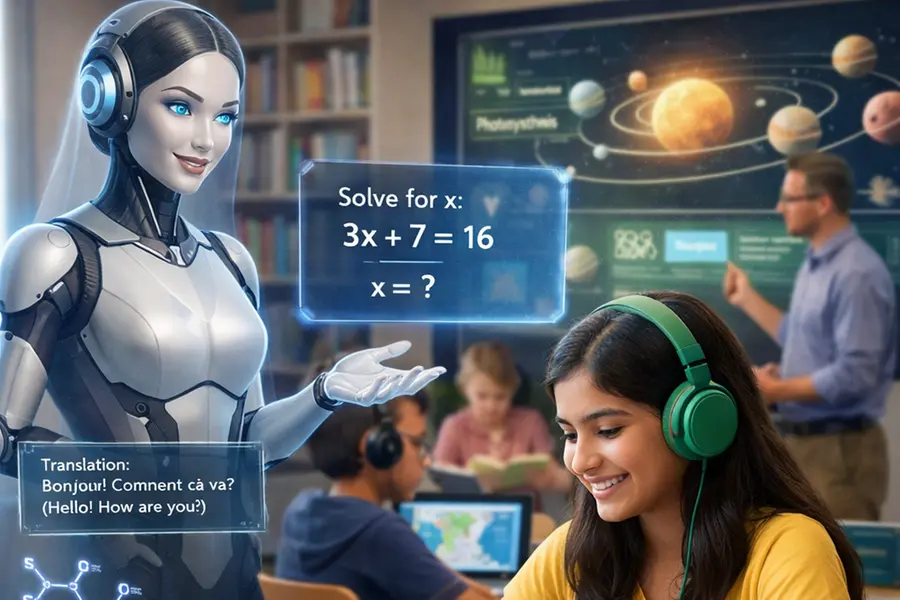
The easiest mistake in the debate on artificial intelligence in education is to pretend it is optional. AI has already entered classrooms. It helps students, adapts content, translates languages, and delivers explanations on demand. In systems facing teacher shortages and uneven quality, its appeal is obvious.
So let us concede the obvious. AI is not the villain of this story. This is precisely why it deserves scrutiny.
For those who went to school before answers became searchable, learning was rarely smooth. This includes late Gen X, millennials, and the early edge of Gen Z who remember textbooks heavy enough to leave a mark on the shoulder. Understanding came slowly. You wrestled with ideas, got stuck in front of others, and learned, often without realising it, that confusion was not failure but part of the process.
The answers lived at the back of the book, delayed by design. You were meant to sit with uncertainty long enough for something to click. When clarity arrived, it felt earned because it had taken time.
Students entering classrooms today inhabit a different learning climate. Many in Gen Z, and almost all of Gen Alpha, use systems designed to remove friction. Questions are answered instantly. Explanations arrive neatly packaged. The pause between not knowing and knowing has nearly disappeared.
This is not a moral difference. It is an environmental one.
Each generation learns using the tools available to it. What has changed now is not just the tool, but how learning feels while it happens.
From a policy perspective, this shift is hard to resist. Governments want scale, consistency, and results that can be measured. In the United States, an executive order signed by Donald Trump pushed AI adoption across public systems, including education, in the language policymakers understand best: competitiveness. In Singapore, AI is being introduced in primary schools early, carefully, and without drama. India, watching from close quarters, is weighing its own pilots, safeguards, and ambitions.
The adults, in other words, are doing their homework.
The more interesting question, however, lies elsewhere. Not in what AI adds, but in what quietly fades when help becomes effortless.
Early signs already point to this trade-off. Research across OECD countries suggests that while digital learning tools improve short-term performance, students who rely heavily on automated assistance struggle more when asked to solve unfamiliar problems on their own. Teachers increasingly describe a pattern of solution dependency: answers arrive quickly, but the reasoning behind them is thinner.
Even students seem aware of this tension. A recent university study found that while most students credit AI with saving time and improving performance, nearly half worry about accuracy and over-dependence. They trust the answer, but not always the habit it creates. When help is always available, effort begins to feel optional. And when effort feels optional, thinking quietly steps aside.
AI’s most convincing trait is not accuracy, but confidence. Even when it is wrong, it rarely sounds unsure. In classrooms, this matters. A smooth explanation can end questioning too early. The risk is not permanent misinformation, but premature certainty. Confusion, as a result, now has a shorter life. Earlier, confusion was something you stayed with. You tried one approach, failed, tried another, and sometimes left the problem for later. In doing so, you learned patience, persistence, and how to be wrong without falling apart.
Today, confusion lasts about as long as a slow internet connection. If an answer does not appear quickly, something is assumed to be broken: the system, the tool, or the learner.
Patience, it turns out, is not a personality trait. It is something learned through repetition.
This pattern is not unique to learning. It appears in material life as well. Many parents who grew up with scarcity worked relentlessly to secure homes, savings, education, and stability so their children would not have to struggle as they did. The intention was protection.
AI makes learning easier, and that is kind. But when everything becomes easy too soon, children lose some chances to learn how to wait and keep trying. Used well, AI can deepen learning. Used carelessly, it can replace it.
That balance was reflected recently by Narendra Modi while speaking to students at Pariksha Pe Charcha. He argued that AI should support learning, not act as a shortcut. Instead of asking a machine to generate summaries or exam-ready notes, he suggested using it to discover books suited to one’s age and interests and then reading those books deeply. Education, he reminded students, is not about scoring numbers quickly, but about shaping one’s life.
This is where the unease around AI in education really sits.
Not in the fear that children will learn less, but in the possibility that they will learn too smoothly. That smoothness may leave them unfamiliar with delay, doubt, and the discipline of staying with a problem when nothing resolves quickly.
Earlier generations did not romanticise this. We simply lived through it. Textbooks enforced it. Teachers allowed it. Silence did its work.
The answers at the back of the book were not just solutions. They were limits. They taught us that understanding had a cost, and that paying it was part of becoming capable.
Today, answers no longer wait.
The question is whether; by removing the wait, we are also removing the quiet training that once came with it. And whether a generation raised on instant clarity will recognise difficulty not as a defect, but as a necessary passage.
Because one day, when no system can help and no shortcut applies, the most valuable skill will not be knowing what to do.
It will be knowing how to stay.
(The author is Regional Provident Fund Commissioner (Kochi & Lakshadweep)
(With inputs from Zara Prakash)
Published: 09 Feb 2026, 09:00 am IST
Related Topics
Disclaimer: Kindly avoid objectionable, derogatory, unlawful and lewd comments, while responding to reports. Such comments are punishable under cyber laws. Please keep away from personal attacks. The opinions expressed here are the personal opinions of readers and not that of Mathrubhumi.
