
As a poet, I should believe in the power of poetry to change lives, but I’m under no illusion
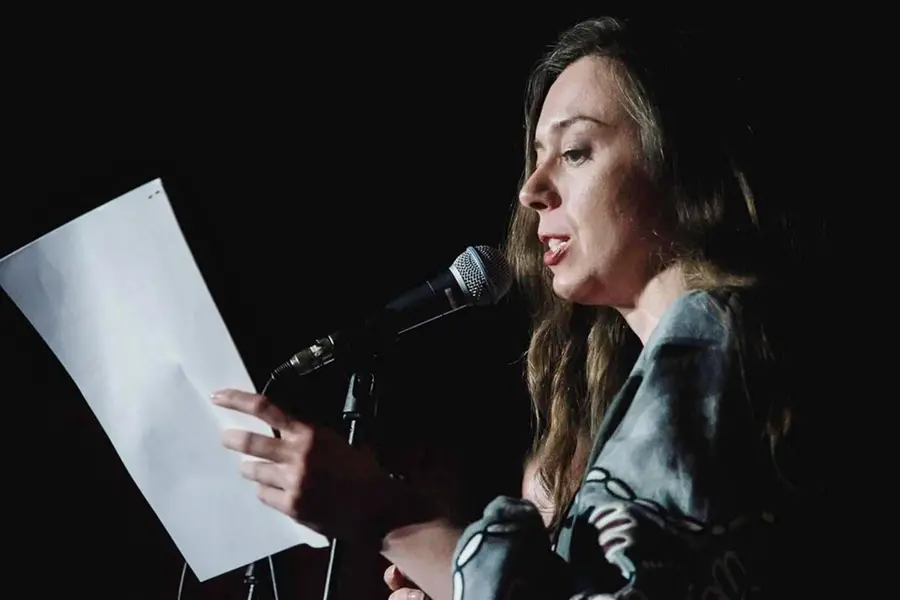
‘They say a poet can change your life,’ a woman tells me in a hotel lift. We’re in Durban, South Africa, where I’m appearing at a poetry festival. ‘Imagine someone is considering suicide. Suddenly, they come across a poem that deeply moves them and they change their mind. Maybe meeting you will change my life.’
As a poet, I should believe in the power of poetry to change lives, but I’m under no illusion. Nevertheless, poetry has become an important way of speaking out about Russia’s war against Ukraine. Ukrainian poetry goes beyond the news stories and clinical statistics; it touches people, makes them feel something. After my reading in Durban, I hear Beverley, a poet from Uganda, telling one of her colleagues, ‘She’s brought the war in Ukraine closer to us through her poetry.’
My friend Roman who has lived in Stockholm for a long time says that poetry heals wounds and saves lives. ‘We’re transforming your poems into tourniquets,’ he adds. That’s arguably the best thing a poem could possibly be. My friend recites my poems at events to raise funds for tactical medical equipment for Ukrainian soldiers. He says he always sees tears in the audience’s eyes, just as I do at my readings. Poetry is an act of the utmost sincerity. The poetry that is recited in Durban, Thiruvananthapuram and San Diego changes perceptions of this war and counters Russian propaganda.
People in Ukraine need poetry too, as a way of voicing and processing collective experience. The need is even greater in small towns than in big cities. As part of a PEN Ukraine project, I travelled with some fellow writers to Derazhnia in the Khmelnytskyi region, where we were taken to a library. On the way there we were offered sincere apologies for the cultural centre’s broken windows: ‘We haven’t managed to replace them since they were shattered by the shockwave from a missile.’ The energetic, inquisitive young people at the event didn’t shy away from painful topics. At a poetry reading, you symbolically take the audience by the hand so that you can shine light on each other in the darkness.
***
In spring 2022, my son and I were hosted by friends abroad. In May, just a few days after we returned to Lviv, the Russians shelled the city. I lay on the bathroom floor, covering my terrified child with my body and listening to the explosions. I cursed myself for coming back and putting him in danger. Then I remembered how unhappy he’d been living far away from his home, his family and his friends. The only one who could cheer him up was our hosts’ White Swiss Shepherd dog.
Lviv is known as a cultural crossroads, and it’s a perfect fit for my family’s tangled roots. My grandfather Volodymyr, an Armenian from Karabakh, was drafted into the Red Army during the Second World War and sent to serve in Lviv when the war ended. He recalls the contempt that the Russians – who usually occupied the higher military ranks – had for other nationalities, especially those from Central Asia and the Caucasus, like him. A typical manifestation of the imperialistic mindset that is still rampant to this day.
The city’s cultural heritage, hospitality and large Armenian diaspora made my grandfather feel at home. It was here that he met my grandmother, a Ukrainian woman who was born in Poland and spent her childhood there. The Soviet policy of aggressive russification meant that they communicated in russian, but mastering the Ukrainian language was a point of pride for my grandfather and a mark of his gratitude to the land that had become his home.
When the Russians launched their full-scale invasion, my grandfather refused to leave, even after the missile strikes on Lviv. He’s almost 100 years old and gets all his news from the radio. My grandfather is now blind, but he sees exactly who the Russians are in this genocidal war. ‘I’m not afraid of them,’ he told me. ‘They’re fascists, just like the ones that I fought against. And fascists always lose.’
***
I remember the first time I stood in front of a packed auditorium outside of Ukraine and said, ‘They’re killing our children. Maiming and raping our children.’
I was in such agonising pain that I thought my heart would shatter. I’d never felt so vulnerable and devastated – or alone.
That was April 2022. We spoke about war crimes at an event dedicated to poetry – I couldn’t speak about anything else. That was when Ukrainian forces drove the occupiers out of the Kyiv region and the world saw the murdered civilians in Bucha, the destruction in Borodianka, the mutilated towns of Irpin and Hostomel.
Since then my poetry has been about war crimes.
***
We live in Lviv, a city close to the Polish border. One day a russian missile killed an entire family here, the Bazylevyches: the mother, Yevheniia, and her three daughters, Yaryna, Dariia and seven-year-old Emiliia. Only the father, Yaroslav, survived. Their home was razed to the ground and 70 other buildings were damaged. This is the murderous game of ‘Russian roulette’ that the aggressor is playing with the entire country.
While Trump was attempting to negotiate a ceasefire, the Russians ramped up their missile strikes on Ukraine. On 4 April, they fired a ballistic missile at a playground in Kryvyi Rih and killed nine children. The youngest, Tymofii, was just three years old. Eleven adults died in the attack too. In Sumy, the Russians killed 35 people, including two children. In the city centre on a public holiday.
As the entire nation suffocates with grief, Ukrainians have to carry on with their daily lives, working, volunteering, defending themselves. Our survival depends on our resilience and solidarity.
***
The world doesn’t want to admit that absolute evil exists. Or that it’s growing like a cancer. This evil has clear intentions rooted in a sense of its own superiority and impunity. This is the origin of the Russian war against Ukraine, and recognising it means accepting the urgent need for change. It means taking on the responsibility of resistance.
My friend, the poet Olena Huseinova, left her job in the capital and moved to Kharkiv, not far from the front line. She now works at Radio Khartiia, telling the story of ‘an army defending its country and a country supporting its army’, while enduring daily shelling. She wanted to be where she was needed most, giving people hope and broadcasting their experiences.
The 24-year-old poet Artur Dron, who has been on the front line since 2022, decided to use his book to raise 1 million hryvnia for children affected by the war. He worked tirelessly despite being injured by a Russian drone and undergoing a series of complex operations. Now he’s raising another million for the charity ‘Holosy Ditei’ (Children’s Voices).
Oleksandr Osadko, who was married to my close friend and fellow writer Hanna, joined the army as a volunteer. His only book, published after his death, is testament to the great writer he could have become. But, like so many of our cultural figures, he made the conscientious decision to defend his family, his home and his people.
Every one of these people chose to serve their country in their own way. Our resilience is a mosaic made up of these tough personal decisions.
***
My next trip to advocate for Ukraine was to Thiruvananthapuram in India. There I read poems by Ukrainian soldiers, alongside my own. The elderly couple with whom I travelled to the festival venue asked where I was from. ‘We didn’t think Ukraine would last three months,’ they replied when I told them, ‘but you astonished us all.’ I recalled the three days that people gave Kyiv at the start of the full-scale invasion.
We refuse to be subjugated or give up our freedom, hard-won by generations of Ukrainians. Never again will we allow anyone to deny our identity or our right to choose our own path – a path of basic human dignity.
On a street in Thiruvananthapuram I passed a wall painted with sunflowers against a background of yellow and blue. This street art was part of the Keraleeyam arts festival, but I like to think it was a symbol of solidarity with Ukraine.
(Translated by Helena Kernan; The author is a poet, writer, and member of PEN Ukraine. Her book The God of Freedom was published by Arrowsmith Press in 2024. This text was created as part of a partnership among PEN Ukraine, UkraineWorld, and the Ukrainian Institute.)
Published: 30 May 2025, 10:34 am IST
Related Topics
Disclaimer: Kindly avoid objectionable, derogatory, unlawful and lewd comments, while responding to reports. Such comments are punishable under cyber laws. Please keep away from personal attacks. The opinions expressed here are the personal opinions of readers and not that of Mathrubhumi.
