
The most striking object I saw inside the museum was a dark wooden reading chair with yellowish-beige fabric. The fabric was torn at the edges, showing its age.
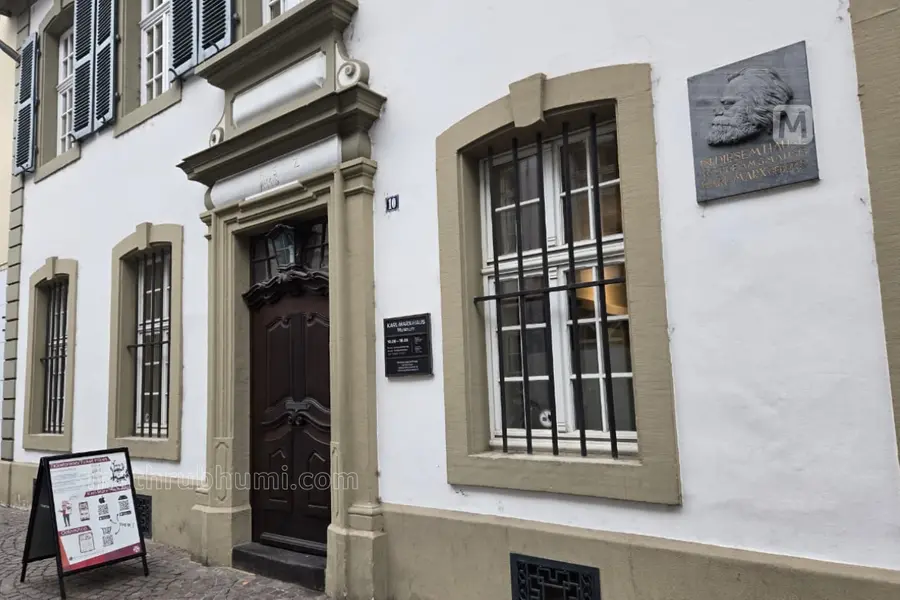
15 months. That's the time Karl Marx spent in this house in Brückenstraße in Trier, Germany. But the building has a place in history because it was here that one of the world's most influential thinkers was born on May 5, 1818. Born in Trier, Marx later lived in several European cities, including France and Belgium, before settling in London.
I visited Karl Marx House during my trip to Trier, and was curious to see what remained of the place where a man whose ideas influenced millions of people around the world had begun his life.
From the outside, the building does not look particularly grand. There is just a small entrance, and nothing about its appearance tells you the importance of the place. But once I stepped inside, I realised that there was much more to see than I had expected.
Through a small doorway, I entered a series of rooms that tell the story of Marx's life, his family, the people who influenced his thinking and the ideas that made him famous. The museum was redesigned in 2018 to mark the 200th anniversary of his birth.
Marx is known in different ways around the world. For some, he is a political icon and a source of inspiration. For others, he represents the darker side of communism. He is also remembered as one of the strongest critics of capitalism. The museum does not simply present him as a historical figure. It encourages visitors to understand his life, his ideas and the impact they continue to have on the world.
The chair where Karl Marx died
The most striking object I saw inside the museum was a dark wooden reading chair with yellowish-beige fabric. The fabric was torn at the edges, showing its age. This was the chair in which Marx is said to have died. He used to sit in it while reading and thinking. Marx died in London in 1883, far from his birthplace in Germany. The chair was brought to the museum from the Marx family's private apartment in London years later. Today, it occupies a central place in one of the rooms.
Another interesting object on display is a pocket watch that Marx used during his revolutionary years. Photographs, historical documents and other exhibits help visitors follow his journey through life.
From Trier to the world
The ground floor takes visitors through Marx's biography, his family tree and the development of his ideas. It also examines how his thinking has influenced the modern world.
His birthplace itself has an interesting history. The building was constructed around 1727. After Marx's family moved out, it passed through the hands of different owners and underwent changes over the years. It was only in 1904 that social democrat Friedrich Schnetter recognised the building as Marx's birthplace. The property was acquired in 1928, and the Karl Marx House was established in 1933. After the Second World War, it was restored with international support. The first exhibition opened here in 1947.
Today, Karl Marx House is run by the Friedrich Ebert Foundation. It is the only museum in Germany dedicated to Marx's life, work and influence.
More than a birthplace
There are no imposing gates or grand structures to announce its importance. You could easily walk past the entrance without realising what the building represents. One does not have to agree with his views to understand why his life and work continue to attract attention. For me, visiting Karl Marx House was an opportunity to connect a name I had known from history books with the actual place where his life began.
Published: 16 Oct 2026, 11:50 am IST
Disclaimer: Kindly avoid objectionable, derogatory, unlawful and lewd comments, while responding to reports. Such comments are punishable under cyber laws. Please keep away from personal attacks. The opinions expressed here are the personal opinions of readers and not that of Mathrubhumi.
