
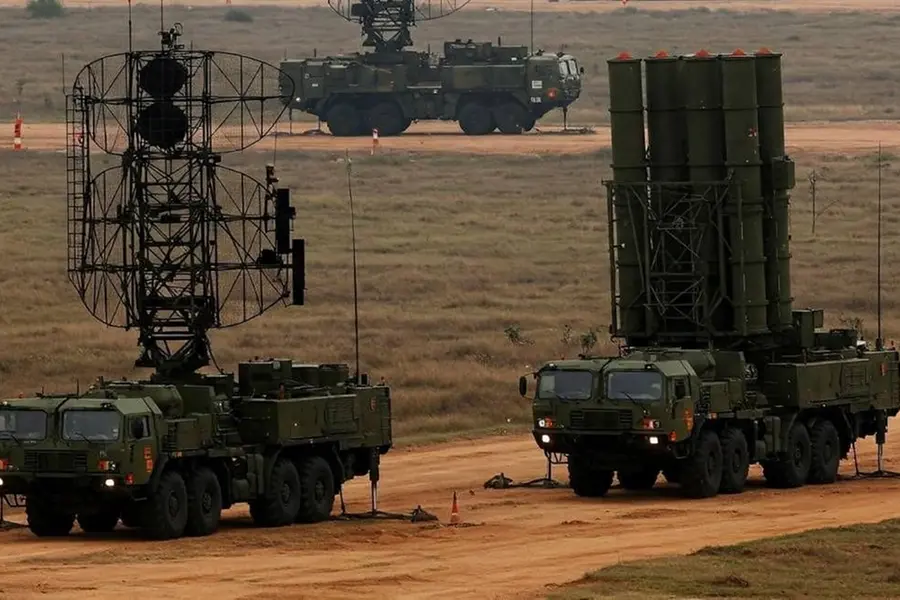
India’s northern skies are lit up, not in celebration, but in confrontation. A wave of hostile drones and aerial munitions launched by Pakistan aimed to disrupt key military and civilian infrastructure in Jammu, Udhampur, and Pathankot. But within moments, the threat was neutralized by India's most sophisticated shield – the S-400 Triumf air defence system, known domestically as ‘Sudarshan Chakra’. This marked the system’s first real-time operational deployment, and it was a resounding success.
But behind this decisive strategic edge are two often understated but visionary architects: Late Defence Minister Manohar Parrikar, and Foreign Minister Dr S Jaishankar. Together, they ensured that India not only acquired one of the world’s most advanced air defense systems, but also preserved its strategic autonomy while doing so.
Parrikar, the strategic realist with a calculated vision
Manohar Parrikar, India’s defence minister from 2014 to 2017, is widely remembered for introducing pragmatic thinking and fiscal discipline into India’s defence procurement processes. At a time when India was still grappling with piecemeal acquisitions of various air defence systems, each with overlapping capabilities and little integration, Parrikar identified the need for a game-changing solution that could offer both comprehensive coverage and future-proof capability.
In a bold strategic move, Parrikar shelved multiple standalone missile procurement programs and instead backed a singular, integrated system that could tackle a wide range of aerial threats, from stealth fighters and cruise missiles to drones and ballistic missiles. That system was Russia’s S-400 Triumf.
His vision wasn't limited to tactical advantage; it was also about cost efficiency and long-term sustainability. By consolidating diverse defence needs into one platform, Parrikar saved the exchequer approximately Rs 49,300 crore in comparative procurement and lifecycle costs.
More importantly, he ensured that India would leapfrog into a top-tier air defence capability bracket on par with global powers like China and Turkey, which had already signed up for the S -400.
Moreover, Parrikar initiated the policy groundwork that made this deal possible like clearing bureaucratic roadblocks, prioritizing inter-agency coordination, and framing the acquisition under India's broader ‘strategic partnership’ with Russia. Even though he passed away in 2019, the S-400 deal stands as a lasting legacy of his forward-thinking leadership.
S Jaishankar: The diplomatic strategist
If Parrikar laid the strategic foundation, Dr S Jaishankar ensured the structure stood tall amid global turbulence. After the deal was signed in 2018 for over $5.4 billion, India came under significant diplomatic pressure from the United States, which was then enforcing its Countering America's Adversaries Through Sanctions Act (CAATSA) to penalize countries buying Russian military hardware. India, a long-time strategic partner of the US, India found itself at geopolitical crossroads.
Jaishankar, with his deep understanding of global power dynamics and nuanced diplomacy, handled the situation with exceptional finesse. During his interactions with US officials, including the Secretary of State, Jaishankar firmly reiterated India’s position that ‘only national interest, not third-party legislation, would dictate its defence choices.’
“We have always maintained the right to make independent decisions on strategic matters. The S-400 deal is aligned with India’s security needs,” Jaishankar said in a widely publicized statement in 2019.
His ability to balance India’s deepening defence ties with the United States, including joint exercises, Indo-Pacific coordination, and technology sharing, while preserving strategic depth with Russia, ensured that the S-400 procurement was neither derailed nor delayed.
To this day, despite intense lobbying and legal threats, India has not been seen sanctions for the S-400 deal. It was a rare diplomatic victory that preserved defence autonomy while maintaining broader geopolitical relationships.
How S-400 changed India’s defence posture
The S-400 is more than a missile system, it is a force multiplier and a deterrence tool. With a range of up to 400 km and the ability to track and engage up to 80 targets simultaneously, it offers India layered defence capabilities against the full spectrum of aerial threats.
During the Pakistani drone incursion in, the S-400 was able to simultaneously detect, lock, and eliminate multiple drones and incoming munitions over the border districts, preventing what could have been catastrophic damage.
Indian military officials confirmed that this real-time interception capability “completely n neutralized the threat without escalation”.
From an operational standpoint, the S-400 has been integrated into India’s broader Integrated Air Command and Control System (IACCS), enabling seamless data-sharing with other radar and missile units. It also covers critical assets like nuclear command centers, airbases, and economic hubs.
India has already received three of the five S-400 regiments, with the remaining two expected by early 2026. Each unit enhances India’s defensive envelope, especially in the context of simultaneous threats from both Pakistan in the west and China in the east.
Strategic Gains for India
1.Credible Deterrence: The operational deployment of the S-400 sends a clear message to adversaries that any aerial adventurism will be met with unmatched precision and speed.
2.Operational Depth: The S-400 extends India’s engagement radius, allowing pre-emptive defence without crossing airspace lines.
3.Technology Exposure: Working with Russia on S-400 deployment has offered Indian scientists and defence planners a deeper understanding of long-range radar, missile tracking, and layered defence systems – skills transferable to indigenous programs like the XRSAM (Extended Range Surface-to-Air Missile).
4.Diplomatic Independence: India’s ability to hold its ground despite US pressure reasserted its place as a sovereign and mature power in global defence diplomacy.
A strategic legacy etched in steel and sky
When the S-400 systems roared to life in India’s defence on that critical morning of 8 May 2025, it was not just a victory of missile over drone, it was a vindication of long-term strategic thinking. It was the moment when visionary leadership from two very different yet complementary domains, defence policy and international diplomacy came together to protect a billion people.
Manohar Parrikar and S Jaishankar may not be the faces we see in radar rooms or control bunkers, but without their resolve, foresight, and execution, the skies above India might have looked very different.
In a world of ever-evolving threats, India's shield stands firm, because two men believed in looking beyond today’s headlines to tomorrow’s battles.
Published: 09 May 2025, 05:49 pm IST
Related Topics
Disclaimer: Kindly avoid objectionable, derogatory, unlawful and lewd comments, while responding to reports. Such comments are punishable under cyber laws. Please keep away from personal attacks. The opinions expressed here are the personal opinions of readers and not that of Mathrubhumi.
