
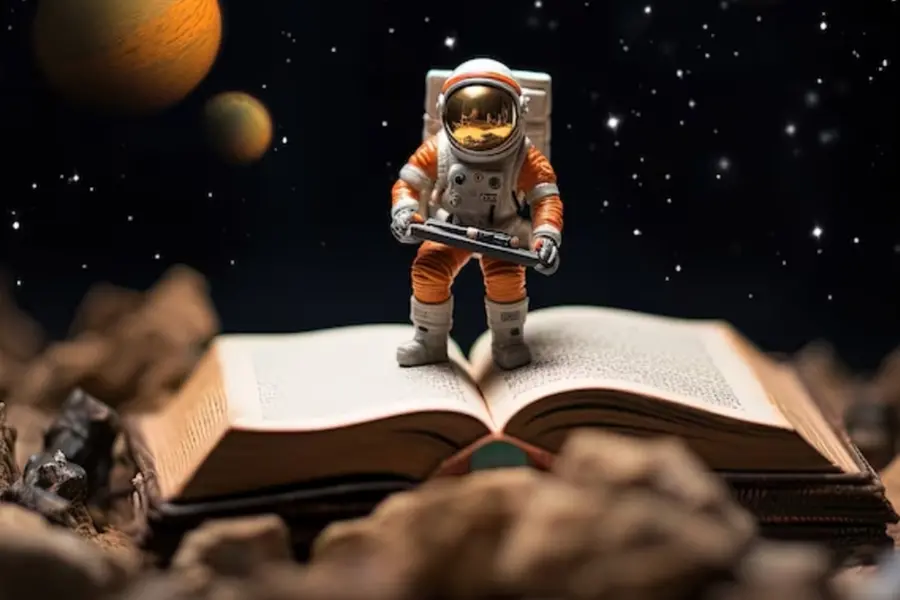
Word of the day: SPACEWALK
Pronunciation
/ˈspeɪs.wɔːk/
Meaning
A spacewalk is the activity of an astronaut exiting a spacecraft and moving outside it while wearing a specialised suit designed for the vacuum of space. Officially termed an Extravehicular Activity (EVA), spacewalks are conducted for tasks like equipment repairs, scientific research, and space station assembly.
Origin
The word spacewalk combines “space” and “walk”, and came into usage during the 1960s, at the dawn of human extravehicular missions. It evokes the image of walking freely in space, untethered from gravity.
History
- First Spacewalk – 1965: Soviet cosmonaut Alexei Leonov performed the world’s first spacewalk on March 18, 1965, from Voskhod 2, remaining outside for 12 minutes. His spacesuit inflated, making re-entry difficult.
- First American Spacewalk – 1965: NASA’s Ed White became the first American to walk in space on June 3, 1965, using a handheld propulsion device during the Gemini 4 mission.
- First Moonwalk – 1969: On July 20, 1969, Neil Armstrong and Buzz Aldrin walked on the Moon during Apollo 11. Armstrong’s famous words: “That’s one small step for man, one giant leap for mankind,” were uttered during this iconic moment.
- Longest Spacewalk – 2001: On March 11, 2001, astronauts Susan Helms and James Voss performed the longest recorded spacewalk — 8 hours and 56 minutes — during NASA’s STS-102 mission aboard the ISS.
- Modern Spacewalks: Today, spacewalks are common aboard the International Space Station (ISS), where astronauts conduct essential repairs, upgrades, and experiments in microgravity.
Examples from books and articles
“It’s like I’m on a spacewalk and somebody is sawing through the tether connecting me to the mother ship.”
— Shine! by J.J. and Chris Grabenstein
“She stayed on her spacewalk for a couple of days, floating around the bubble, making crazy faces at its mirrored exterior.”
— Down and Out in the Magic Kingdom by Cory Doctorow
Synonyms
- Orbital walk
- Zero-gravity walk
- Astronaut walk
Published: 12 Apr 2025, 07:00 am IST
Related Topics
Disclaimer: Kindly avoid objectionable, derogatory, unlawful and lewd comments, while responding to reports. Such comments are punishable under cyber laws. Please keep away from personal attacks. The opinions expressed here are the personal opinions of readers and not that of Mathrubhumi.
