
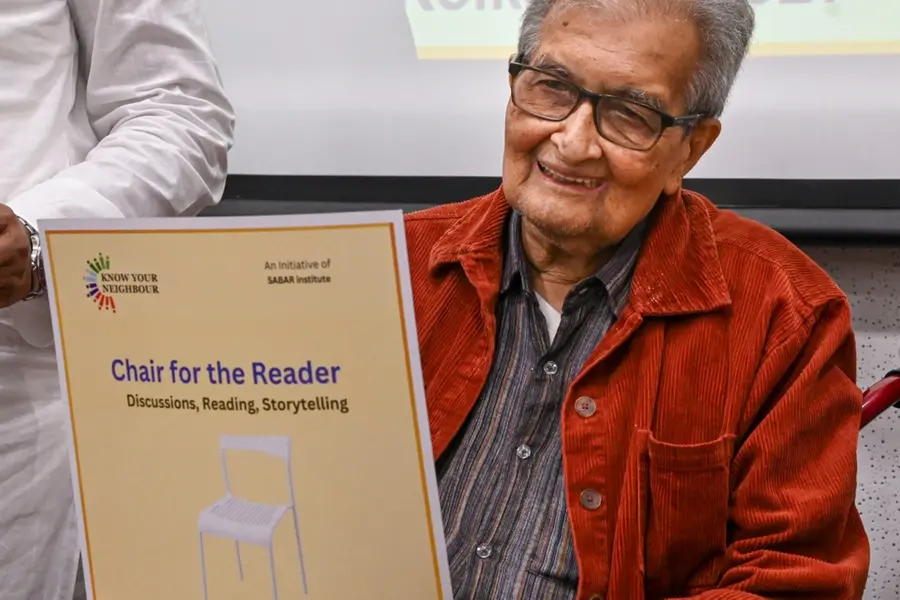
West Bengal: There exist loftier aspirations in life beyond winning the Nobel Prize. At least, one would hope so. This sentiment is shared by Nobel laureate Amartya Sen, renowned as a philosopher, economist, and advocate for welfare. He regards the Nobel Prize as a “nice thing to have”, yet believes his life would have been meaningful even without it.
The monetary award from the prize enabled Sen to establish Pratichi Trust, a research-focused charity dedicated to children's education and healthcare. "Nobel is an award I received but I don't think my life would have been wasted even if I didn't get it. It was nice to have received it. I got some money and could start a charity called Pratichi Trust involving education and healthcare elements of children… There's also a little bit of luck involved in whether or not you end up getting one of these prizes... I do not think I had a goal to get the Nobel or any other prize for that matter," Sen reminisced.
Sen was honoured with the Sveriges Riksbank Prize in Economic Sciences in 1998 for his contributions to welfare economics and social choice theory, alongside his dedication to alleviating poverty.
"When the Nobel award came my way, it also allowed me to do something immediate and practical about my old obsessions, including literacy, basic health care and gender equity, aimed specifically at India and Bangladesh. The Pratichi Trust, which I have set up with the help of some of the prize money, is, of course, a small effort compared with the magnitude of these problems. But it is nice to re-experience something of the old excitement of running evening schools, more than fifty years ago, in villages near Shantiniketan," Sen states.
Reflecting on his childhood, Sen, a recipient of the Bharat Ratna, reminisced about moving from Dhaka to Bolpur at seven years old. He studied at Patha Bhavana, an institution for primary and secondary education in Shantiniketan founded by Rabindranath Tagore, while living with his grandparents.
"I was born in Shantiniketan but was not here immediately, because we were staying in Dhaka. That's the city I come from. I moved back to Shantiniketan at the age of seven and enrolled as a student here, staying with my grandparents. My father, Ashutosh Sen, was a professor of Chemistry at Dhaka University. I used to go there during my holidays," he recounted.
Sen credited his upbringing in Bolpur, education at Patha Bhavana, and the influence of his parents for shaping his extensive body of work and numerous publications.

"There must be. But I suppose it would be easier for somebody else to connect the dots than for me to diagnose. I think some of the ideas that got attached to (my works) came from my childhood," he said.
Regarding his early attachment to Gurudev Tagore, Sen hinted that while he never aspired to be a poet like Tagore, he deeply appreciated Tagore's profound and personal influence on his life.
"I couldn't have been a poet like Rabindranath because I do not like poetry. Anyway, I think my family was quite close to the Thakur poribar (family) and my mother was very close to Tagore and his painter-nephew Abanindranath… Rabindranath gave me my name. Immediately after my birth, he sent a letter to my mother saying that 'you should find a name which is new'. And he proposed 'Amartya', and that seemed to have been decisive," he said.
When asked about his closer bond between his parents, Amita and Ashutosh, Sen acknowledged both had a lasting impact on his life.
"That's a tough competition. I think I was close to both of them. My mother was a writer, an editor and a dancer in traditional Indian schooling, Bharatnatyam, Manipuri. Tagore was very keen on dance dramas and she took a leading part in some of them. My mother was also interested in learning from abroad in Shantiniketan school and became a judo expert. It was interesting that there was women's liberation within the family.
"My father was a very successful teacher of Chemistry and he tried to rise above the Hindu-Muslim division that was going on at that time. He had a very clear notion that he wanted a united India. So, I have learned a lot from both of them. I've been interested in politics since my childhood. And I got input from both sides of my family," he said.
About his future plans, Sen said, "I can tell you that winning a race in running is not part of my plan. I like reading and writing. I enjoyed poetry a lot when I was young although I never wrote any. I'm glad that I didn't. I don't know what it would have been… I don't know how many years more I have left. Whatever time I have, I think I could enjoy myself by reading again and again to find out what's happening in the world. And at the same time, (I will) try to contribute by expressing my thoughts about them. I have never been shy of expressing my views even when they were quite different from that of others," he concluded.
Agencies
Published: 14 Jul 2024, 01:30 pm IST
Related Topics
Disclaimer: Kindly avoid objectionable, derogatory, unlawful and lewd comments, while responding to reports. Such comments are punishable under cyber laws. Please keep away from personal attacks. The opinions expressed here are the personal opinions of readers and not that of Mathrubhumi.