
AI boosts farm productivity in Karnataka and Maharashtra, offering scalable solutions across India.
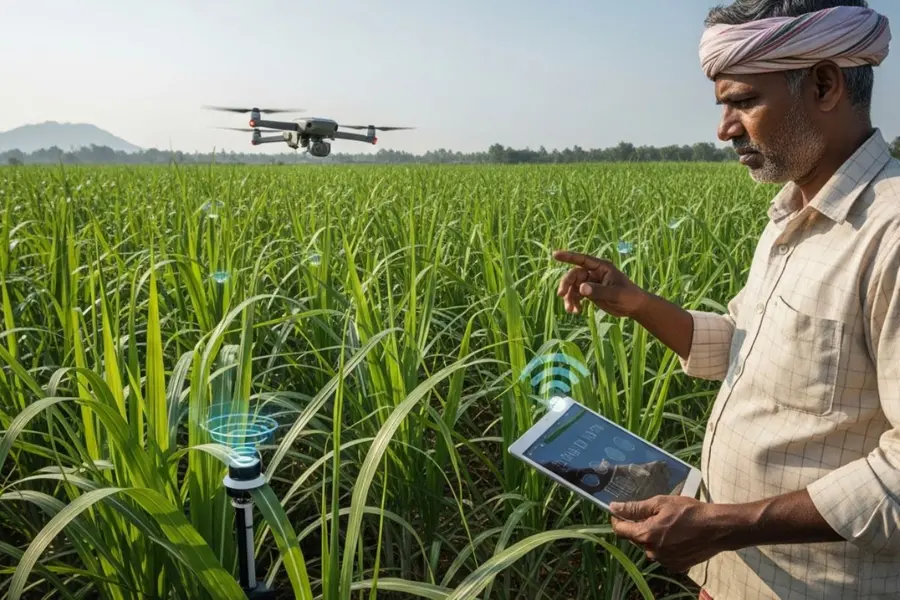
Artificial Intelligence (AI) is transforming agriculture in Karnataka and Maharashtra, giving farmers sharper tools to boost productivity and reduce waste. From sugarcane belts to national-scale strategies, AI is reshaping how India grows food.
Precision farming doubles yields in Karnataka and Maharashtra
Sugarcane growers in Karnataka’s Tadakal and nearby Aland taluk are seeing nearly double yields thanks to AI-guided cultivation. For the first time in the state, farmers are using sensors and AI analytics to optimise irrigation and nutrient use, cutting costs by 30–40 per cent.
Farmers have adopted technology pioneered in Baramati, Maharashtra. IoT sensors measure soil moisture, canopy health, leaf wetness, and crop growth, feeding real-time data to AI systems. Satellite monitoring and local weather stations inform irrigation schedules, nutrient supply, and pest control. Farmers also adjusted planting methods, spacing sugarcane six feet apart instead of three, improving air circulation, sunlight penetration, and photosynthesis.
Some farmers reported a 40 per cent yield increase and significant water and fertiliser savings using drip irrigation combined with AI analytics. NSL Sugars is supporting growers with upfront cultivation costs and training, aiming to expand AI adoption across more fields.
India positions AI as the backbone of agriculture
At the recent AI4Agri Summit in Mumbai, Union Minister of Science and Technology and Earth Sciences, Dr. Jitendra Singh, outlined how AI can tackle long-standing challenges in Indian farming such as erratic weather, information gaps, and fragmented markets. He highlighted initiatives including BharatGen’s Agri Param model, which provides advisory support in 22 Indian languages, making AI accessible to farmers across the country.
Dr. Singh also explained the integration of drones, satellite mapping, and climate intelligence to strengthen soil health monitoring, early warning systems, and pest detection. State-level projects, like Maharashtra’s ₹500-crore MahaAgri-AI Policy, are examples of scalable AI solutions, while the upcoming Bharat-VISTAAR platform will deliver customised guidance via mobile phones and farm machinery, even in remote areas.
Dr. Singh projected that India’s 140 million farm holdings could collectively generate ₹70,000 crore annually if AI-enabled advisories save each farmer even ₹5,000 per year. Plans for a federated national architecture will link state initiatives, research networks, and data commons, creating a standardised, scalable ecosystem. Investors were urged to back platforms rather than isolated pilots to ensure AI delivers real benefits on the ground.
With AI, Indian agriculture is moving from reactive practices to data-driven decision-making, turning fields into precision landscapes where every drop of water and nutrient counts.
Published: 25 Feb 2026, 07:15 pm IST
Related Topics
Disclaimer: Kindly avoid objectionable, derogatory, unlawful and lewd comments, while responding to reports. Such comments are punishable under cyber laws. Please keep away from personal attacks. The opinions expressed here are the personal opinions of readers and not that of Mathrubhumi.
