
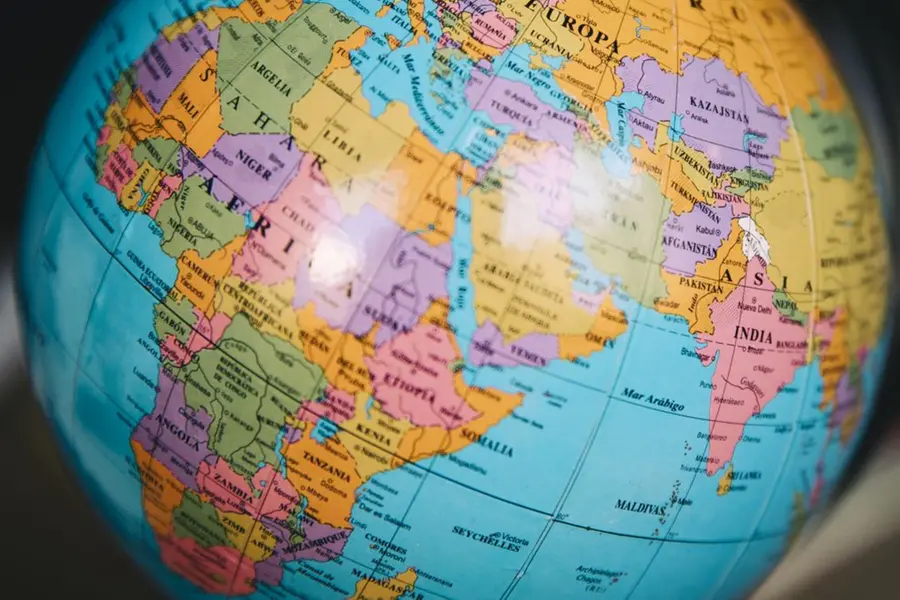
In the dry, arid Ethiopian desert land, a mysterious shift -- barely noticed by the human civilization that populates the area -- has been occurring since 2005. A new ocean is being created in East Africa through changes in the tectonic plates -- huge segments of the Earth’s crust that move on top of the semi-fluid mantle underneath -- in the Afar Triangle, causing the African, Arabian and Somali plates to drift apart.
The solid outer part of the Earth, known as the lithosphere, is separated into several tectonic plates, which are constantly moving. The movement of tectonic plates has, over millions of years, led to the break-up of continents and creation of new ones.
Dr Kangna Yadav, managing director at the CERT Group & Shree Ram Group of Institutions, Hospitals and Schools quotes Science Direct in her LinkedIn post, as saying that 'rifting' is when a single tectonic plate breaks up into two or more plates separated by divergent boundaries. A lowland area, or ‘rift valley’, appears where tectonic plates move away from each other, according to National Geographic.
For millions of years, the Arabian plate has slowly, but surely, been separating from the African continent, even as the Somali plate drifts away from the African plate, peeling its way through the East African Plate. This intricate system of rifts, faults and volcanic activity—which started forming roughly 30 million years ago, although its effects are continuing till the present day—has been shaping the African landscape for millions of years and is known to have created some of the continent’s most iconic landmarks, including the peaks of Mount Kilimanjaro and Mount Kenya.
A plume of super-heated rock is raising its head beneath the East African mantle to create this rift. Called the ‘East African Rift System’ (EARS), this crack extends over 3,500 kilometres (2,174 miles) from the Red Sea in the north to Mozambique in the south-east, stretching across Ethiopia, Kenya, Tanzania and beyond -- marked by the drift of the Nubian, Somali and Arabian tectonic plates.
This tectonic shift is causing Earth's crust to break, and forming valleys and ridges, in the process, giving rise to volcanic activity. Ethiopia's Erta Ale volcano offers clues to how active tectonic shifts occur. Geographical Positioning Systems (GPS) and satellite radar have indicated ground movements, with the African plates drifting apart by up to 0.5 inches each year.
This intricate interaction between diverse geological forces could potentially lead to the formation of Earth’s sixth ocean containing 10,000 billion gallons of water! It is not only an amazing geological phenomenon, but may also lead to many countries vanishing off the face of the Earth, thus drastically changing both the socio-economic and political map of our planet. The shifts in the tectonic plates will displace, and realign, flora and fauna, thus threatening biodiversity.
Seismic activity caused a major fissure in Ethiopia in 2005, followed by another in Kenya in 2018. Several media reports quote marine geophysicist and Professor Emeritus at the University of California, Ken Macdonald, as saying that the Gulf of Aden and the Red Sea will, ultimately, swamp the Afar region (and the East African Rift Valley), forming the world’s sixth ocean and creating a new land mass in East Africa.
When the split is completed, a new continent -- separate from Africa -- will be created, comprising such countries as Somalia, Kenya and Tanzania. Landlocked Ethiopia, Zambia and Uganda, for instance, could gain coastlines. This could throw up new economic opportunities, by offering scope for new maritime trade routes, ports and eco-diversity.
But, although this would vastly alter the region’s coastlines, climate patterns, human settlements and ecosystems -- both land and marine -- the reassuring fact is that this ocean that we talk about could take between one and five million years to take shape. Earlier, it was believed that the full separation could take up to tens of millions of years.
Indian Plate Hypothesis
A fascinating aspect of the East African rift is the idea that it may, ultimately lead to the continent splitting, and merging with the Indian subcontinent, says Dr Yadav. This theory, known as the ‘East African Rift System-Indian Plate boundary hypothesis’, is based on several pieces of evidence—geological observations, geophysical data and computer models.
The Indian Plate is currently moving northward and colliding with the Eurasian Plate at a rate of about 5 centimetres each year, resulting in the formation of the Himalayas. But some geologists believe the Indian Plate may eventually shift direction and start moving towards the East African region. The Indian Plate could then collide with the Somali Plate, creating a new mountain range, and may lead to the break-up of the continent.
And Earth’s Secret Ocean
Besides the ocean that is emerging in East Africa, studies suggest, a huge, hidden reservoir of water exists deep inside Earth’s mantle, according to The Economic Times, quoting research published in Nature Geoscience. This trapped reservoir is locked within minerals in the transition zone between the upper and lower mantles, between 410 kilometres and 660 kilometers below Earth’s surface.
This underground storehouse of water is trapped inside a blue rock formation situated deep within Earth’s mantle, known as ‘ringwoodite’ -- a mineral that forms in Earth’s mantle under extreme pressure and temperatures. Unlike surface water, this pool of water makes the mantle region extremely water-rich, although it does not exist in liquid form.
These discoveries underscore the mercurial nature of Earth’s geology and the hidden potential of water resources deep within the womb of the planet that have the capacity to change both ecology and economy on Earth as we know it.
Published: 18 Feb 2025, 10:43 am IST
Disclaimer: Kindly avoid objectionable, derogatory, unlawful and lewd comments, while responding to reports. Such comments are punishable under cyber laws. Please keep away from personal attacks. The opinions expressed here are the personal opinions of readers and not that of Mathrubhumi.
