
The report found that 27% of children worldwide who are one year below the official primary school entry age are already enrolled in primary education
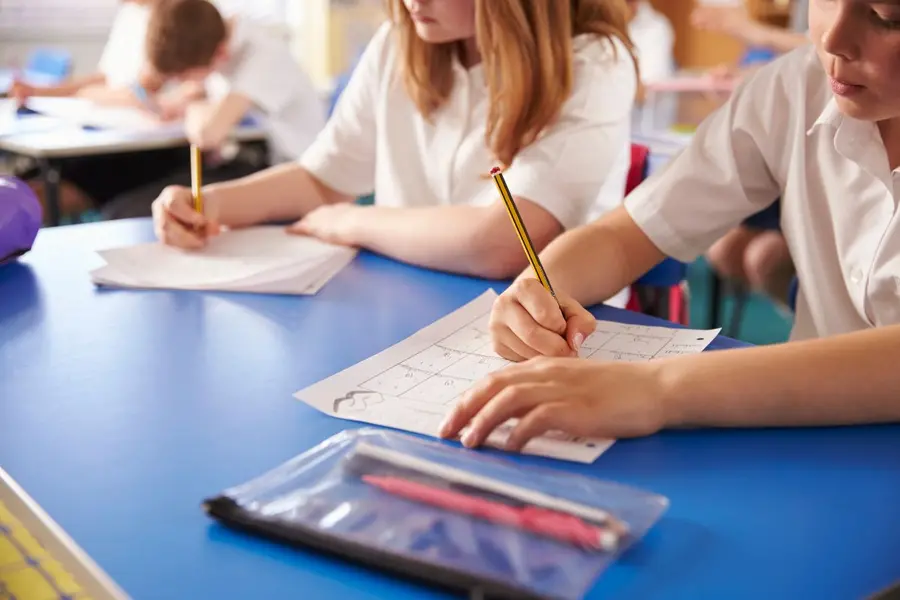
More than half of India's five-year-old children are enrolled in primary school instead of pre-primary education, raising concerns about whether children are entering formal schooling before the recommended age of six, according to UNESCO's 2026 Global Education Monitoring (GEM) report released on Friday.
The report found that 27% of children worldwide who are one year below the official primary school entry age are already enrolled in primary education. India accounts for much of this trend, with 51% of five-year-olds attending primary school rather than pre-primary education.
Also Read

The report suggested that the proportion may have increased during the COVID-19 pandemic, when early childhood education services faced significant disruptions.
Primary school enrolment among young children rises
Data from India's Unified District Information System for Education Plus (UDISE+), maintained by the Union education ministry, showed a rise in the share of children under six enrolled in primary rather than pre-primary education. The proportion increased from around 35% in 2019 and 2020 to 41% in 2021 and 60% in 2022.
These figures do not include children attending Anganwadi centres or private kindergartens.
However, UNESCO cautioned that early entry into primary school does not necessarily mean children have missed preschool education. The proportion of students entering Class 1 with prior preschool experience rose from 41% in 2019 to 80% in 2025, indicating that many children may have attended preschool before starting primary school.
The report also highlighted structural challenges in early childhood education in Bangladesh, India and Pakistan. In India, responsibility for early childhood education is divided between Anganwadi centres under the Ministry of Women and Child Development and pre-primary classes being introduced by state education departments.
According to UNESCO, this fragmented system weakens quality assurance and limits efforts to implement a consistent curriculum.
What is India's policy on school admission age?
The findings come as India implements the National Education Policy (NEP) 2020, which places children aged three to eight in the foundational stage of education.
The framework includes three years of preschool education, followed by Classes 1 and 2. It recommends that children enter Class 1 at the age of six.
In February 2023, the Union education ministry directed states and Union territories to align the minimum age for Class 1 admission with the six-plus-year norm.
The government has also introduced Bal Vatika programmes in Kendriya Vidyalayas (KVs). In July 2021, it launched Vidya Pravesh, a three-month, play-based school preparation module designed to help children transition into Class 1.
However, the implementation of the recommended admission age continues to vary across states.
UNESCO highlights measures to improve early learning
The GEM report cited evidence from India showing that targeted interventions can improve access to preschool education and learning outcomes.
In rural Karnataka, scholarships covering preschool fees increased participation by 20 percentage points, with cognitive gains continuing through Grade 1. Research in India also found that adding part-time staff to preschools increased instructional time and improved the quality of education.
International examples highlighted in the report include Uzbekistan, which tripled preschool enrolment in seven years, and Azerbaijan, which brought access to preschool education for five-year-olds close to universal levels within five years.
The findings underline the need to expand access to quality pre-primary education while ensuring that children enter formal schooling at the recommended age.
Global out-of-school numbers rise
The report also raised concerns about global access to education, estimating that 273 million children, adolescents and young people were out of school in 2024. This was 3% higher than in 2015.
The number of out-of-school children and young people has risen for seven consecutive years, following a 33% decline between 2000 and 2015.
In higher education, India's NEP 2020 aims to increase the gross enrolment ratio from around 24% in 2024 to 50% by 2035.
The report's findings highlight the continuing challenge of ensuring that improvements in enrolment translate into equitable access to quality education at every stage.
Published: 09 Oct 2026, 11:03 am IST
Related Topics
Disclaimer: Kindly avoid objectionable, derogatory, unlawful and lewd comments, while responding to reports. Such comments are punishable under cyber laws. Please keep away from personal attacks. The opinions expressed here are the personal opinions of readers and not that of Mathrubhumi.