
Teachers, parents, and evaluators report workflow issues, technical glitches, and rising re-evaluation requests after implementation
New Delhi: Central Board of Secondary Education (CBSE) may have proceeded with the rollout of its on-screen marking (OSM) system for Class 12 board examinations this year without fully acting on suggestions from members of its governing body, who had reportedly called for pilot testing across regional offices before implementation, according to reports from HT.
Instead, the board conducted a limited two-day exercise involving only 100 teachers at five Delhi schools in January. Teachers who participated in the exercise reportedly said they had advised CBSE against proceeding with the rollout, citing the need for improved features, extensive training, and additional time to adapt to the system.
The OSM system is now facing widespread criticism, with evaluators alleging that it introduced an unfamiliar workflow, resulted in poor-quality scans of answer scripts, and in some cases recorded marks incorrectly. Parents have also raised concerns that answer sheets were mixed up.
CBSE formally announced the implementation of OSM on February 9, just a week before the Class 12 examinations began on February 17. The board later conducted demonstrations, webinars, and mock evaluations, which school principals and evaluators described as procedural formalities rather than structured nationwide training for a major shift in examination evaluation practice. Actual evaluation work under OSM began on March 7, according to CBSE officials.
Governing body minutes flag suggested pilot projects
According to reports from a governing body meeting held in June 2025, members had suggested that OSM “may be implemented in all subjects only after completion of pilot projects in some subjects across various regional offices of the board”. The governing body had “noted the suggestion”. CBSE operates through 22 regional offices, but no such pilots were conducted before this year’s rollout.
Teachers involved in the January dry run told HT that they had warned CBSE the system required further refinement.
“We told officials that OSM required at least a year or two of proper training before rollout. During evaluation from March 7 onwards, many teachers were unfamiliar with the software and effectively learnt while evaluating live answer scripts,” said a teacher from a Delhi school who participated in both the dry run and the live evaluation.
Training measures and evaluation timeline
CBSE conducted a nationwide webinar on OSM on February 13, attended by schools and teachers across the country. The board opened its training portal on February 15, allowing evaluators to practise using previous years’ answer books.
At a press conference on May 17, officials said nearly 300,000 teachers had logged into the portal for training, while around 77,000 ultimately participated in evaluation.
However according to HT reports, a second evaluator told that teachers were under pressure from CBSE to complete checking quickly so results could be declared on time and the digital rollout could be presented as successful.
“Teachers had daily targets. Speed mattered more than careful reading,” said a private school principal.
Evaluators flag digital donstraints and workflow challenges
Teachers involved in evaluation said the screen-based marking system created practical difficulties compared with traditional paper-based assessment.
“In manual checking, you can flip pages, revisit answers and catch missed steps. On screen, answers can be overlooked easily,” said a physics teacher involved in evaluation.
A mathematics teacher said fatigue from prolonged screen time also affected step-marking accuracy.
“Some evaluators were still figuring out the software while checking live answer books. With physical copies, unusual handwriting or answers written in corners are easier to notice. Digitally, they can be missed,” the teacher said.
Technical glitches acknowledged by CBSE
CBSE did not respond to a specific query on why no region-wise dry run was conducted. Instead, officials referred to the May 17 press conference, where they said a nationwide webinar was held on February 13 and the training portal was opened on February 15 for practice on previous years’ answer books.
Officials also acknowledged at the same press conference that OSM faced initial technical glitches, including login failures, system overload, and scanning issues.
Out of 9,866,622 answer books evaluated this year, 68,018 had to be rescanned due to poor image quality, while 13,583 were assessed manually after repeated scanning attempts failed to produce legible copies.
Surge in revaluation requests and student concerns
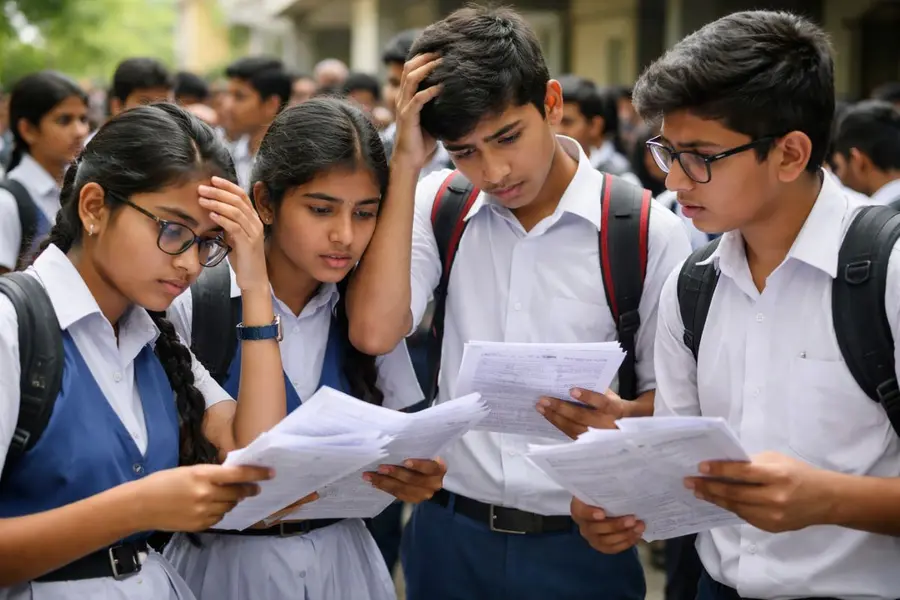
The scale of student concern has been reflected in post-result data. As of May 26, CBSE had received 404,319 applications requesting scanned copies of 1,131,961 Class 12 answer books. This marks a rise of over 208% in applications and 301% in answer-book requests compared with the previous year.
CBSE attributed the increase to a sharp reduction in fees announced on May 17, which cut the cost of a scanned copy from ₹700 to ₹100 per subject.
However, students, parents, and school principals told that the surge also reflected growing anxiety over evaluation quality, especially after the Class 12 pass percentage fell by 3.19 percentage points to 85.20%, the lowest since 2019.
Case of mismatch and earlier pilot experience
Concerns about accuracy have also emerged in individual cases. In one widely reported incident, Class 12 student Vedant Shrivastava alleged that the physics answer sheet uploaded under his roll number did not belong to him. CBSE later acknowledged the error and provided the correct sheet.
CBSE had previously piloted OSM in 2014 for select Class 10 subjects across regions and two Class 12 subjects in Delhi, but the initiative was scaled back due to scanning and connectivity limitations.
Despite the current controversy, officials stated at the May 17 press conference that OSM would continue for next year’s board examinations.
Former CBSE chief flags need for stronger preparation
Former CBSE chairperson Ashok Ganguly said the initiative was promising but required significantly better preparation.
Pending distribution of scanned copies ahead of re-evaluation
Several students are still awaiting receipt of their scanned answer copies ahead of the re-evaluation window, adding to ongoing concerns over the implementation and reliability of the CBSE’s on-screen marking system for Class 12 examinations.
With agency inputs
Published: 27 May 2026, 08:23 am IST
Related Topics
Disclaimer: Kindly avoid objectionable, derogatory, unlawful and lewd comments, while responding to reports. Such comments are punishable under cyber laws. Please keep away from personal attacks. The opinions expressed here are the personal opinions of readers and not that of Mathrubhumi.
