
The sinking of the Merkury comes at a time when the Russia-Ukraine war is increasingly spilling beyond Europe’s borders.
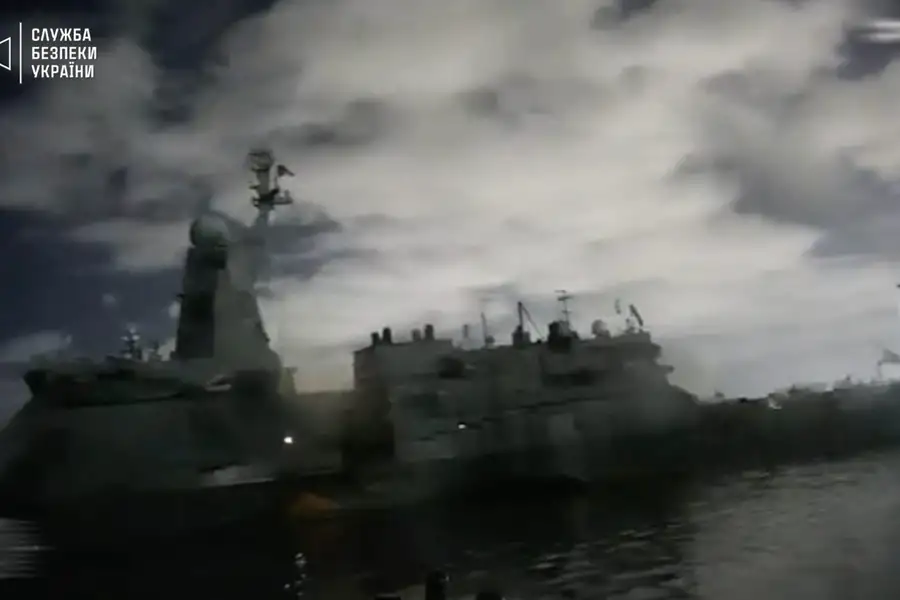
Ukraine has claimed one of its most dramatic strikes yet against Russia’s navy, saying its forces sank the Russian corvette Merkury in the Libyan port of Benghazi using seven domestically-made naval drones. The operation, confirmed by President Volodymyr Zelenskyy on Monday, marks the first official acknowledgement that Ukraine has carried out an attack in Libya.
The strike, carried out on Sunday, November 22, also hit a Russian military-linked cargo ship, the Angara, in the Gulf of Finland. The twin operations underscore Ukraine’s growing ability to project force far beyond its own borders, striking Russian assets in distant theatres.
Ukraine’s Security Service (SBU), working jointly with the country’s Defence Forces, deployed seven Ukrainian-made naval drones against the Merkury while it was moored at the Benghazi Naval Base in eastern Libya.
The drones, described as uncrewed, explosive-laden boats, slammed into the side of the corvette. Video released by Ukrainian authorities shows several of the drones striking the ship.
Despite Russian attempts to counter the attack, the Merkury was sunk. Zelenskyy announced the outcome on Telegram, calling it an “exemplary Ukrainian operation.”
The corvette that went down
The Merkury is a Project 20380 corvette, hull number 734, and one of Russia’s newest warships, commissioned in 2023.
The vessel was 344 feet long and was carrying a Ka-27 multi-purpose combat helicopter at the time of the attack. Both the corvette and the helicopter were destroyed.
Satellite imagery taken by US commercial provider Planet and reviewed by Defense News showed the ship ablaze in the port of Benghazi, with a long smoke trail. Additional satellite images shared by open-source investigators appeared to confirm that the ship had been sunk.
Imagery taken on Sunday showed that most of the vessel had capsized and sunk, with only its bow still visible above water.
A strike far from the front lines
The attack took place near the Libyan port of Benghazi, some 1,500 miles from the established front lines of the Russia-Ukraine conflict.
This is the first time Ukraine has officially acknowledged carrying out an attack in Libya. The operation marks a significant expansion of the war’s geographic reach, taking the fight to Russian assets in North Africa.
The strike on the Angara cargo ship in the Gulf of Finland, carried out a day earlier, further underlines Ukraine’s ability to hit Russian-linked targets across multiple theatres.
What it means for Russia
The loss of the Merkury is a blow to Russia’s naval prestige. The corvette was one of the country’s newest warships, commissioned during the full-scale war in 2023.
The destruction of the Ka-27 helicopter adds to the damage. The helicopter was a multi-purpose combat aircraft, and its loss alongside the corvette represents a double blow to Russian naval and air capabilities in the region.
The strike also raises questions about the security of Russian naval assets in distant ports. If Ukrainian naval drones can reach and sink a corvette in Benghazi, the reach of Ukraine’s drone campaign is no longer limited to the Black Sea or the Baltic.
What it means for Ukraine
For Ukraine, the operation is a major propaganda and strategic win. It demonstrates the country’s ability to strike Russian assets far from the front lines, using domestically produced technology.
The use of seven naval drones in a single operation shows the scale and sophistication of Ukraine’s unmanned maritime capabilities. The drones were able to penetrate a port, evade or overcome Russian countermeasures, and sink a modern warship.
The operation also sends a message to Russia and its partners: Ukrainian forces can reach Russian assets wherever they are moored, even in ports far from the traditional theatre of war.
The bigger picture
The sinking of the Merkury comes at a time when the Russia-Ukraine war is increasingly spilling beyond Europe’s borders.
Ukraine’s ability to strike Russian-linked targets in Libya and the Gulf of Finland suggests a widening conflict, with both sides projecting force into new theatres.
For Russia, the loss of a modern corvette and a combat helicopter in a distant port is a setback. For Ukraine, it is a demonstration of reach, resolve and technological capability.
The war is no longer confined to the front lines. It is now being fought in ports, on the high seas and across continents.
Published: 23 Nov 2026, 06:42 pm IST


ABOUT THE AUTHOR

Related Topics
Disclaimer: Kindly avoid objectionable, derogatory, unlawful and lewd comments, while responding to reports. Such comments are punishable under cyber laws. Please keep away from personal attacks. The opinions expressed here are the personal opinions of readers and not that of Mathrubhumi.