
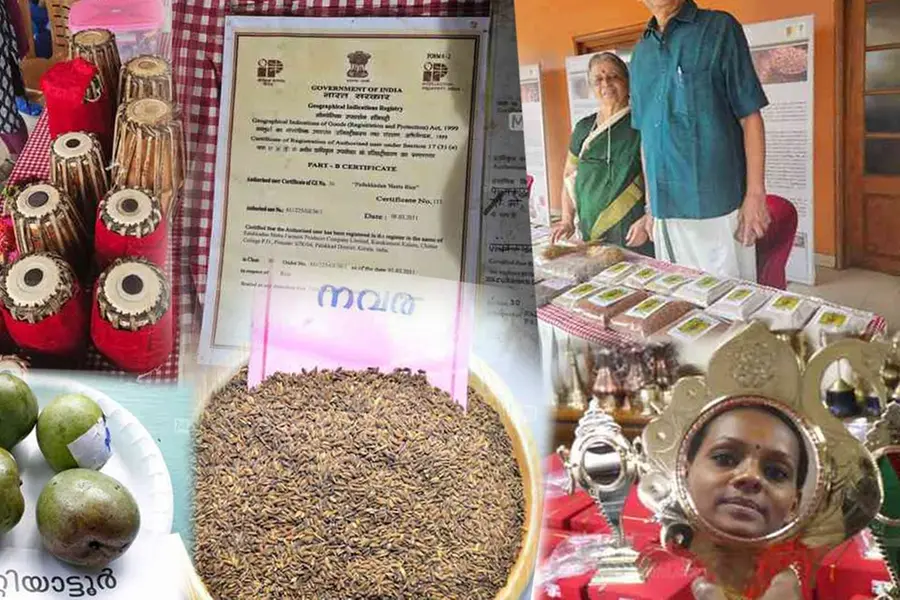
The puny Peruvamba village near Chittoor in Palakkad district has earned a unique place in history. It is arguably the country’s only panchayat with three products that have earned the prestigious Geographical Indication (GI) tag. They are Navara and Palakkad Matta, two indigenous rice varieties, and Palakkad Maddalam, a percussion instrument, all with centuries-old traditions. The World Intellectual Property Organisation (WIPO) defines GI as a sign used on products with a specific geographical origin and possess qualities or a reputation due to that origin. This year, Navara, Kerala’s only medicinal rice, has completed twenty years since it won the GI tag, one of the first agricultural products to make the grade. In India, the GI tag is issued by the Geographical Indication Registry, which is part of the Controller General of Patents, Designs & Trademarks under the Department of Industrial Policy & Promotion (DIPP), Ministry of Commerce & Industry. GI tags for Matta and Maddalam soon followed Navara's recognition.
Yet, how many, even among Malayalis, know of Peruvamba and its unique products?

Compare them with products we are all familiar with: Champagne, Scotch whisky, Tequila, Swiss chocolates, India’s own Basmati rice or Darjeeling Tea. Like Peruvamba products, they are all known by their places of origin, have GI tags and earn higher market prices. Indeed, Navara and Matta have popular demand and earn good returns. Yet it has no comparison with the other global products mentioned above, which are immensely popular worldwide and command premium prices. The situation of the meticulously manufactured Palakkad Maddalam - now made by a few families of Peruvamba- is even more unfortunate, as they face a limited market that shrinks every day for multiple reasons.
Indeed, well-known products with global markets certainly cannot be compared to those with minimal geographical appeal. But why can't our governments or the tourism industry project these products’ use and value as mascots of Kerala’s tradition and culture, as they do in many countries?
“We are unable to carry forward the tradition as the new generation is not interested due to the low returns compared to the economic and physical efforts put in for making a maddalam,” says Raghavan, 69, the eldest in one of Peruvamba’s maddalam-making families belonging to the Kadachi Kollan community. The family has been designing leather-based percussion instruments like Mridangam, Maddalam, Tabla, Timila, Chenda and Idakka for about 200 years. Their products deliver the best performance and are sought by prominent musicians thanks to the craft of manufacturing and the right choice and processing of the materials -cattle hide and jackfruit wood- used.
P. Narayanan Unny, who runs the world’s largest organic Navara farm -Unny’s Navara Farm - in Peruvamba, laments the lack of support for branding and marketing his medical and nutritional rice. Navara rice was one of the earliest in India to win the GI tag and the first through farmers' initiative. The Navara rice farmers society is led by Unny, who gave up his computer business during the 1990s to take over his family’s century-old paddy farm. He later converted it for exclusive and organic cultivation of Navara. “Navara is one of the most significant products in Ayurveda, and it is now popular worldwide. Yet, repeated efforts to make the authorities help project Navara as Kerala’s traditional health and wellness product have met with apathy”, says Mukundan Unni, a former Agriculture Officer in Chittoor.
farmer and his wife Rema
The other Kerala traditional rice varieties that have won GI are Wayanad Jeerakasala and Gandhakasala, Kannur’s Kaipad and Ernakulam’s Pokkali. “Why can’t the tourism department serve a Navara dessert at its hotels, the social welfare department serve a medicinal Navara porridge in old age homes, or the education department include a nutritional Navara dish for school children in the noon meal programme?” asks Dr Sreevats, an Ayurveda doctor. Not just authorities, Malayali society, in general, too has been indifferent to its culinary traditions. Why don’t we see a Kaipad biriyani, a Jeerakasala Pulao or a Pokkali Payasam on the buffet spread at our star hotels or on the hoardings across even remote villages that blare out Kentucky Fried Chicken, Chicking grilled chicken, Beirut Shawarma, Italian wood pizza, Yemeni Manthi or Istambul rolls?
The story is no different for most of the 30-odd Kerala products that have won GIs since the concept was introduced in India as part of the World Trade Organisation agreement in 2003. According to the GI Registry, Kerala secured the highest number (6) of GIs in 2023. Five of them were agriculture products: Attappadi Attukomb Avara (beans), Attappadi Thuvara (red gram), Onattukara Ellu (sesame), Kanthalloor Vattavada Veluthulli (garlic), and Kodungallur Pottuvellari (snap melon). Other notable Kerala farm products with GI tag are Malabar Pepper, Kannur Kuttiattoor Mango, Vazhakulam pineapple, Wayanad Robusta coffee, Thrissur Chengalikodan bananas, Malappuram’s Edayur chilli and Tirur betel leaves, Pathanamthitta’s Central Travancore Jaggery, Idukki’s Marayoor Jaggery and Alleppey Green Cardamom. Kerala’s non-farm products with GI are Pathanamthitta’s Aranmula Kannadi, Alleppey Coir, Malappuram’s Nilambur teak, Balaramapuram sarees, Kasaragod Sarees, Thrissur’s Kuthampully Sarees and dhotis, Chendamangalam Mundu, Payyanur Pavithra Mothiram, Kollam’s Screw Pine craft (thazha paya), Kannur’s Cannanore Home Furnishing, Kozhikode’s brass and coconut shell craft ware.
Unlike industrial products, farm products face a specific drawback in Kerala. Most of them are produced by small farmers who are incapable and unfamiliar with modern marketing and branding. This is where governments, the tourism industry, and business bodies like the CII have to play a more significant role. According to Unny, CII Kerala has backed Navara from the beginning, but it must do more. Vinod Manjila, convenor of CII-Kerala, was present at the 20-year celebrations of Navara’s GI tag at Chittoor and offered every help in propagating the medicinal rice.
“GI is only the first step. Without follow-up measures for branding and marketing, GI tag won't help sell products,” said T Nandakumar, former Secretary of the Union Ministry of Agriculture, who attended the 20th anniversary of Navara’s GI recognition. However, he is sceptical about seeking government support. “Often government intervention turns into interference. Never waste time selling in Supplyco shops”. Nandakumar, a former chairman of the National Dairy Development Board, says only farmer collectives like farmer producer companies or co-operatives like Amul can bring real benefits to them. “Amul used to pay 75% of the sale proceeds to farmers. Has any government-run Support price scheme offered to pay this much to farmers?” asks Nandakumar. However, a key challenge for Kerala's producers is the insufficient production scale.
Dr N Anil Kumar, the newly appointed chairman of the Kerala State Biodiversity Board, underscored the critical need to conserve Navara, “Kerala's superfood”, and other traditional rice varieties. India, once home to over 150,000 indigenous rice varieties, has lost 90% in the past decades.
Rajni Kant from Varanasi, called “India's GI man”, also attended the Navara event in Palakkad. He has taken the initiative to felicitate GI tags for over 50 products. Uttar Pradesh leads the country in GI, with more than 70 products securing the tag. Of them, over 30 products are from Varanasi district alone. “However, India still has only around 700 products with GI tags. Compare this with China's 7000 GI products. With its wide geographic and climatic diversity, India can easily multiply its numbers”. He lamented India's poor performance is because most products have secured GI appellation through government departments instead of actual producers or authorised users. For instance, Palakkad Maddalam’s GI applicant is the Directorate of Handicrafts.
According to TC James, former director of DIPP, Ministry of Commerce and Industry, India has the potential to have at least 7000 products with GI tags. “But most Indian producers are from rural regions unaware of the concept or its benefits. There should be massive campaigns to fill the gap”. A few GI-tagged products like Darjeeling Tea or Basmati rice get attractive prices. Successful brands also lead to the preponderance of duplicate and fake products. Some time ago, quantities much larger than the actual production of Darjeeling Tea used to be auctioned at London. The fake tea production was traced to Sri Lanka. The Tea Board effectively intervened to stem the trend, and today, Darjeeling Tea fetches the highest price for tea globally. Only about 90 estates in Darjeeling in West Bengal have the right to use the GI tag.
James said the One District One Crop scheme launched under the Central Government’s Atmanirbhar Bharat programme has been effective. Over 1000 crops have been identified from 760 districts across the country. Unny pointed out some drawbacks of the programme. “Bananas are decided as the crop for Palakkad, a paddy land”.
Another prominent person who attended the Navara celebration was Hormis Tharakan, former Director General of Police and Director of the Research and Analysis Wing. The former cop has turned to Pokkali farming after retirement in his native Alappuzha district. Tharakan said agriculture has been in his blood, and one was reminded of the prosperous Parayil Tharakan family, who pioneered coconut farming in coastal Alappuzha three centuries ago, to which he belonged.
Hope Kerala takes the initiative to present its unique GI-tagged products to the world. Why can't the CII and P Rajeev, emerging as one of Kerala's best Industries Ministers, join hands to open a Kerala supermall to display and sell the state's every unique GI product and demonstrate their making process? The Grand Bazaar in Istanbul, an exclusive supermarket for Turkish products (not any superior to our own), overflows with tourists worldwide every day until midnight. Another huge tourist attraction in Turkey is the ceramic mall in the Canakkale (it means the land of pottery) region, where the traditional potters display their famed wares and the process of manufacturing at a dedicated centre and mint money in droves.
Published: 14 Oct 2024, 09:53 am IST
Related Topics
Disclaimer: Kindly avoid objectionable, derogatory, unlawful and lewd comments, while responding to reports. Such comments are punishable under cyber laws. Please keep away from personal attacks. The opinions expressed here are the personal opinions of readers and not that of Mathrubhumi.