

Discover the Kerala roots of Anita Marangoly George, a key figure in the Tata Sons boardroom battle. Explore her finance expertise and the impact of women from Kerala in global leadership.
The bitter boardroom battle raging within the Tatas, India’s oldest and largest business empire, has rocked the global corporate world. Understandably so. The 157-year-old conglomerate is entwined with almost every facet of Indian life—from salt to software, from tea to textiles, and from automotives to aviation. With an annual revenue of ₹15.34 lakh crore and over a million employees, the Tatas are the country’s largest private-sector employer. It is, therefore, unsurprising that even Union Ministers Amit Shah and Nirmala Sitharaman have stepped in at the request of the rival factions, setting aside the usual aversion to state intervention in corporate disputes.
The media, too, has been abuzz with the Tata turmoil. Yet, few have noticed its Kerala connection. One of the flashpoints in this high-voltage tussle is the reappointment of two independent directors to Tata Sons, the group’s holding company—Vijay Singh, former Defence Secretary, and Anita Marangoly George, who has roots in Kerala. While exhaustive profiles have appeared on many of the dramatis personae in this corporate saga, little has been written about Anita—even by Kerala’s media, usually quick to claim any Malayali angle in national stories.
Noel Tata, chairman of Tata Trusts, reportedly supports the reappointment of both Singh and George, while a rival group of four Tata trustees vehemently opposes it. Before exploring the reasons for this rift, it is worth pausing to know who Anita George is.
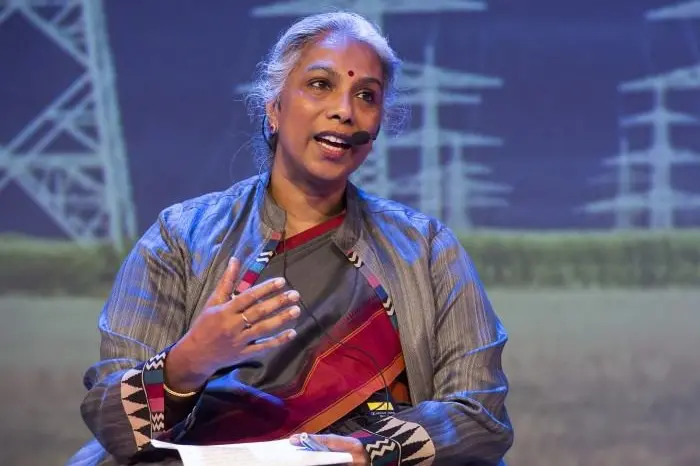
A widely respected expert in global finance and sustainable governance, Anita is the daughter of V.M. Marangoly, former Delhi representative of Malayala Manorama, from the Marangoly family of Thalayolaparambu in Kottayam district. After earning her MBA from Boston University, she joined the World Bank in 1991 and later worked with the International Finance Corporation for nearly two decades, specialising in infrastructure, natural resources, and finance. She went on to hold senior roles at Siemens AG, where she helped establish its financial services arm in India, and at the Canadian pension fund giant CDPQ Global.
Anita is the founder of Edhina Capital, an investment fund focused on climate-change solutions, and serves as president of the Indo-Canadian Business Chamber. Known for her commitment to sustainability and gender equity, she advises several non-profits, including Women in Private Equity and Venture Capital (WinPE) and the International Solar Alliance. Besides Tata Sons, she serves on the boards of First Solar Inc., a major American solar technology company, and Piramal Enterprises.
“I knew her father very well and saw Anita and her siblings growing up. We used to meet often in the US. They were all exceptionally bright and successful,” recalls Dr. George Marangoly, patron of the Marangoly Family Welfare Association. Anita’s elder sister, late Rosemary Marangoly George, was a noted professor of literature at the University of California and author of books like Politics of Home: Postcolonial Relocations and Twentieth-Century Fiction (1996) and Indian English and the Fiction of National Literature (2013) published by Cambridge University. She passed away in 2013 at just 52.
The opposition to Anita’s reappointment, reports suggest, has little to do with her personally. It stems from procedural and transparency disputes within Tata Sons’ boardroom. The so-called “super board,” aligned with the Mistry camp, has alleged that her reappointment was made without consulting the full board. The disagreement reflects broader tensions over governance, leadership succession, and the conglomerate’s strategic direction. Anita’s husband, Mahesh Babu, is an entrepreneur.
Interestingly, Anita joins a growing list of high-profile women of Kerala origin who have made their mark on the global corporate stage. Among them are Leena Nair, the first Indian-born CEO of the French luxury house Chanel; Priya Nair, the first woman CEO and Managing Director of Hindustan Unilever; and Gita Gopinath, the first woman Chief Economist of the IMF and later its First Deputy Managing Director.
Though all these women built their careers largely outside Kerala—and often outside India—their Malayali roots lend a symbolic resonance. Kerala, despite its social progress and educational achievements, has not produced many internationally recognised corporate leaders. Fittingly, all these trailblazers are women, reflecting yet another facet of Kerala’s progressive gender narrative.
The stories of Leena Nair and Priya Nair, both from Malayali families settled in Kolhapur, Maharashtra, are strikingly similar. Each earned an MBA in Pune and rose through the ranks at Hindustan Unilever (HUL), the ₹60,000-crore FMCG giant.
Leena, 56, began as a management trainee in 1992 after an engineering degree and an MBA with a gold medal from Xavier School of Management, Pune. The first woman at HUL to work night shifts on factory floors, she rose through the hierarchy to become Unilever’s global Chief Human Resources Officer in 2016—the first female, first Asian, and youngest-ever to hold the position. She spearheaded Unilever’s gender-parity agenda, achieving a 50:50 balance in global leadership, and championed a commitment to pay living wages across its supply chain by 2030.
In 2021, Leena became the first Indian-origin CEO of Chanel, the 115-year-old French luxury brand, despite no prior experience in fashion. Under her, Chanel has expanded its sustainability and cultural investments, increasing its annual funding for UK cultural initiatives fivefold. She was ranked 68th on Fortune’s list of the world’s most powerful women in 2023. Her family hails from Palakkad, and she is married to Kumar Menon, a financial services entrepreneur, with two sons.
Priya Nair, 53, joined HUL in 1995 after an MBA from Symbiosis Institute of Management, Pune. Known for her deep grasp of consumer insights, she managed some of HUL’s most iconic brands, including Dove, Rin, and Comfort. Her early innovations included the rural radio campaign Earthworm Radio, which reached 11 million subscribers and won multiple Cannes Gold Lions.
Priya credits her mother, a physician who served low-income patients, as her strongest role model. Rising through HUL, Priya became Executive Director (South Asia) in 2014 and later moved to London as Unilever’s Global President for Beauty & Wellness. She returned to India this August as HUL’s first female chief. She is married to entrepreneur Manmohan Nair, and they have a daughter.
The first in this league to shatter global glass ceilings was economist Gita Gopinath, 54, appointed Chief Economist of the International Monetary Fund in 2018 and later its First Deputy Managing Director. During the COVID-19 pandemic, she co-authored the Fund’s influential Pandemic Paper, which led to the formation of a multilateral task force with the World Bank, WHO, and WTO.
Gita’s family hails from Kannur, and she has ancestral ties to the legendary Communist leader A.K. Gopalan. Her appointment in 2016 as Chief Economic Advisor to Chief Minister Pinarayi Vijayan—while she was still teaching at Harvard—sparked debate over her supposed ideological leanings. “I don’t believe in any ideology,” she told me then. “I’m a technocrat trying to address economic issues.” She credited her Kerala upbringing for her gender-just worldview and social consciousness.
After studying economics at Delhi University, she earned her master’s at the University of Washington and a PhD from Princeton. She joined Harvard in 2005, where she became the John Zwaanstra Professor of International Studies and Economics. Having stepped down from the IMF this August, she is returning to Harvard as professor of economics.
A naturalised U.S. citizen, Gita is married to Iqbal Singh Dhaliwal, her classmate from the Delhi School of Economics and now global executive director of the Abdul Latif Jameel Poverty Action Lab (J-PAL). They have a son.
Despite their diverse journeys, what binds Anita George, Leena Nair, Priya Nair, and Gita Gopinath is a shared conviction that excellence and empathy can coexist — that boardrooms and balance sheets need not be devoid of conscience. Their Kerala roots may be incidental, but their success carries quiet echoes of a culture that valued education and equality long before the corporate world began to speak their language.
Kerala has produced thinkers, reformers, and politicians in abundance, but rarely corporate leaders of global stature. These women, though largely shaped outside the state’s professional ecosystem, embody the values that Kerala once prided itself on — intellectual curiosity, social commitment, and gender fairness.
Published: 13 Oct 2025, 11:20 am IST
ABOUT THE AUTHOR
Related Topics
Disclaimer: Kindly avoid objectionable, derogatory, unlawful and lewd comments, while responding to reports. Such comments are punishable under cyber laws. Please keep away from personal attacks. The opinions expressed here are the personal opinions of readers and not that of Mathrubhumi.