

Azerbaijan which was mostly unheard of until a few years ago, is recently a popular destination for Malayalis too
There was no hint of war when our small group of friends decided to plan a five-day trip to Azerbaijan in February. One of the first Soviet Republics to declare independence and one which straddled Europe and Asia along the historic Silk Road and located on the Caucasus with Caspian Sea on its east, Azerbaijan held a unique allure. Adding to the appeal were the affordable costs, the relatively simple visa process—far less daunting than the Schengen or the near-impossible U.S. visa—and the fact that the tour was being organised by a group familiar to some of us. Not surprisingly, Azerbaijan which was mostly unheard of until a few years ago, is recently a popular destination for Malayalis too.
But our plans were suddenly upended with the unexpected outbreak of hostilities between India and Pakistan. Azerbaijan, along with its close ally and patron, Turkey, declared full support for Pakistan, turning our travel plans on their head.
India was understandably enraged, and fervent calls arose from all around the country to retaliate. Among the several ways to hit back was the call to cancel all proposed visits, including those by Indian tourists to both countries. This was sure to hit both countries seriously as tourism was their key source of income. Indians formed a substantial number of the tourists to Turkey and Azerbaijan, and it has been rising significantly in recent years. The number of Indian tourists visiting Turkey rose by 21% last year to cross 3.3 lakhs. Indian tourists were of even more significance to Azerbaijan as they doubled in 2023 to cross 2.4 lakhs from 1.4 lakhs in the previous year. Indians constituted the third-largest contingent of foreign visitors to Azerbaijan, and they spent an average of $1280 per visit.
With patriotic emotions running high, cancellations of proposed tours from India to both countries rose rapidly. However, our tour operator, a minor player in the travel industry, found it would be disastrous to cancel all the group reservations it had already secured for the flights, hotels and other various arrangements in Azerbaijan. Neither could most members of our group, who were elderly pensioners, afford to abandon their long-cherished travel dreams, without the prospect of refunding their hard-earned money drawn from their lifetime savings.
There was yet another allure for the few journalists among us. After all, what journalist would willingly pass up the chance to be in a place currently at the centre of global attention? We were eager to understand firsthand—and to tell others—why Azerbaijan was taking the stand it was. After much deliberation, we decided to proceed with the trip, fully aware that it might invite criticism or raise uncomfortable questions back home. Yet, the pull of the story was too strong to resist.
After an 11-hour journey that began early in the morning on an Air Arabia flight—with a taxing five-hour layover at the overcrowded Sharjah airport—our 25-member group finally arrived in Baku, the capital and largest city of Azerbaijan, by evening.
What immediately strikes a first-time visitor to Azerbaijan is its eclectic identity, shaped over centuries by a rich layering of racial, political, and religious influences from the many cultures that once dominated the region. Straddling both Europe and Asia, Azerbaijan presents itself as a historical mosaic—a fusion of Western and Eastern traditions, Persian and Islamic heritage, the legacies of Tsarist Russia and Soviet socialism, and the present-day blend of a mixed economy and secular politics, tinged with a moderately Islamic character.
Azerbaijan’s hybrid identity is vividly reflected in the architecture of Baku, a city that stands as a living testament to the country’s long and often turbulent history under successive empires—Seljuk, Tsarist, and Soviet. The cityscape not only preserves the footprints of each historical phase but also showcases the energy of the present and even offers an avant-garde glimpse into the future.
The well-preserved, tourist-thronged Old City of Baku, a UNESCO World Heritage Site, is dotted with ancient forts, minarets, and palaces dating back to the 12th century, built during the Persian Seljuk era and the reign of indigenous dynasties like the Shirvanshahs. Scattered across the modern city are buildings with intricate Islamic designs alongside stark, functional structures from the minimalist Soviet period.
Yet Baku is no relic of the past. The city boldly proclaims Azerbaijan’s evolution beyond its history of foreign domination, emerging as a modern, oil-rich nation. This transformation is symbolized by its striking post-modern architecture, most notably the trio of spectacular Flame Towers, completed in 2012. These flame-shaped skyscrapers, fully wrapped in LED screens that simulate the flickering of fire, have become the defining image of Azerbaijan—a country known as the "Land of Fire" due to the natural gas flares that burn out perpetually from its Yanar Dagh mountains.
Azerbaijan's other remarkable attractions include the ancient rock carvings of Gobustan, dating back 40,000 years and classified another UNESCO World Heritage Site, the curious mud volcanoes which emit mud believed to be having healing powers, or the ancient fire temple (Ateshgah) with its intertwined Islamic, Hindu and Zoroastrian heritage.
Beyond its history and unique sights, what intrigued me most was a pressing question: why did Azerbaijan side with Pakistan against India? My curiosity only deepened when we encountered the surprising warmth and admiration that local Azerbaijanis expressed toward India.
We were genuinely overwhelmed by the number of people—men and women—who eagerly approached us in public places, asking excitedly if we were Hindustanis and insisting on taking selfies with us. The chief reason for this affection? Hindi cinema. Everywhere we went, people greeted us with enthusiastic shouts of "Shah Rukh Khan!", "Aamir Khan!", or "Amitabh Bachchan!"
Interestingly, we had experienced the same last year in Turkey—another country currently viewed as India’s adversary. Even though social media was abuzz with stories about India’s outrage over Azerbaijan’s pro-Pakistan stand and the calls to boycott tourism, none of this seemed to dampen the affection ordinary Azerbaijanis held for Indians. Despite the diplomatic standoff, Indian tourists were still visible everywhere, joyfully dancing the Bhangra to Hindi film songs that resonated in the streets.
We were reminded of another era—the days of the Soviet Union—when Raj Kapoor and Nargis were cultural icons across the USSR, and their song Awara Hoon was played at India-Soviet banquets and even hummed by Russian leaders. Some affinities, it seems, transcend politics and people -to-people affection often trump politicians.
Azerbaijan has an over 1000 member-strong Indian community consisting of business people, professionals, students etc. There are four active Indian associations including a Baku Malayali association. What's more, this year's annual conference of the World Malayali Council is being held in Baku this month despite protests.
So, why did Azerbaijan become a Pakistan supporter? The clue lies in the trilateral economic, military, and religious axis among Pakistan, Turkey, and Azerbaijan. These countries call their friendship the “Three Brothers alliance” which has been conducting joint military exercises. Turkey was the first country, and Pakistan the second, to recognise Azerbaijan when it became the first Soviet republic to declare independence in 1991. Turkey and Pakistan gave military assistance to Azerbaijan when, in 2020, it fought and won against its neighbour and long-time enemy, Armenia, over the disputed Nagorno-Karabakh region. Armenia was accused of backing the separatist movement of the ethnic Armenian Christian community in Azerbaijan’s mountainous Nagorno-Karabakh since 1991.
The “three brothers” held their first trilateral summit in January 2021, and the second occurred at Baku after the recent India-Pakistan conflict on May 28, Azerbaijan’s independence day. It was attended by Turkey’s President Erdogan, Azerbaijan’s President Ilham Aliyev and Pakistan's Prime Minister Muhammad Shehbaz Sharif. Pakistan has recently supplied Azerbaijan fifty JF-17 Block III fighter jets, which the former developed jointly with China and equipped with Turkish missiles. Turkey was one of the earliest countries to recognise Pakistan when it was born, and alongside Azerbaijan, supports it in its dispute with India over Kashmir.
Azerbaijan’s political history is, in many ways, quite paradoxical. Although the country’s hard-won independence from the Soviet Union came at the cost of much bloodshed and the martyrdom of hundreds, power has remained concentrated in the hands of the Aliyev family—ironically, one of the staunchest allies of the former Soviet Communist system.
Heydar Aliyev, widely regarded as the architect of post-Soviet Azerbaijan, was once at the very heart of Soviet power. He served as the General Secretary of Azerbaijan’s Communist Party, held a top position in the KGB, the Soviet intelligence agency, and was a member of the Politburo, the highest decision-making body of the Soviet Communist Party.
However, Aliyev’s fortunes changed when he fell out with Soviet leader Mikhail Gorbachev in the final years of the USSR, forcing him into retirement and exile in his native village. Yet, the intense internal strife and instability that followed Azerbaijan’s independence paved the way for his political comeb
ack. In a tightly controlled election, Aliyev who was seen as an Azerbaijani nationalist, returned to power with an overwhelming majority, beginning a new chapter of centralized rule under his leadership.
Aliyev not only brought stability to Azerbaijan but also ushered in sweeping economic reforms. He struck lucrative deals with Western companies to more effectively exploit the country’s vast oil and natural gas reserves, setting Azerbaijan on a path of rapid growth. Today, Azerbaijan is classified as an upper-middle-income economy, with a per capita income three times that of India despite having just one-hundredth of India’s population.
Aliyev's rule combined capitalist business practices with Soviet-style political authoritarianism, allowing him to maintain a decade-long, iron grip on power. He systematically suppressed opposition and ultimately reshaped the presidency into a hereditary post, paving the way for his son, Ilham Aliyev, to succeed him when he stepped down in 2003, shortly before his death at the age of 79.
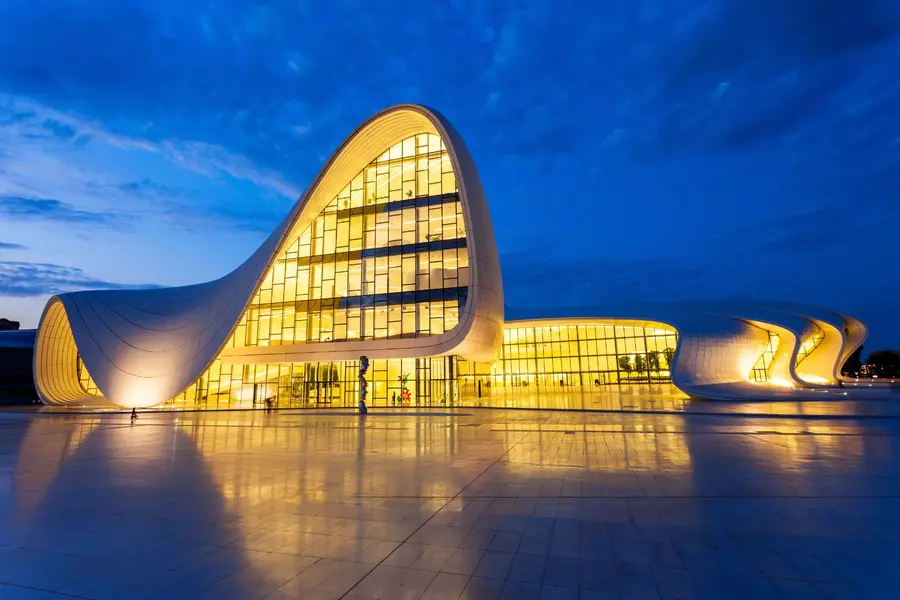
One of the most striking tributes to Heydar Aliyev is the grand Heydar Aliyev Center in Baku—a must-visit for its architectural brilliance, cutting-edge technology, and sweeping historical exhibits. (Also, just next door is the fantastic vintage car museum, where a dazzling collection of the world’s finest automobiles from the 19th century is immaculately preserved.)
Heydar’s son, Ilham Aliyev, further consolidated the Aliyev family's authoritarian grip on Azerbaijan, even appointing his wife as the country’s vice president. Now 64, Ilham has held the presidency for 22 years, entrenching the family’s dominance over the nation’s political life.
Despite impressive economic growth and a relatively high Human Development Index, largely driven by its oil and gas wealth, Azerbaijan’s record on human rights remains abysmal. The country is routinely criticised for widespread corruption, suppression of dissent, and systematic curtailment of civil liberties.
There is one more Azerbaijan paradox- it is the only Muslim country with close strategic alliance with Israel which is it's major arms supplier!
Published: 10 Jun 2025, 10:36 am IST
ABOUT THE AUTHOR
Disclaimer: Kindly avoid objectionable, derogatory, unlawful and lewd comments, while responding to reports. Such comments are punishable under cyber laws. Please keep away from personal attacks. The opinions expressed here are the personal opinions of readers and not that of Mathrubhumi.