
The Aam Aadmi Party’s (AAP) electoral debacle in Delhi signals the collapse of an extraordinary dream. To the cynic, it may be the inevitable downfall of an illusion that was always unsustainable in the contemporary age. To many rationalists, the denouement marked the natural end of the urban middle-class myopia and the eclipse of a maverick without ideological roots. To Arvind Kejriwal’s foes, it was the inescapable fate of a political charlatan.
Yet, one fact is irrefutable. However short-lived it was, AAP and Kejriwal scripted a new experiment in India's political history. In its 13-year journey, AAP stood in stark contrast to all the dark forces that have engulfed our polity and society—religious and caste sectarianism, endemic corruption, hunger for power and wealth, unscrupulous market capitalism, and the politics of triviality and self-interest. AAP was the first political party that actually translated its promises immediately after it came to power to improve the lives of the poor. At a time when the political landscape has turned starkly communal and bigoted, AAP appeared as a solitary secular island. Its very name and symbol (broom) resonated with the common people's long-cherished desire to cleanse India's political pigsty.
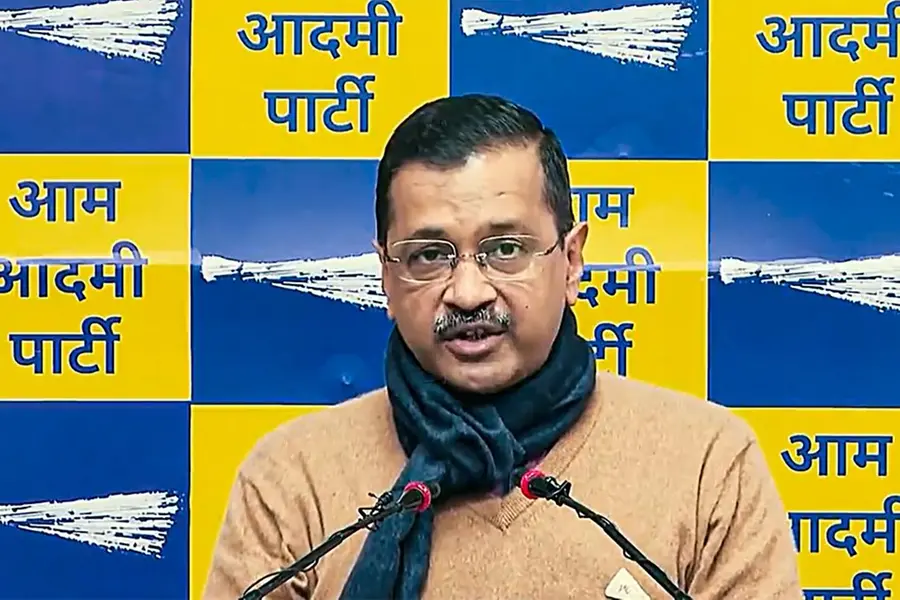
AAP’s image owed most to its founder Kejriwal who embodied all its virtues. A graduate of the elite IIT who gave up a coveted IRS job to fight corruption and serve the common people, he personified honesty, sacrifice and selflessness. A Magsaysay award-winning crusader against corruption, the diminutive Kejriwal in his blue Maruti Wagon R, his trademark Monte Carlo sweater, the ubiquitous muffler, with even a persistent cough, truly looked like the archetypal common man (Aam Aadmi). “A circle of Arvind Kejriwal’s shirt was poking from a hole in the middle of his rumpled sweater. And below his bare feet were clad in well-worn sandals with a relaxed coating of dust”, wrote Andrew North of the BBC in 2014.
This was in stark contrast to the bloated, and extravagant Delhi netalog cruising in limousines, escorted by machine-gun trotting black cats. This made a tremendous impact on people, especially in the age of television and social media. Born out of India’s most vocal and widely covered anti-corruption movement -India Against Corruption-, AAP embodied the idea that the browbeaten nation has been waiting for a long time. Kejriwal assumed the aura of a messiah of the masses and a crusader in shining armour.
AAP’s debut in the Delhi assembly poll of February 2013 was simply stunning. Ever since independence, the nation's capital had been ruled only by Congress or BJP. Unlike these two grand old parties which were led by stalwarts who were well-known in Delhi, the newly born AAP consisted of unknown and ordinary people. Despite these phenomenal challenges, the AAP grabbed 28 of the 70 seats in its first election and came second to the BJP which won 31 seats. The ruling Congress ate humble pie with barely eight seats. Topping AAP’s giant killers was Kejriwal himself who trounced the Congress’s three-time incumbent Chief Minister, Sheila Dikshit, in the New Delhi constituency by a huge margin. However, as no party secured an absolute majority, surprising political shifts ensued. The Congress lent outside support to its bete noire, the AAP, to form the government. The 41-year-old Kejriwal, the bureaucrat-turned-greenhorn politician, created history by becoming the national capital’s seventh Chief Minister on December 28, 2013. However, the new regime ended short-lived as Kejriwal resigned after 48 days when Congress refused to support the AAP’s most important election promise to introduce the Jan Lokpal Bill. Delhi came under the President’s rule.

counting of votes for Delhi Assembly elections, in New Delhi | PTI
Within months, the country witnessed a momentous political event when the NDA led by the BJP under its new leader Narendra Modi swept the polls to the 16th Lok Sabha. NDA won 336 seats and Congress was crushed to an all-time low of 44 seats. However, barely a year later, yet another incredible political drama unfolded in Delhi. In February 2015, AAP stunned the world when it halted Modi’s saffron juggernaut right under its nose in the nation’s capital. AAP won a landslide grabbing 67 of the 70 assembly seats and securing a whopping 54.3% vote share. The formidable BJP had to be content with just three seats. Congress was decimated as it drew a blank. AAP proved beyond doubt that it was no flash in the pan but was here to stay.
Keeping up its promises, the second Kejriwal government launched its flagship welfare schemes for the capital’s poor masses; free electricity and water and the famous “Mohalla Clinics” to provide free medical care that won international acclaim. Jai Bheem Prathibha Vikas provided free entrance test coaching to SC/ST students. Another major initiative was the “Delhi Model” which radically improved the government schools’ infrastructure with renovated buildings, toilets, libraries, science laboratories, and swanky classrooms. The next was the free bus travel scheme for all women.
However, the spectacular success brought some problems in its wake. Rumblings began within against Kejriwal’s allegedly dictatorial ways leading two of its most high-profile leaders -Prashant Bhushan and Yogendra Yadav- to quit the party in 2016. But it didn't prevent the AAP from spreading its wings outside Delhi. It became Punjab’s principal opposition by winning 20 seats in the 2017 assembly elections. By then, the Kejriwal government was embroiled in constant duels with the Modi government and also Delhi’s Lieutenant Governor on several issues including over the control of the Delhi Police or bureaucrats.
The 2019 Lok Sabha elections proved that the Modi wave grew even bigger and unstoppable with increased seats and votes. Yet, in the Delhi assembly election held a year after, AAP repeated its magic. Kejriwal did a magnificent hat-trick with AAP winning 62 seats. BJP was left with eight seats and Congress drew a blank again. Two years later, AAP took control over the second state -Punjab- when it won 92 of the 117 assembly seats and it secured national party status. AAP shocked the BJP by winning 13% of votes and 5 assembly seats in Modi’s Gujarat and made inroads into Goa and Jammu & Kashmir.
AAP’s hat-trick convinced the BJP that it was now or never to stop the broom army. Losing repeatedly in the capital after winning most of the country appeared like what St. Matthew warned- “gaining the whole world but losing one’s own soul”. BJP realised that the Hindutva strategy it deployed successfully elsewhere would not work in Delhi with AAP in power. So, BJP’s top leadership worked overtime plotting ways to cripple the AAP. The first step was the “Operation Lotus” project to lure poach AAP legislators and divide the party though it yielded little success.
The saffron think tanks realised that the AAP’s strength lay in its pro-poor welfare schemes and also Kejriwal’s personal integrity. Days after the formation of the third Kejriwal government, an unprecedented crisis erupted; the outbreak of COVID-19 and the subsequent lockdown. The BJP promptly blamed the AAP for all the problems related to the management of the pandemic. The high number of cases and fatalities, the breakdown of healthcare facilities, and the horrifying hardships of migrant workers whose mass exodus on foot from Delhi to their distant villages created global headlines. The pandemic was the first major instance when Kejriwal’s image began to flounder.
Next that put Kejriwal in difficulty was the agitation over the Citizenship Amendment Act (CAA). Kejriwal has always been cautious to avoid the BJP’s trap to brand him as anti-Hindu and anti-national. He knew that this branding would cost him heavily in a place like Delhi which still bore the scars of past communal clashes. He openly proclaimed himself to be a proud Hindu and a “Hanumanbhakt” even as he questioned BJP’s Hindu communalism like Gandhiji did. A former AAP politician and journalist, Ashutosh, wrote, “Hanumanbhakt Kejriwal is the best antidote to the polarising politics of Modi and Amit Shah”. However, Kejriwal’s counter-strategy appeared overstretched when he refused to visit Shaheen Bagh even once where a marathon agitation led by Muslim women was being held against the sectarian CAA. This made many secularists slam Kejriwal saying that this revealed his secret saffron stripes. AAP government's abject failure to control the anti-Muslim riots and Kejriwal's demand to have the images of Hindu goddesses on the currency notes only buttressed these charges. The Sangh Parivar was jubilant to see Kejriwal losing sheen even among the secularists.
after the party's thumping win in the Assembly election in 2020 |PTI
Though Kejriwal could surmount these challenges reasonably well, what hit him most grievously was the assault on his greatest strength; the moral sheen. The outbreak of the multi-crore liquor scam and Kejriwal’s subsequent arrests along with his closest cabinet colleagues damaged their core image as crusaders against corruption, despite the BJP’s political motives being too visible behind the allegations. Kejriwal was the country’s first sitting Chief Minister to be arrested for graft charges. Another targeted attack came on Kejriwal’s image as a man of simple and humble ways. The decision to renovate Kejriwal’s official residence at an alleged cost of Rs 40 crore was used to the hilt by his opponents who called his new home, the “Sheesh Mahal”. His journey from the “Muffler Man to the Lord of Sheesh Mahal” became the hottest campaign point for the BJP and the Congress during the recent election. His failure to clean the Yamuna and blaming Haryana for poisoning the river too boomeranged. Congress party also played the spoiler and split anti-BJP votes and truncated the INDIA alliance’s credibility further. Kejriwal’s defeat in New Delhi by the BJP’s probable Chief Ministerial candidate Parvesh Verma was reminiscent of his trouncing Sheila Dikshit, a decade ago.
A decade in power may make anyone more autocratic, less idealistic, or less accountable. Delhi’s citizens may have taken AAP’s welfare model for granted, turning instead to the BJP’s grander promises. AAP may have also fallen short in addressing Delhi’s many other challenges. Yet, for a brief period, Kejriwal and AAP demonstrated that politics could take a different path—one focused on public service and earning the people's trust. However, sustaining that momentum and spirit seems to have eluded Kejriwal.
Published: 12 Feb 2025, 07:57 am IST
Related Topics
Disclaimer: Kindly avoid objectionable, derogatory, unlawful and lewd comments, while responding to reports. Such comments are punishable under cyber laws. Please keep away from personal attacks. The opinions expressed here are the personal opinions of readers and not that of Mathrubhumi.