
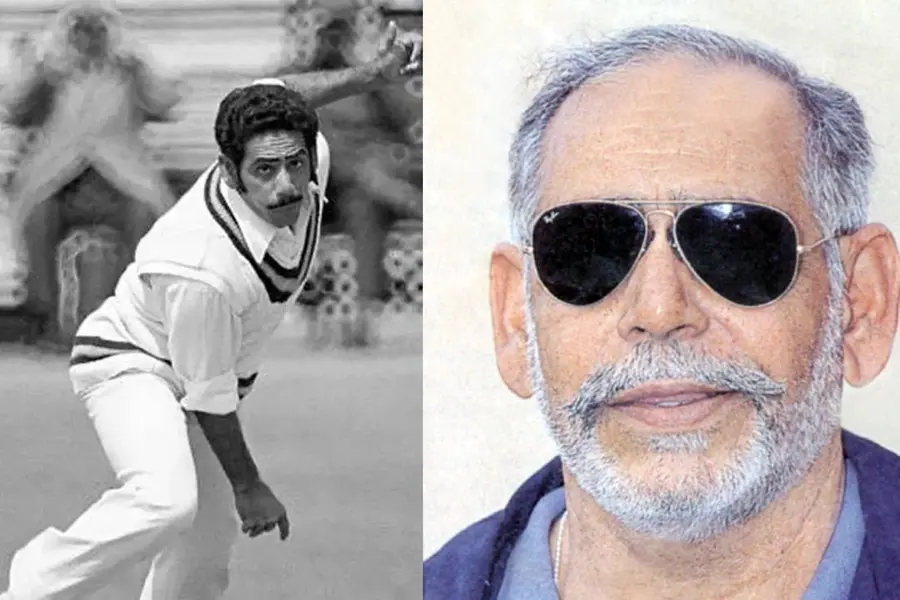
Syed Abid Ali, one of India’s finest all-rounders, who passed away at 83 in the US recently, was a proud icon for cricket-crazy adolescents like me in the 1970s. The Hyderabadi cricketer was, in many ways, our redemption—at a time when India boasted the world’s best spin quartet but lacked fast bowlers to match the fiery pacers of other nations.
Blame it on our youth, but while we admired the guile and artistry of Bishan Singh Bedi, EAS Prasanna, BS Chandrasekhar and S Venkataraghavan, we secretly craved speed—seeing it as a symbol of strength, aggression, and machismo. In Abid Ali, we found that rare breed - a complete cricketer. He opened both the bowling and batting, excelled as a wicketkeeper, and dazzled as a brilliant close-in fielder—a true all-rounder in every sense.
I still vividly remember the thrill of seeing Abid Ali in person as an 11-year-old schoolboy at Thiruvananthapuram’s University Stadium in August 1969. Unlike most cricketers of that era, who paid little attention to fitness, Ali stood out—muscular, with a thick moustache and long sideburns. He had come to play a Ranji Trophy South Zone league match, and at the time, he was more fearsome with the bat, especially against Kerala which, unlike today when it is the national runner-up, was one of India’s weakest teams during those days.
Ali had already tormented Kerala in the past, scoring centuries in their two previous Ranji encounters, including his career-best, an unbeaten 173. But he wasn’t the only star in the Hyderabad team-alongside him were even bigger names like the legendary Indian captain MAK Pataudi, the flamboyant ML Jaisimha, and the elegant Abbas Ali Baig, all of whom we mobbed for autographs.
Though Ali was the chief wrecker of Kerala who grabbed five wickets for 31 in the second innings, he did not shine with the bat (18 runs) in the 1969 match, unlike his impressive performance a few months earlier in Hyderabad. In that Ranji match against Kerala in November 1968, Ali made his best-ever score (an unbeaten 173) as the opener. Kerala thus took a special place in Ali's career. Baig also made a century in the match pulverising Kerala for an innings and 187 runs! A year earlier in Thiruvananthapuram, Ali had hammered another ton (124) against Kerala to help Hyderabad notch another innings win.
Despite Kerala’s embarrassing drubbings at the hands of Hyderabad, those encounters also unearthed a rare Kerala star—V Manikanta Kurup, the team’s spirited medium pacer. The University Stadium skipped a heartbeat in 1969 when Kurup sent "Tiger" Pataudi packing for just two runs, caught behind by Ashok Sekhar. Even as die-hard Kerala supporters, we were stunned to witness India’s captain dismissed so cheaply. I also vividly recall the Tiger sprinting off to the nearby Mascot Hotel when an unexpected downpour halted play during the final session!
Kurup’s scalps weren’t ordinary; he claimed top-class batters like P. Krishnamoorthi and Abbas Ali Baig. He had shone in the 1967 match too, taking three crucial Hyderabad wickets in the first innings—Santosh Reddy, Baig, and ML Jaisimha. Kurup didn't play in the next match in which Ali hit his record score, as he was unwell. I took special pride in the fact that Kerala’s new-ball attack in that match was led by Kurup alongside the left-handed TA Mohammed Ibrahim, my senior at St Joseph’s School. Ibrahim, a fine cricketer in his own right, passed away in 2011 at the age of 61.
Kurup who played 34 first-class matches for Kerala, is now 87 and lives in Thiruvananthapuram. He was attending the Attukal Pongala festival when I called him to inform about Ali’s demise. “Abid was a hero. I am happy that my best performances also were in those two matches. Pataudi’s wicket is my greatest trophy”, Kurup said.
Ali holds the record of taking a wicket off his first ball in a test match twice. His victims were no less than the Australian Captain Bill Lawry in the 4th test at Mumbai in 1969 and England’s legendary opener Geoff Boycott who was out first ball at English cricket’s Mecca, the Lord’s in the 2nd test in 1974. Ali sent off legends like Rohan Kanhai and Gary Sobers of West Indies off consecutive balls at Port of Spain in 1971.
1971 proved historic for Indian cricket, as the team secured its first ever Test series victories against both the West Indies and England that year in their soil. On both momentous occasions, Syed Abid Ali was at the batting crease.
In March, during the triumph against the West Indies in Port of Spain, Ali took a single and moved to the non-striker’s end, allowing Sunil Gavaskar—the young opener who had masterminded the win—to hit the winning shot. But in September at The Oval in London, Ali did the honours himself, by sealing India’s victory against England, executing a crisp square cut to the boundary.
In terms of speed of bowling, Abid Ali was only a “gentle” medium pacer compared to his phenomenal contemporaries, like Australia’s Dennis Lillie or Jeff Thomson, England’s John Snow or Willis, West Indies’ Roberts or Holding or even Pakistan’s Imran Khan. While Ali’s average speed never passed 130 km/hour, the others mentioned above used to cross 150 km/h. Even Ali's Indian contemporaries like Ramakant Desai and Karsan Ghavri bowled slightly faster than him. Don't forget that it took many decades more for the first Indian -Javagal Srinath - to break the 150 km barrier! Though Kapil Dev (145 km at his peak) couldn't achieve this, nine more Indians have scaled this height subsequently with Umran Malik, the 25-year-old Jammu and Kashmir all rounder, cloaking the fastest- 157 km/h in a 2022 IPL match for Sunrisers, Hyderabad.

Yet, at a time when India did not have many genuine seamers who could instil fear in opposing openers, Ali could do so with his swing, accuracy and the capability to strike early. His career-best test wicket haul - 6 for 55 - came in his debut test against Australia in Adelaide in 1967. He was India's star in this series when he made two fifties also.
In an international career spanning two decades that ended rather abruptly with the 1st One Day International World Cup of 1975. In his 29 test matches, Ali took 47 wickets and made 1018 runs including six fifties. In his domestic cricket career for Hyderabad, he played 212 first-class games taking 397 wickets at 28.55 and scoring 8732 runs with 13 hundreds and 41 fifties.
Compared to India's iconic cricketers, Ali’s international record may be modest. However, his high strike rate as an opening bowler at a time when Indian cricketing strength revolved around its world-class spinners was tremendous. He also inspired a generation of pacers starting from Kapil Dev who demonstrated that India too can bowl fast.
ESPNcricinfo wrote thus in its obituary: "Abid Ali had the feet of a sprinter, the energy of a marathon runner and the will of a decathlete, but his misfortune was that he was born 20 years too early. His game was made to order for one-day cricket: he bowled brisk medium-pace, fielded outstandingly, and was a busy lower-order batsman who ran between the wickets as if on invisible skates.”.
Published: 21 Mar 2025, 09:40 am IST
Related Topics
Disclaimer: Kindly avoid objectionable, derogatory, unlawful and lewd comments, while responding to reports. Such comments are punishable under cyber laws. Please keep away from personal attacks. The opinions expressed here are the personal opinions of readers and not that of Mathrubhumi.