

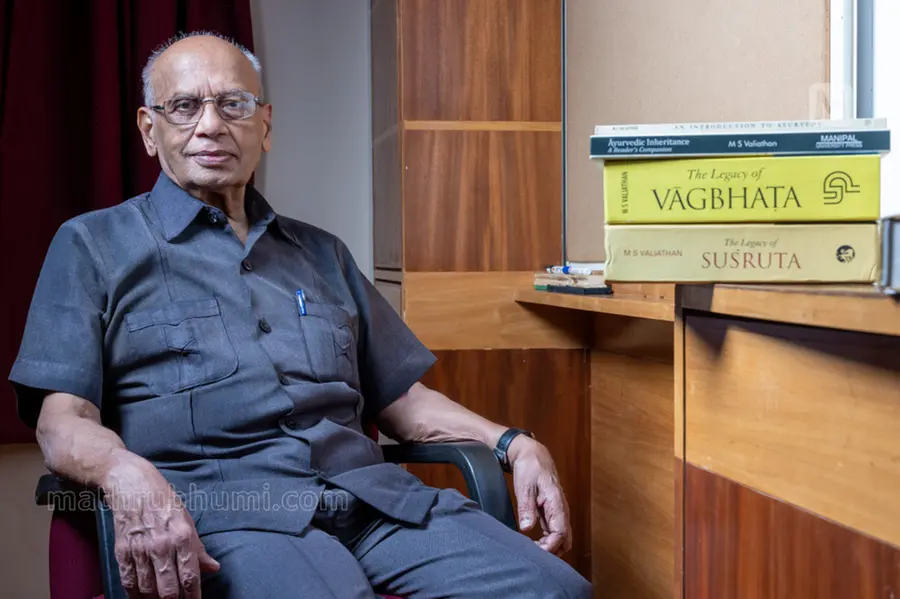
Today (July 17) marks the first death anniversary of Dr Valiathan — eminent cardiac surgeon, visionary academician, master teacher, prolific author, and institution builder
Which city is the world’s largest producer of blood bags?
Which city manufactures the world’s most affordable artificial heart valve?
The answer to both: Thiruvananthapuram
And who deserves credit for these path-breaking achievements in a city often dismissed as a haven of power-hungry politicians, fossilised bureaucrats, and strike-happy trade unions?
The answer: Marthanda Varma Sankaran Valiathan — the Malayali Midas who turned everything he touched into gold.
Today (July 17) marks the first death anniversary of Dr Valiathan — eminent cardiac surgeon, visionary academician, master teacher, prolific author, and institution builder. He passed away at 90, leaving behind a legacy that transcends medicine.
Despite lucrative offers abroad after training under some of the world’s finest medical minds, Valiathan chose to return to his homeland to serve underserved millions. In an age when modern medicine was becoming entangled in corporate greed, he remained a steadfast advocate for ethics in medical practice.
Decades before "Make in India" became a national slogan, Valiathan lived its spirit — indigenously developing critical, high-cost medical devices like the heart valve and blood bag to make them affordable and accessible. He led Kerala’s early strides in successful technology transfer from academia to industry.
And his contributions didn’t end with modern medicine. While many of his peers scoffed at traditional systems, Valiathan spent his final years passionately championing Ayurveda, insisting on rigorous research and validation rather than romanticism or rejection.
This June also marked the 50th anniversary of the declaration of Emergency, the darkest chapter in post-independent India’s history. Many have often wondered why Kerala re-elected the United Democratic Front (UDF) alliance led by CPI and Congress in the historic 1977 polls held after the Emergency, when most of the country trounced Indira Gandhi's authoritarianism. A reason cited often was the UDF government’s (1970-77) record in the state’s development front notwithstanding its crackdown on freedoms and custodial murders. Among the government’s achievements was the setting up of a slew of academic centres of excellence, specialising in different fields. Even more impressive was (rarity in Kerala) choosing the most suitable persons to head them, for which the credit went to the visionary and scholarly Chief Minister C Achutha Menon. Among such centres were the Sree Chitra Tirunal Medical Centre, now known as Sree Chitra Institute of Medical Sciences and Technology (SCTIMST), Centre for Development Studies, and Centre of Earth Science Studies, headed by Dr Valiathan, Dr KN Raj and Dr Harsh Gupta respectively. Under the right leadership, each of these institutions rose to become among the finest in the country. That Kerala has not seen the emergence of many such institutions since may well be a reflection of the state’s changing priorities in the decades that followed.
Born in an aristocratic family in Maveklikkara with rich cultural traditions, Valiathan did his studies at the local government school, after which he joined Thiruvananthapuram’s University College (then known as Maharaja’s), where he studied science. Following in the footsteps of his uncle, Dr VS Valiathan, who studied medicine in Edinburgh at the beginning of the 20th century, MS Valiathan graduated from Trivandrum Medical College in 1957 as a member of its first batch of students.
He left the country for postgraduate studies in surgery at the University of Liverpool in England and obtained a fellowship from the Royal College of Surgeons of Edinburgh in 1960. Despite the abundant opportunities overseas, Valiathan chose to return to India and began his career as faculty in Chandigarh’s Postgraduate Institute of Medical Education and Research. After a short while, Valiathan left for the USA for specialised training in cardiovascular surgery at the Johns Hopkins Hospital and Georgetown University Hospital. In the US, Valiathan had the opportunity to work under two titans in the field: Dr Vincent L Gott and Dr Charles Hufnagel, eminent cardiac surgeons and inventors of critical biomedical devices implanted on cardiac patients. They were his mentors who kindled Valiathan’s lifelong passion in biomedical engineering. Hufnagel was the inventor of the first artificial heart valve during the 1950s, and Gott is credited with developing, alongside Ronald Daggert, the Gott-Daggert heart valve prosthesis -the butterfly valve- in the 1960s, used for mitral and aortic replacement. Valiathan also had the opportunity to learn at Philadelphia’s Thomas Jefferson Medical College about the ground-breaking development of the heart-lung machine. Valiathan obtained a fellowship of the Royal College of Physicians and Surgeons of Canada.
Once again, ignoring the opportunities abroad, he returned to India in 1972. But, as Dr. Sunil K Pandya, neurosurgeon and medical historian, wrote in his obituary on Valiathan, the bureaucracy-bound Indian system failed to recognise her highly qualified son’s value. He obtained only an ad-hoc post at New Delhi’s Safdarjung Hospital and could do no cardiac surgery or research. Pandya recalled that Dr Hufnagel had once told him that he had made a mistake by returning to India, despite having a promising future in America. “The Indian virus will destroy you”, Dr Hufnagel had warned, wrote Pandya. (Unfortunately, Dr Pandya too passed away last December.) Valiathan’s interest in biomedical engineering took him, the next year, to Chennai, where the IIT had launched a new programme on the topic. He joined as a visiting professor there and also took up a part-time honorary surgeon position at Perambur’s Railway Hospital, where he performed one of South India’s earliest open-heart surgical operations. In Chennai, Valiathan started chasing his dream to make an affordable artificial heart valve in India. He made a project proposal to the Council for Scientific and Industrial Research (CSIR), which, however, was not approved. As Dr M Unnikrishnan and Dr G D Bhuvaneswar, who were Valiathan’s colleagues in Sree Chitra Medical Centre, wrote, this setback made Valiathan “redouble his future efforts”.
This was exactly when Valiathan received an unexpected call from his home state, which he had left two decades ago. The caller was none other than the Chief Minister Achutha Menon, who invited him to take over the setting up of a super speciality hospital in Thiruvananthapuram. In October 1974, Valiathan took over as director of the Sree Chitra Tirunal Medical Centre. Even as he immersed in the heavy work of setting up the centre, Valiathan did not abandon his passion for biomedical engineering. He was determined to develop a low cost, indigenously-built heart valve to replace the highly expensive imported one, which was unaffordable to the large number of Indian patients suffering from rheumatic heart disease. In the 1980s, 6 out of 1000 children had rheumatic fever, and 12 lakh of them were at risk of valvular disease in India.
Valiathan submitted a project proposal to the Government of India’s Department of Science and Technology for developing artificial heart valves and disposable medical devices, jointly with Dr V. Gowarikar of Thiruvananthapuram’s Vikram Sarabhai Space Centre (VSSC) and Dr S Ramaseshan of Bengaluru’s National Aerospace Laboratory (NAL). DST accepted the project and sanctioned Rs 90 lakhs. The Achutha Menon government transferred the Satelmond Palace, once the residence of the erstwhile regent queen of Travancore, along with a grant of Rs 50 lakhs, a whopping sum for the state then, for setting up the biomedical wing. In 1980, the Parliament passed an act to make Sree Chitra an institute of national importance. A newly recruited multi-disciplinary team began work on the valve, which came into being after three failed attempts that lasted more than a decade. The first Indian-made heart valve, named Sree Chitra Valve, became one of the world’s least expensive too. Successfully implanted in a patient on December 6, 1990 -who is still doing well- the technology was transferred to the Chennai-based TTK group. Branded TTK Chitra Heart Valve, improved and upscaled over time, is being manufactured in the KINFRA International Apparel Park in Thiruvananthapuram. It is now being used in 300 cardiac centres across India with over one lakh implantations till now. According to a 2016 report, while an imported mechanical valve costs up to Rs 55,000, the TTK-Chitra mechanical valve was priced at Rs 20,000. The second-generation valves were implanted in 42 patients according to a SCTIMST report of 2024.
Even before the development of the heart valve, Valiathan’s team had succeeded in developing the first Indian blood bags in 1983. Until then blood bags were imported in the country at a higher cost. C Balagopal, then a 30-year-old IAS officer belonging to Thiruvananthapuram, was bowled over on his visit to SCTIMST by Valiathan’s passion and his indigenisation projects. Inspired by Valiathan, who offered him the transfer of technology, the adventurous Balagopal resigned from the coveted civil service to set up the Peninsula Polymers Ltd, a company to manufacture the SCTIMST-developed blood bags. In 1999, the Tokyo-based Terumo Corporation acquired the company, which was renamed Terumo Penpol. The Thiruvananthapuram-based Terumo Penpol, which posted a revenue of Rs 655 crore in 2023-24, is today world’s largest producer of blood bags, selling in 64 countries with a capacity of 38 million bags per year. Terumo Penpol, alongside the public sector Hindustan Latex Ltd (capacity of 13 million) make Kerala’s capital city the world’s blood bag capital. Balagopal, presently the chairman of the Kerala State Industrial Development Corporation, recalled that he had neither capital nor the entrepreneurial background at the time, but made the leap inspired by Dr Valiathan. Even more products emerged subsequently from SCTIMST.
Along with these great strides in “Make in India”, during his two decades at its helm, Valiathan built SCTIMST up as one of the country’s best medical institutes. He set up one of India’s first Institutional Medical Ethics Committees in SCTIMST in 1984 to ensure ethical conduct and high standards of safety and performance. His other significant contribution was to set up the Achutha Menon Centre for Health Sciences at SCTIMST, named after the visionary who was instrumental in the genesis of the institution, which offered the country’s first postgraduate course in public health during the mid-1990s. After retiring from SCTIMST, Valiathan served as the vice chancellor of Manipal University (1994-99). Subsequently, Valiathan immersed himself in the study of the “Great Three” of Ayurveda -Charaka, Sushrutha and Vagbhata- with a fellowship from the Homi Bhabha Council. This culminated in a series of books by him now compiled together in his “Ayurvedic Inheritance: A Reader’s Companion” (2017).
For leading such a full and purposeful life, Dr. Valiathan was honoured across the world — showered with accolades and awards by some of the most prestigious institutions which included the Padma Vibhushan. Yet one cannot help but ask: has Kerala truly recognised one of her greatest sons in the manner he deserved? When will we see even a single institution in the state bear the name of this visionary who so profoundly enriched our lives — and made it easier for countless others simply to live?
Published: 17 Jul 2025, 10:42 am IST
ABOUT THE AUTHOR
Related Topics
Disclaimer: Kindly avoid objectionable, derogatory, unlawful and lewd comments, while responding to reports. Such comments are punishable under cyber laws. Please keep away from personal attacks. The opinions expressed here are the personal opinions of readers and not that of Mathrubhumi.