
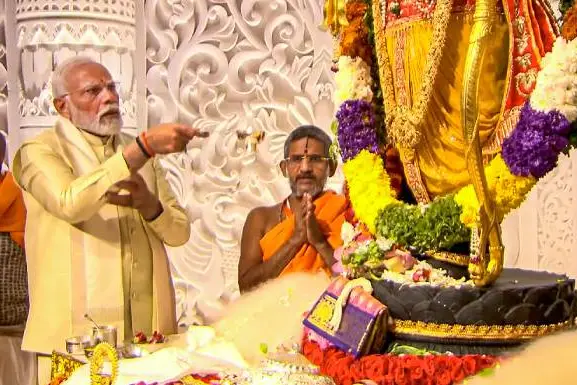
''The greatest spectacle after independence,'' remarked Ram Madhav, the RSS idealogue, in his article on the consecration of the Ram Temple in Ayodhya. It goes without saying that BJP and RSS made it really spectacular. From educational institutions to hospitals, the spectrum of participants was indeed impressive! Flying on the wings of hindutva the Prime Minister was there in Ayodhya like a colossus towering over anything and everything. The event was so well planned and centralised that no-one could have missed the man at the centre.
There were two sanyasinis among the crowd who didn't get the attention they deserved- sadhvi Rithambara and Uma Bharti. Of the two, Uma Bharti merits special mention. Sometime back she had a crucial role in one of the mega projects by BJP and RSS. The Sangh Parivar must have had its own calculations when Uma,the saffron clad BJP leader, was chosen as the Chief Minister of MP in 2003 December. But the expectations came tumbling down when Uma had to step down in 2004 following the arrest warrant issued against her in the Hubli riots. She quarrelled with LK Advani, the then president of BJP in the public in the same year and that had its impact on her trajectory in the party. There was no attempt on the part of the leadership to bring her back to electoral politics in 2019 when she announced her retirement. Just like Advani and Murali Manohar Joshi, Uma Bharti too is no longer relevant in the political schemes of the Parivar. We should not forget that these three persons had an active role in the Ram Janmabhoomi movement. It may be poetic justice that LK Advani, who spearheaded the movement, couldn't make it to the consecration on January 22.
Arrival of Yogi
While Uma was losing her ground in BJP, another monk was on the rise. The Sangh Parivar chose Yogi Adityanath as the CM of UP in 2017 which sent shock waves across the country. The most severe criticism was raised not by a politician but by Fali S Nariman, a leading constitutional legal luminary in the country. Nariman viewed the move by the BJP as a challenge against the Indian Constitution.

''The Constitution is under threat'' Nariman's words were precise and to the point. ''With the massive electoral victory in UP, a priest has been installed as the chief minister at the insistence of the prime minister. It is a signal and if you cannot see that, either you are the spokesperson of political parties or you must have your head and eyes examined,'' Nariman told Shekar Gupta, in an interview. Nariman wanted the media and the opposition MPs to ask the PM if it was the beginning of the Hindu Rashtra.
Dr Radha Mohan Agarwal, one of the most loyal followers of Yogi announced once : ''Gorakhpur is Hindu Rashtra, Yogiji is the President and PM here.'' The success of the 'Yogi experiment' was very much visible in the electoral strategy of the BJP in 2019. There were no populist schemes in the national budget presented by Nirmala Sitaraman that year. The nation saw BJP deploying hindutva as the panacea for all the crisis the nation was facing. It paid good dividends for BJP as the party's tally in the Lok Sabha went up from 282 to 303 in the 2019 elections. Pulwama and Balakot metamorphosed into votes against this backdrop.
Gorakhnath Math, Sufism
Yogi Adityanath was 26 years old when he was elected for the first time from Gorakhpur in 1998. He was the youngest MP in Lok Sabha then. Mahant Digvijaynath and Mahant Avaidyanath, the predecessors of Yogi in the Math, too got elected from this constituency earlier. Gorakhnath Math has a history of many centuries. It is said that math was founded by Gorakhnath in the 11th century. Matsyendranath was the guru of Gorakhnath. The texts and legends stand testimony to the fact that Gorakhnath math was beyond the confines of caste and religion.
Sufism had a great impact on the thoughts and activities of the chief priests of Gorakhnath. The couplets of Kabir were engraved on the walls of the Gorakhnath temple. There have been a lot of Muslim Yogis in and around Gorakhpur. Manoj Singh, a media person, has recorded some interesting dialogues of such muslim yogis in one of his articles. One of the muslim yogis told Manoj : ''These are bad times. We are Muslims but we keep the Ramayana in our homes alongside the Quran. We narrate the tales of Baba Gorakhnath and his disciples Gopichand and Bhartruhari. Earlier, we were only jogis. Nobody asked us whether we were Hindus or Muslims. But nowadays, there is a lot of fear. Wherever we go, the first thing we are asked is about our religion.'
Gorakhnath math underwent some drastic changes in its character when Mahant Digvijay Nath joined Hindu Mahasabha in 1937. Digvijaynath was there in the forefront of those who went to Ayodhya to install the idols of Ram inside the Babri masjid. He was accused of inflaming passions among Hindus against Mahatma Gandhi. Under the leadership of Mahant Avaidyanath, the math deviated more to the Right wing. Yogi was anointed as the chief priest of the math by Mahant Avaidya. There were never two ways in front of Yogi. UP saw Yogi evolving as the most vociferous proponent and campaigner of hindutva in the heartland of India.
President at Somnath
2025 will see the centenary of RSS. That makes this Lok Sabha election very crucial for the Sangh. Yogi retained power in UP in 2022 surviving the onslaught of covid and the farmers' strike. What the nation saw on January 22 in Ayodhya was the pan-India launch of this formula. Narendra Modi, who was appointed as the main 'yajman' at the consecration, looked virtually like the supreme head of hindutva. Mohan Bhagwat, the sarsangh chalak of RSS, was there by his side offering all support and sustenance.
BJP has always been seen as the political front of the Sangh. The Sangh has had its hegemony imposed upon the political party from the very beginning. But, now it seems that for the first time the Sangh is capitulating to a more powerful leader than the sarsangh chalak. There is now only one supreme leader of hindutva in India. Remember Henry VIII, the British King who broke with the pope and church and anointed himself as the pontiff of the anglican church. Ayodhya witnessed the coronation of Modi as the supreme leader of hindutva. Anyone, who criticises this leader, be it the Sankaracharyas, will see the aggressive face of the Sangh.
In 1951, when the Somnath temple was renovated, Dr Rajendra Prasad, the then president of India, was invited to be the chief guest at the opening. Nehru, the then Prime Minister of the country, didn't favour this. He was of the firm opinion that the head of the state should not attend a religious function. Dr Rajendra Prasad then enquired whether he could go in his personal capacity. Nehru didn't object to this. But this meant that neither protocol nor security could be provided to Prasad at Somnath. At this point, Morarji Desai, home minister in Bombay, came up with an alternative. The Bombay Province Fairs and Melas Act provided that it was the state's responsibility to ensure law and order at fairs. As such, this act could be used to provide the president with the protection he needed. The organisers would look after protocol.
Dr Prasad made it clear then that he would go to other religious centres as well if he was invited. The speech delivered by Dr Prasad at the Somnath temple opening underlined his belief in the pluralism of the country: ''All paths lead to God just as all rivers flow to the ocean. ''We should add to this the profound statement by Nehru on Gandhi Jayanti the same year: ''If anyone raises his hand against another in the name of religion, I will fight him till the last breath of my life, whether from within the government or outside.'
Karpoori Thakur and Bharat Ratna
No prominent leader from the opposition parties went to Ayodhya on January 22. Some leaders like Chandra Babu Naidu, who are sitting on the fence, were present. But neither Sonia Gandhi nor Kharge made it to Ayodhya. Sharad Pawar, Mamata, Stalin and Uddhav Thakaray too kept away. Even Navin Patnaik and Jagmohan Reddy, who support the Modi regime in all critical junctures, were conspicuously absent. One must reckon with the fact that the opposition parties could make it a point that the Ayodhya project was politically motivated by the Sangh Parivar.
CPM could easily take the decision to boycott the Ayodhya ceremony. But, for Congress it was really a tough call. Much was at stake. Still, the grand old party eventually decided to say no to the invite by the Ram Temple Trust. The Sangh Parivar might not have expected such a stand. Anyway, it must be said to the credit of the Congress that the party refused to walk into the trap set by the Parivar. When Congress made it crystal clear that they wouldn't be party to the political project of the Parivar, both Gandhi and Nehru might have heaved a sigh of relief from their graves.
The last few days have proved that the think tanks of the Sangh Parivar never rest. The Parivar knows that war rooms can't have intermissions. The Bharat Ratna to Karpoori Thakur indicates that. RSS knows very well that mandir alone won't be enough to retain power at the centre. 'Mandal' has its own relevance in the Indian political arena. If a Bharat Ratna to Karpoori Thakur could do the job, so be it. NDA grabbed 39 out of the 40 Lok Sabha seats in Bihar in 2019. But, JDU switched over to the Congress camp after the election. BJP wants Nithish and his party back in their fold somehow. The Bharat Ratna to Karpoori Thakur is meant more for JDU than the backward communities. If Bihar turns against NDA that will be a severe blow to BJP. So, they will go to any extent to win the upcoming battle.
It was Karpoori Thakur ministry that implemented 26% reservation for the backward communities in government jobs in 1978. Jan Sangh, a partner in the ministry, was the first to oppose this move. The Karpoori govt had to resign in the wake of the ensuing conflicts. Now, the BJP govt, led by Modi, may not want to recall the happenings in 1978. As the saying goes, everything is fair in war.
Victory and Humility
Modi refers to the Supreme Court verdict in his speech after the consecration. He points out that the temple was constructed as per the SC verdict. A friend of mine, who listened to the PM's speech, made a pertinent observation that the kind of intensity shown to implement the Ayodhya verdict was not there in the Sabarimala verdict. Anyway, let us return to Modi's speech. The PM reminded everyone that it was not just the moment of victory but the moment of humility as well. He invited those who opposed the temple construction to come and feel the experience.
In fact, the Modi regime wasted a golden opportunity to practice humility in the wake of victory. The SC proposed that 5 acres of land must be handed over to the Muslims to build a mosque. The SC might have seen it as an act of atonement to what was done in 1992. The apex court had pointed out that the destruction of Babri Masjid was an egregious violation of rule of law. The Modi regime should have seen to it that the mosque was completed first. Had the PM participated in the opening of the mosque and tendered an apology for the wrong committed in 1992, that would have been the most sacred moment in Indian history after independence. Let us recall the apology by Manmohan Singh, former PM, on the floor of the parliament for the anti sikh riots in 1984: 'I have no hesitation in apologising to not only the Sikh community but also to the nation. I bow my head in shame that such a thing happened.' Those words mattered a lot to the secular, democratic republic of India. A similar historical moment awaited Modi in Ayodhya. A moment that the republic and the people were waiting for. If the consecration of the temple was done after, the secular feature of the Indian republic would have shone much brighter in every sense.
Let me quote Oriya poet Jagannad Prasad Das :
''When Babri rises
poetry will affirm
that temples are made
not with blood-scribed bricks
or stones carved in hate,
that they, like poetry,
are founded on imagination and faith
in the hearts of men.''
We should also remember what the SC stated emphatically in the SR Bommai vs the Union of India case : ''If the Constitution requires the State to be secular in thought and action, the same requirement attaches to political parties as well. The Constitution does not recognise, it does not permit, mixing religion and State power. Both must be kept apart. That is the constitutional injunction. None can say otherwise so long as this Constitution governs this country. Introducing religion into politics is to introduce an impermissible element into body politic and an imbalance in our constitutional system. If a political party espousing a particular religion comes to power, that religion tends to become, in practice, the official religion. All other religions come to acquire a secondary status, at any rate, a less favourable position. This would be plainly antithetical to Articles 14 to 16, 25 and the entire constitutional scheme adumbrated hereinabove. Under our Constitution, no party or Organisation can simultaneously be a political and a religious party.'
There is a famous couplet in Gorakh Bani, the philosophical text of the Gorakhnath math: ''A Hindu by Birth, a yogi by action and a Muslim by the intellect.'' This has been the hallmark of the age of tolerance. The proponents of Hindutva would not like to chant these couplets now. The Muslim yogis who used to sing the lores of Ramayana are fast becoming a chapter in history.
Tolerance is forced to exit when religion and communalism are deployed to retain power.
Nariman puts forth a striking observation in his interview with Shekar Gupta. ''85% of the Constitution Assembly that gave us the Constitution based on secularism, were Hindus. Majority of these Hindus were highly orthodox like Dr Rajendra Prasad, the first President of independent India. But they had no hesitation to accept that secularism was an inbuilt feature of the country. It is this Constitution that is standing face to face with the Modi regime now.
Published: 27 Jan 2024, 12:00 pm IST
Related Topics
Disclaimer: Kindly avoid objectionable, derogatory, unlawful and lewd comments, while responding to reports. Such comments are punishable under cyber laws. Please keep away from personal attacks. The opinions expressed here are the personal opinions of readers and not that of Mathrubhumi.