
From box office flop to cult legend, Jaane Bhi Do Yaaro remains a razor-sharp satire on corruption, packed with absurd humour and unforgettable performances that still resonate today.
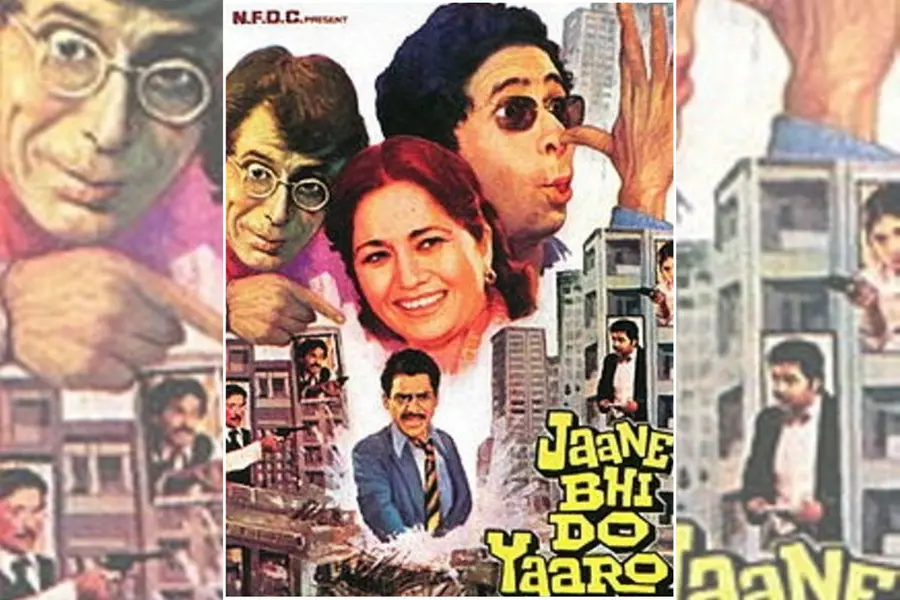
By definition, a ‘cult’ film, commonly referred to as a cult classic, is a film that has acquired a cult following with a specific group of fans. Cult films are often known to be eccentric, do not follow traditional standards of mainstream cinema and usually explore topics not considered in any way mainstream, yet there are examples that are relatively normal (Wikipedia). In India, cult films are often defined by their initial failure to draw in packed theatres or be commercially successful, but they acquire archival value among the same and following generations. Some examples of cult films in India are Mughal-e-Azam, Sholay and yes, Mera Naam Joker. They were turnips at the box office during the first week or two of their release. Mera Naam Joker did not pick up later but over time, all three have become the greatest cult films in the history of Indian cinema.
Jaane Bhi Do Yaaro (1983) was a commercial failure when it was first released perhaps because in the ‘happily-ever-after’ ambience of that time, the ‘sad’ ending did not jell with audience expectations. Today, reality is admired and sad endings are considered more real than fictional and that is what large sections of the audience are fond of. Ishaqzaade for instance, or, Quayamat Se Quayamat Tak were thumping box office hits in spite of, or perhaps because of their tragic endings, because the young audience took it as a reflection of life around us. A digitally restored print of JBDY was released on 2 November 2012 at theatres across Indian cities.
Also Read

The story is straightforward, simple and narrated without any special gimmicks with side-splitting laughter all the way. A photographer-duo, named Vinod Chopra and Sudhir Mishra – you can guess where the inspiration has come from – these two names are now famous in the Bollywood directorial circuit. These two simple souls, desperate for a source of income, open a photography studio in Haji Ali (today a very posh Mumbai neighbourhood in Worli), only to find things going wrong from the moment of its launch.
However, their photographic assignments lead them to shady stories about the city's builders, municipal officers and others. The film exposes the evils of real estate dealers and multi-millionaire promoters, one of whom is named Tarneja (Pankaj Kapoor as a strapping and slim young man), who can mercilessly kill, the funny municipal commissioner De Mello (Satish Shah), who double crosses both the real estate villains, the other one being Ahuja (a very young Om Puri). The Commissioner is killed by one of them, Tarneja. But his dead body keeps vanishing, finally finding a place in a theatre on the vastra haran episode of the Mahabharata.
The film throws the media in a shady light as well by portraying the double-dealing tactics of the lady editor Shobha Sen (Bhakti Barve) of a paper with the double-entendre name of Khabardar. It has two meanings. In Hindi, khabardar means “Danger” and it also means “do not dare” and in this film, the newspaper suggests both! It feeds on gossip and scandalous stories and Shobha is forever on the lookout for these sources.
Through its hilarious style, the late Kundan Shah weaves slapstick comedy into the narrative and a wonderful version of the Mahabharat’s vastra-haran episode, called vastra-cheeran in the film’s play. This becomes a comment on the dishonesty of life all around. A fictional ‘code’ for a phone call from an imaginary person is identified as ‘Albert Pinto Ko Gussa Kyon Ata Hai.’
The film has every ingredient of a masala film but has turned things around to make them not only funny but hilarious and yet, bursting at the seams with acidic satire on journalism and journalists, on two complete failures of photographers who cannot run their own studio, a dead body being pulled along right through the streets of Mumbai in the middle of the night, a brisk-talking, snobbish promoter/ builder(Pankaj Kapoor) who is as corrupt as they come and so on.
Harper Collins India Limited published a book on the film in 2010 authored by Jai Arjun Singh a freelance journalist based in Delhi. He titled the book after the film. “Jaane Bhi Do Yaaro is now a byword for the sort of absurdist, satirical humour that Hindi cinema just hasn’t seen enough of. This is the story of how it came to be despite incredible odds – and what it might have been. Jai Arjun Singh’s engaging take on the making of the film and its cult following is as entertaining as the film itself,” goes the blurb on the book.
The credits spell out a veritable Who’s Who of good Indian cinema and also evolves into an excellent promotional platform for the Film and Television Institute, Pune on the one hand and the National School of Drama, Delhi, on the other. It was produced by the National Film Development Corporation, a surprise considering they produced a film with strong political shades which would not have passed the CBFC today. Most of the cast and crew are now household names not only in India but also beyond Indian shores. Naseeruddin Shah who portrayed Vinod Chopra said in an interview on a television channel that wherever he goes, be it to England, USA, Poland, Dubai, locals identify him with three films – Monsoon Wedding, Masoom and Jaane Bhi Do Yaaro.
Many of the actors, then struggling to make it in Bollywood, are no more with us. Examples are – Kundan Shah, the director, followed by Om Puri, Satish Kaushik, Satish Shah, Bhakti Barve and Ravi Baswani. But they made sure that they became household names before they passed on.
The wonderful, completely spontaneous and organic performances of every single actor have made the film timeless and universal in its comic statement on corruption in high places, which is no longer the exception now but the rule. ‘Hum Hongey Kaamyaab’, the theme song, turned out to be true to each word in time to come. Jai Arjun Singh points out that “Given that this very song was the Hindi version of the gospel song ‘We Shall Overcome’, a song sung by forces during the Civil Rights Movement, the irony could not have been starker.” A small note on the song: "We Shall Overcome" is a seminal protest song that served as the anthem of the US Civil Rights Movement in the 1950s and 60s, embodying hope and resistance against injustice. Originating from earlier hymns and African American work songs, it was popularised by activists like Pete Seeger and used globally as a rallying cry for equality and peace. (Source: The Kennedy Centre).
The late Kundan Shah, the director, won the Indira Gandhi Award at the National Awards for the Best Debut film of a director. The late Ravi Baswani bagged the award for the Best Comedian of the year from Filmfare. But had I been one on the jury panel, I would have most certainly given an award to Satish Shah for his brilliant performance first as the corrupt Municipal Commissioner, then as a corpse being pulled on a cart-like contraption right through the city and finally, dressed up to play Draupadi in a play! The other possible awardee could have been the very thin, moustached and corrupt builder Ahuja played by Om Puri who is the funniest drunkard with the sole exception of Kesto Mukherjee in the history of Hindi cinema.
The comedy is unending! For example, Dhritrashtra, still blind, says, "This is too much! Yeh Akbar kahaan se aa gaya?"... Or Tarneja and Ahuja entering the Mahabharat in complete costumes, but still wearing their specs and sunglasses! If you have never seen a male corpse playing the role of Draupadi in Mahabharat or portraying Anarkali in the Salim-Anarkali love story, then please watch Kundan Shah’s Jaane Bhi Do Yaaro. A 1983 film made on a shoestring budget of Rs. 7 lakh, Jaane Bhi Do Yaaro hobbled and stumbled its way to its finish. But came back again more than 40 years later to become a cult classic. The film, without doubt, is timeless, universal and crosses all boundaries of class, status, education, culture and geography.
Published: 11 Apr 2026, 07:58 am IST
Related Topics
Disclaimer: Kindly avoid objectionable, derogatory, unlawful and lewd comments, while responding to reports. Such comments are punishable under cyber laws. Please keep away from personal attacks. The opinions expressed here are the personal opinions of readers and not that of Mathrubhumi.