

The universality of Amma’s message teaches us one truth: One World, One Family, One Light
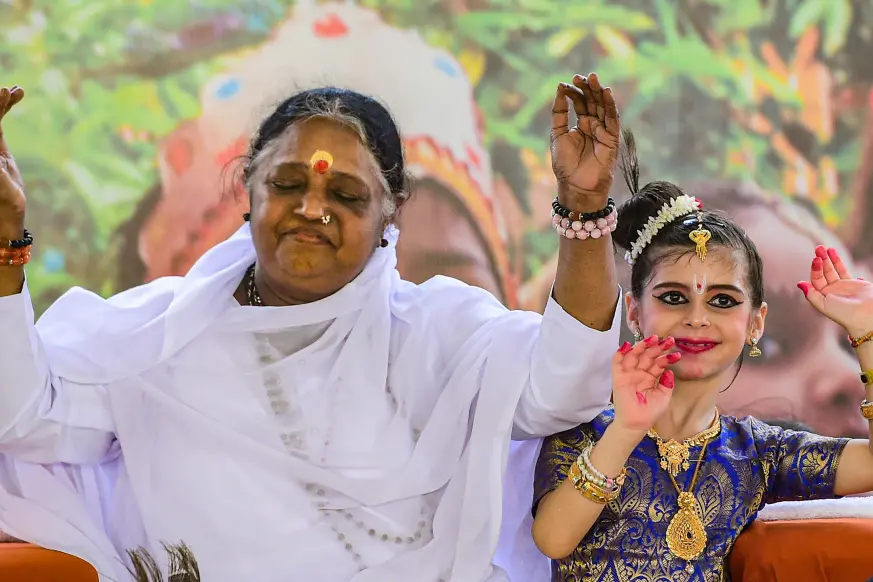
On September 27, Mata Amritanandamayi – the beloved “Amma” to millions – turned 72. I was there amid the throngs of devotees and admirers to commemorate the special occasion.
My association with Amma goes back 26 years, when she visited New York during my years of service at the United Nations and stayed at the home of a friend, who invited me to meet her. I was struck by her simplicity and evident goodness, and played a small part in having her invited to address the Millennium World Peace Summit convened by Secretary-General Kofi Annan at the United Nations in the year 2000.
There are rare moments in history when a mother tongue rises above geography, when the voice of a single person becomes the voice of humanity. Such a moment came when Amma—the Mother of Compassion—addressed the Millennium World Peace Summit. That day, Malayalam was heard in the august UN General Assembly hall for the first time. But it was not merely a language that echoed in that hall—it was music, it was prayer, it was light. For every Malayalee, that moment will remain an imperishable crown of pride.
The Millennium World Peace Summit was historic in its own right. It was the first-ever gathering of over 2,000 spiritual and religious leaders from every continent, representing virtually every major faith tradition of humanity—Hinduism, Christianity, Islam, Buddhism, Judaism, Sikhism, Taoism, Shintoism and many more. Never before had the United Nations formally welcomed such a conclave of spiritual teachers, recognizing for the first time that true peace is not secured merely by diplomacy, resolutions, or treaties, but by the moral and spiritual awakening of communities. Into that gathering Amma walked—not as a political leader or diplomat, but as a simple woman clad in white, representing the eternal soul of Bharat. The choice to speak in Malayalam itself was a powerful statement: that spiritual wisdom flows from authenticity, from the intimate music of one’s own mother tongue.
Music and spirituality are like twin rivers that flow without borders. They are not bound by language, nation, or creed. Just as music moves the human heart through melody and rhythm, spirituality touches us through compassion, love, and unity. Hence, the world accepts both as universal languages. When Amma spoke in Malayalam, it was as if the voice of music itself rose, carrying the fragrance of love and the rhythm of peace. Spirituality is not the possession of one faith; it is the shared treasure of all humanity—another name for love, kindness, and coexistence. It is in this background that the simple Malayalam spoken by Amma became not just a regional tongue from India but a universal vibration that the world received with reverence.
Amma, Mata Amritanandamayi, embodies this truth in her very being. She is not merely a personality but a presence—a presence with a spiritual identity that embraces the whole of creation. She loves everything in this world—humans, animals, plants, even rivers and stones. The Vedas proclaim: “Sarvam khalvidam Brahma” — all this, indeed, is Divine. Amma’s life is living testimony to this ancient truth.
Her humanitarian activities are living scriptures. Through her charitable organization, Embracing the World, Amma has built hundreds of thousands of homes for the poor, provided scholarships for children, opened hospitals, and pioneered disaster relief operations—from the tsunami-hit shores of South India to earthquake-struck regions of Japan, Nepal, and Haiti. She also leads the creation of “Amrita SeRVe,” a program dedicated to making 101 villages in India self-reliant and sustainable. In the field of education, Amma established Amrita Vishwa Vidyapeetham, a university that today ranks as one of the leading institutions in India and is recognized globally for its research and innovation. Her work proves that spirituality must always flow into action; compassion cannot remain only as words, but must become tangible service to mankind.
Sound, in fact, is the first scripture. The Vedas themselves are Śruti—heard, not written. From sound emerged prayer, from vibration emerged language, and from rhythm emerged the song of life. The universe, in its vastness, is cloaked in darkness, but life is the expression of light energy within that darkness. Amma teaches us that this light is within each of us, and when kindled, it spreads not only in our inner world but radiates into the universe itself.
Her Malayalam words at the United Nations may not have been understood by many, yet her compassion, her message of peace, her spiritual vibration—all were understood by every heart present. Leaders and delegates rose in reverence, honouring Amma and, through her, honouring Malayalam itself.
Important to remember also is the cultural significance of Malayalam itself. It is a language that UNESCO has recognized as one of the six classical languages of India, with a recorded history of at least a thousand years and an oral tradition reaching far earlier. It is the tongue of the great poet Vallathol Narayana Menon, who revived Kathakali; of Kumaran Asan, whose verses awakened social consciousness; and of the philosopher Sree Narayana Guru, the subject of my next book, who taught, “One caste, one religion, one God for humanity.” Malayalam is not merely a language of literature—it is a vessel of philosophy, music, and reform. When spoken in the United Nations, it brought this grand lineage with it. But Amma does not even need to speak – her famous hug conveys the boundless love and compassion she embodies.
Today, the world trembles with conflicts and divisions. In such times, spirituality must be our greatest strength. A song, a prayer, a compassionate word—all can unite beyond borders. Amma’s hug, even more than her speech that day, was such a song, an eternal event, a living echo that continues to inspire.
Indeed, the United Nations has since 2000 increasingly recognized the importance of spirituality and culture in peace-building. Programs like the International Day of Yoga, sponsored by India, and UNESCO’s declarations on intangible cultural heritage, have roots in this same recognition—that humanity cannot survive on economics and military treaties alone; it must breathe through shared values and inner awakening. Amma’s presence at the UN came at a time when the world was about to enter a new millennium marked by uncertainty. Goethe, one of the giants of world literature, famously called for “More light!” Amma’s words in Malayalam were precisely that—an offering of more light to a darkening world.
The universality of Amma’s message teaches us one truth: One World, One Family, One Light. Through education, let us nurture that truth; through culture, let us preserve it; through language, let us proclaim it; and through spirituality, let us live it. Only then will true world peace be born.
I celebrate Amma’s birthday in gratitude and reverence, for teaching us that the true light of the universe is the love we carry within our own hearts. May the Divine bless her with many years of service to humanity.
Published: 01 Oct 2025, 09:45 am IST
ABOUT THE AUTHOR
Disclaimer: Kindly avoid objectionable, derogatory, unlawful and lewd comments, while responding to reports. Such comments are punishable under cyber laws. Please keep away from personal attacks. The opinions expressed here are the personal opinions of readers and not that of Mathrubhumi.