

Kerala Raj Bhavan`s journal fostering public engagement, constitutional values, and inclusive development. Explore its unique approach to governance
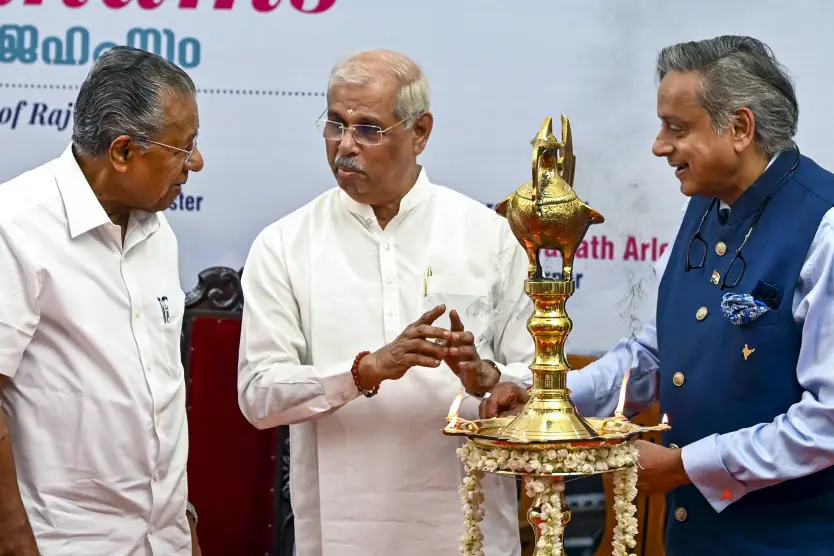
I had the pleasure recently of participating in an unusual instance of a rare phenomenon in our conventional politics – an example of gubernatorial outreach to the general public. The occasion was the release of “Rajahams”, the official in-house journal of the Kerala Raj Bhavan. Raj Bhavans rarely issue their own publications, and Governors do not usually see outreach to the public as being among their principal duties. But this publication is an exception. It is not a mere chronicle of events—it is a living testimony of the Governor, Rajendra Arlekar’s, commitment to constitutional values, inclusive development, and service to the people.
The very name ‘Rajahams’ evokes a wealth of images from our cultural memory. In Sanskrit literature, the hamsa—the swan—is celebrated as the bird of wisdom and purity. Kālidāsa, in his immortal works, used the image of the hamsa as a messenger gliding across skies, carrying songs of love, duty, and longing. In Meghadūta, the poet gives wings to yearning, while in Raghuvaṃśa he likens the swan’s gait to the grace of noble queens. Ancient lore even speaks of the hamsa as a bird capable of separating milk from water—a symbol of discernment, the ability to choose the true from the false. What better name, then, for a journal that seeks to convey truth, culture, and values from the Raj Bhavan to the people?
Internal communication, it is often said, is the success mantra of every great establishment. Just as the swan becomes a bridge between realms, Rajahams becomes a bridge between governance and the governed. In this way, Raj Bhavan does not remain a distant institution, but one that listens, reflects, and shares.
In the Indian constitutional scheme, the Governor occupies a curious space; he is a figure both exalted and elusive. Appointed by the President, yet expected to act as the constitutional head of a state, the Governor is often seen as a ceremonial presence, a dignitary who presides over oath-taking ceremonies, signs bills into law, and occasionally delivers speeches drafted by the elected government. But beneath this formal veneer lies a deeper tension: what do the people expect of their Governor, and should that role evolve?
Traditionally, the Governor is viewed as three things. First, a neutral constitutional guardian, expected to uphold the Constitution, especially during political uncertainty, such as hung assemblies or breakdowns in governance. Second, a dignified “elder statesman”. Often a retired bureaucrat, judge, or politician, the Governor is imagined as wise, aloof from partisan fray, and above the hurly-burly of daily politics. Finally, a ceremonial figurehead, presiding over Republic Day parades, convocation ceremonies, and official receptions, the Governor’s public visibility is often symbolic rather than substantive. A “man of the people” is decidedly not among his (or her) job descriptions.
Yet this image is increasingly at odds with public sentiment. Citizens, especially in politically aware states, often perceive Governors as agents of the Centre, wielding discretionary powers in ways that may seem partisan or opaque. Controversies over assent to bills, delays in legislative approval, or interventions in university appointments have sharpened scrutiny. There is a compelling argument for reimagining the Governor’s role as more directly connected to the people.
Democratic legitimacy, for one thing, demands it. While not elected, Governors govern in the name of the people. Greater transparency, accessibility, and responsiveness could enhance their credibility. Governors could also play a vital role in educating citizens about constitutional values, federalism, and civic duties -- especially in times of democratic strain, such as increasing tensions between Governors and the state governments over which they preside. And there is a case for moral leadership: in moments of crisis -- communal tension, natural disasters, or institutional breakdowns -- a Governor who speaks with moral clarity and empathy can unify and reassure. Regular dialogues with students, NGOs, and citizen groups could make the Raj Bhavan a space of civic engagement rather than distant protocol.
Kerala, of course, provides the perfect soil for such a venture to take the form of a journal from the Raj Bhavan to the general public. We are the proud heirs of an unparalleled literary tradition. Our 200-year-old State Central Library in Thiruvananthapuram stands as a living monument to that heritage. From Ulloor S Parameswara Iyer’s classical elegance, to Kumaran Asan’s soulful reformist poetry, to the many luminous voices of Thiruvananthapuram who enriched Malayalam letters, our capital has been a fountainhead of cultural light.
It is fitting, then, that ‘Rajahams’ does not confine itself to official proceedings alone. It opens its wings to cultural reflections as well. I was especially delighted to see contributions such as Dr K Jayakumar’s article on the cultural underpinnings of Vishu, which carry us back to the innocent joys and nostalgic rhythms of our childhood. To borrow Francis Bacon’s timeless words: “Reading maketh a full man.” A journal like this not only informs but also inspires -- it shapes the mind and refines the heart.
At the same time, this publication does not shy away from pressing realities. The Governor has rightly focused attention on issues such as drug abuse and the violence it spawns, which threaten to erode the very fabric of our society. One of the articles, by his legal adviser, also raises a thorny constitutional question, prompting the Chief Minister, in his remarks on the occasion of the publication’s release, to distance his government from the contents of the publication. But that’s fine: it’s the Governor’s magazine, not the elected government’s. By engaging with such challenges openly, ‘Rajahams’ strengthens Governor Arlekar’s aspiration of turning Raj Bhavan into a Lok Bhavan, a people’s institution that mirrors both the dreams and concerns of Kerala.
As we released this inaugural issue, with the Chief Minister presenting me the first copy, I expressed the hope that Rajahams, like the mythic swan, will continue to soar gracefully, carrying messages of wisdom, values, and hope across our beloved State. May it remind us always that governance is not about walls and boundaries, but about wings -- wings that carry trust, culture, and inspiration to the people.
This is not a call for populism or political activism on the part of Governors. Rather, it is a plea for Governors to embody the spirit of constitutional democracy -- not merely its letter. A Governor who listens, explains, and occasionally questions in public view can enrich the democratic fabric without breaching constitutional propriety.
India’s federalism is not just a legal arrangement; it is a lived experience. The Governor, as its symbolic custodian, must reflect not only the will of the Centre but the pulse of the state. Perhaps it is time to ask: can the Raj Bhavan be less of a fortress and more of a forum, truly a House for the People, in spirit if not in name a Lok Bhavan?
Published: 15 Nov 2025, 09:55 am IST
ABOUT THE AUTHOR
Related Topics
Disclaimer: Kindly avoid objectionable, derogatory, unlawful and lewd comments, while responding to reports. Such comments are punishable under cyber laws. Please keep away from personal attacks. The opinions expressed here are the personal opinions of readers and not that of Mathrubhumi.