

What made Chopra’s fall all the more extraordinary was his own enviable record of success up until now.
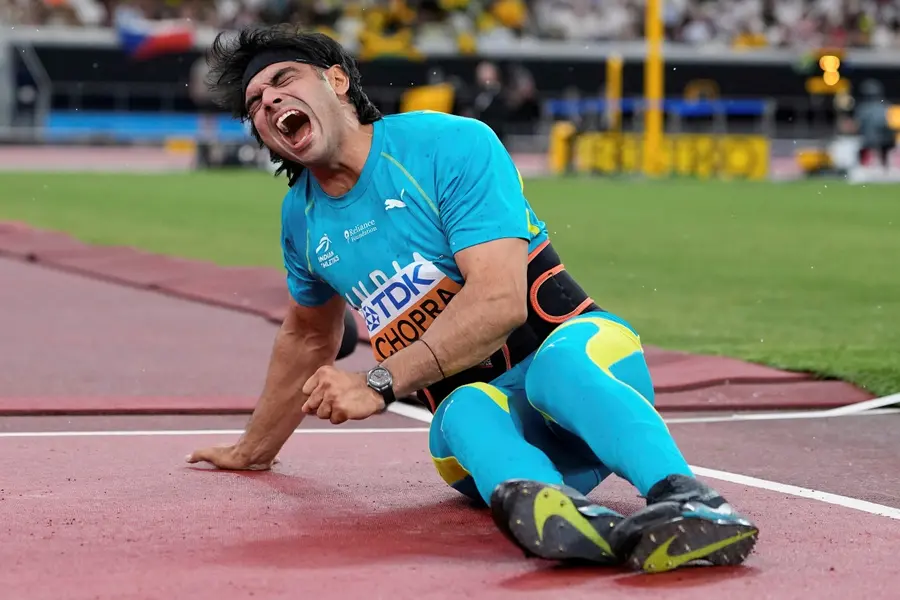
Too much expectation can be the enemy of all pleasures! Decades ago when I was in college a professor had this to say in a specific context but that sentiment came to mind watching our icon Neeraj Chopra struggle and then collapse in his pet javelin event in the World championship in Tokyo. A million eyeballs the world over wanting to see another high from this great talent were in for a shock. The expected highs turned to sighs of disbelief. Never having had the experience of not being in the top since he rose to be a powerhouse in javelin, the agony that came forth on that evening simply seemed out of place. In effect the venue where he first rose to earn a celebrity status with his gold medal in the Olympics, Chopra unfortunately had the mortification of falling low at the same venue.
True, as in life, so in sports, ups and downs are part and parcel but somehow Chopra had always looked unshakable. If not a win, at least finishing among the top two or three seemed the norm. But as it turned out it was after over 2500 days or 33 events that this great Indian had missed out on a podium finish. Imagine the enormity of the disappointment then! Even less than a month ago in Zurich in the Diamond League final Chopra had managed to finish second for the third straight year. There also Chopra had been trailing third for most part before his final heave of 85.01 m helped him to jump to second spot edging out Trinidad and Tobago’s Keshorn Walcott. As it happened, it was Walcott who stole a march on everyone to emerge as the world champion in Tokyo. This was Walcott’s first global title since his 2012 Olympic gold — and the man who helped engineer his turnaround was none other than Dr Klaus Bartonietz, the German biomechanics expert. More importantly, he’s the same coach who previously trained Neeraj Chopra. Ironies never cease!
Not that Chopra is in the hands of a lesser-known figure now. Jan Železný, the legendary Czech athlete, is the greatest name in the world of javelin — the man who launched the spear to a mammoth distance of 98.48 metres, a world record set in 1996. Železný is considered the ultimate authority in the sport, and it’s safe to assume he has been a source of inspiration for the Indian ever since joining his coaching team earlier this year.
But then, what could even he do when his athlete was not in peak physical condition?
As Chopra later revealed following his shock exit, he had been carrying a back injury, sustained during training. Yet, he believed he could still go the distance. When he appeared for the initial qualification round with a strong belt strapped around his midriff, it may have been a clue — though many dismissed it as standard support gear, as the ever-energetic Indian showed no visible signs of discomfort.
His self-confidence drove him forward, his mind firmly fixed on the target — but, unfortunately, the means to achieve that goal failed him on the day.
What made Chopra’s fall all the more extraordinary was his own enviable record of success up until now. It is doubtful whether any other Indian sportsperson in recent times has captured the public’s imagination quite like this humble native of Haryana. Rarely has one seen an Indian in an Olympic discipline rise with such dominance and take the world by storm.
Yes, we have had chess wizard Viswanathan Anand as a worthy parallel, and Pankaj Advani, the billiards and snooker specialist, for company. Both have been undisputed masters in their respective fields — and chess, in particular, is currently witnessing a revolution of sorts, thanks to Anand’s lasting legacy.
Perhaps javelin will follow suit. A strong indication came at this very World Championships, when another Indian, Sachin Yadav, shot into the limelight with a remarkable fourth-place finish — and, more notably, ahead of Chopra himself.
For someone who had crossed the 90-metre barrier just once — at the Diamond League in Doha earlier this year — many following him would have expected Chopra to spring another surprise in Tokyo. Under a new coach, and a world-beater at that, the Indian was believed to have trained in a new technique to push his limits.
But, as he himself admitted, the back injury “finished off everything,” though he still held out hope till the last moment of making it to the podium — even if only through one big throw.
In the end, amid the disappointment, Chopra will still take solace in knowing that the streak he began nearly seven years ago has inspired at least one more Indian to rise and get noticed. The young man from Uttar Pradesh, Yadav, is already being spoken of in glowing terms.
This was only his second international outing, and his 86.27m throw bettered his previous best of 85.16m, recorded at the Asian Championships in May.
Keen observers are already viewing him as a talent capable of dominating the javelin scene for years to come, with consistent 90-metre-plus throws.
Surely, interesting times lie ahead. For Chopra is not one to sit back in disappointment. He will no doubt begin the next phase of training at the earliest — determined to prove that all is not lost when it comes to his golden arm.
Published: 23 Sept 2025, 07:30 am IST
ABOUT THE AUTHOR
Related Topics
Disclaimer: Kindly avoid objectionable, derogatory, unlawful and lewd comments, while responding to reports. Such comments are punishable under cyber laws. Please keep away from personal attacks. The opinions expressed here are the personal opinions of readers and not that of Mathrubhumi.