
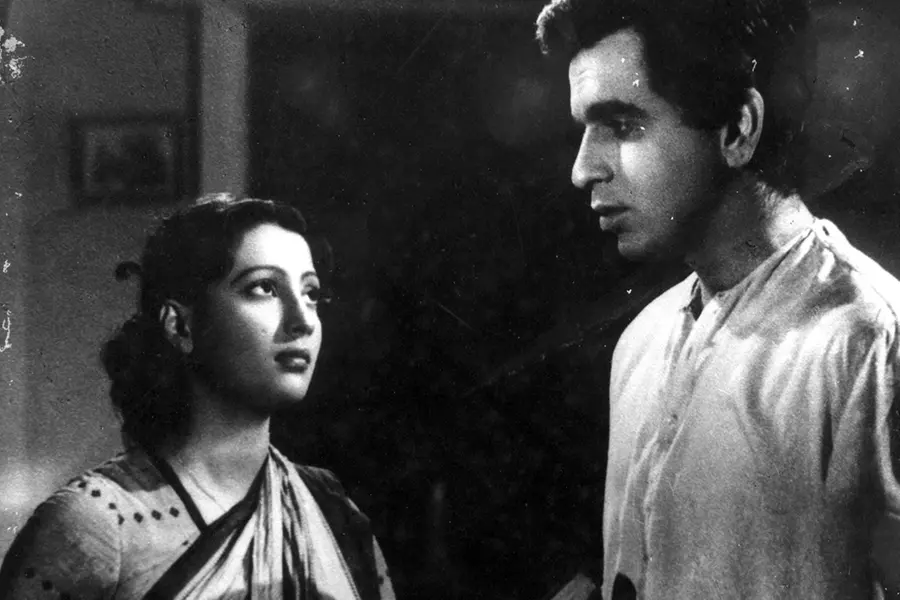
Devdas (1935), produced by New Theatres, is an all-time hit. It made Pramathesh Chandra Barua (1903-1951) a star overnight and revolutionalised the concept of cinema as entertainment into (a) cinema of social concern and (b) literature expressed through celluloid. Sarat Chandra, a then-frequent visitor at the New Theatres studio in south Calcutta, told Barua after seeing Devdas, “it appears that I was born to write Devdas because you were born to re-create it in cinema.” It was a rare tribute from a writer to the actor-director of a film based on his story. Bimal Roy was the cameraman of New Theatres’ Devdas. It was his first film as independent cinematographer.
Sarat Chandra Chattopadhyay (1876-1938) wrote Devdas in 1901 when he was 17. But he could not find a publisher till 1917. Sarat Chandra was sympathetic to the woman – repressed at home and tortured outside. He was partial to those who, for no fault of theirs, incurred the disapproval or displeasure of the family or community. The social and domestic atmospheres in Sarat Chandra’s works do not exist anymore. But the story interest keeps the reader hooked, irrespective of the plausibility or otherwise of the narrative.
His stories are extremely cinema-friendly and therefore, many of his novels appear as topical to the Indian filmmaker as stories written by contemporary writers. Translated in many Indian languages, Devdas as film has been made around 14 to 15 times. The one made by Sanjay Leela Bhansali (2002) with Shahrukh Khan playing the hero, Aishwarya Rai his girlfriend Paro and Madhuri Dixit as Chandramukhi was an exaggerated, lavishly mounted mega drama which was glitzy and glamorous and retained nothing of the naïve innocence of the legendary love story. The latest heard version was Daas Dev by Sudheer MIshra which died with a whimper.
Mishra’s Daas Dev is a film about power as it gets in the way of love. Mishra tells us a reverse tale of Sarat Chandra Chatterjee’s Devdas where his Dev ultimately breaks free of his addictions and dynastic ambitions of his family. Neither does Paro stay trapped behind a big gate inside her husband’s house. As for Chandni- is she a money handler, fixer, manipulator or simply a girl in love? In today’s world, will our characters come together and ditch the Daas? This is somewhat vague and confusing but perhaps, this has been done by design because the makers do not want the story to leak.
The two films that run completely off the mark from the original story of triangular love that ends in tragedy are Anurag Kashyap’s Dev D and Sudhir Mishra’s Daas Dev and this perhaps explains the tweaking of the titles of these two films. Santanu Mandal, a researcher in literature, in his paper, Love’s Labour’s Not Lost – 21st Century Reincarnation of Devdas, offers a brilliant and imaginative reading of Anurag Kashyap’s Dev-D, a novel and very different celluloid avatar of Sarat Chandra’s novel. This Bengali novel, finally accepted by the publisher in 1917, began its celluloid journey from the silent era in 1928. The memorable ones are Pramathesh Barua’s version in Bengali and Hindi (1935-36) for New Theatres and Bimal Roy’s Devdas (1955) featuring Dilip Kumar, Vyjayantimala and Suchitra Sen, with a beautiful musical score in all three films that remained faithful to the original novel. The third most discussed and debated version is Sanjay Leela Bhansali’s Devdas (2002) in bright colour with loud music, lots of songs and exaggerated melodrama, the version the present young generation are most familiar with. This version projects a hysterical, rather than failed, masculinity without showing why this myth is so popular:
Devdas continues to be Sarat Chandra Chatterjee’s most successful and controversial novel. The most marked feature in Sarat Chandra’s work was his concern for the inner-life of his characters. Most of his novels are explorations of personal relationships; uncomfortable relations between judgment and compassion; torturing conflict between instinct and ideals; and problems of finding space between social consciousness and half-awakened personal instincts.
P C Barua’s Devdas left such a deep impression on its strapping young cameraman that when the same person, Bimal Roy, decided to make a Hindi version of the film 20 years later, his climax was the exact replica of the climax of New Theatres’ Devdas. Barua used Sarat Chandra Chatterjee's novel as his raw material, creating his own structure and transforming what was purely verbal into an essentially visual form. Avoiding stereotypes and melodrama, Barua raised the film to a level of noble tragedy.

grand music, numerous songs and intense melodrama
The difference between Barua’s Devdas and Bimal Roy’s Devdas is subtle, but strong. It lies in the style and interpretation of character through acting that had changed from Barua to Dilip Kumar, already established as the top tragic hero of Hindi cinema. Vyjayantimala’s Chandramukhi is embellished with her graceful dance style that evolves with her transition from a dancing woman to a woman, who, in love with Devdas, has unconsciously mutated to reflect the mainstream woman. The change in Chandramukhi is evident from Ab aage teri marzi through O jaanewale ruk jaa thodi dum to Jise tu kabool kar le woh ada kahan se laoon sung by Lata Mangeshkar, a timeless number, and Mubarak Begum's Woh na aayenge palatke, unhein lakh hum bulayein. She dances only on a music track when she tries to revive Devdas from his drunken stupor and then begins to sing Jise tu kabool kar le to bring him back. At one point, Devdas laments, “Parvati and you are so different from each other and yet so very similar.” The differences between the two have blurred beyond recognition.
The film's characters are not heroes and villains but ordinary people conditioned by a rigid and crumbling social system. Even the lead character, Devdas, has no heroic dimensions to his character. What one sees are his weaknesses, his narcissism, his humanity as he is torn by driving passion and inner-conflict. Bimal Roy’s Devdas reflects an almost identical approach. Seen in retrospect, the two women in his life, Parvati and Chandramukhi, are stronger than he is, as independent women with minds of their own. Devdas is an unwitting catalyst in Chandramukhi’s life.
Unlike Barua, Bimal Roy creates a build-up of the love between Devdas and Parvati by tracing their childhood through Devdas’s pranks and Parvati backing him up all the time. Some of their ‘signals’ are echoed when they grow up and Devdas throws a stone on the roof of Parvati’s house to call her, like he did when they were kids. Roy dots these with songs and two baul numbers, namely, Geeta Dutt-Manna Dey's Sajan ki ho gayee and the eternally beautiful Aan milo Shyam saawre, drawing on the Radha-Krishna allegory to symbolize the tragedy of their love. The music, composed by S.D. Burman on lyrics penned by Sahir Ludhianvi is another hallmark of this beautiful film. Background music is used very sparingly. In the shot showing the transition of Parvati from a little girl to a grownup woman when she goes to fetch water in the local pond, a line of basant bahar plays in the background, indicating the coming of spring as Devdas is coming back to the village. Once more, when Chandramukhi picks Devdas off the streets and brings him to her abode, off the frame, she belts out a line of song in bhairavi, a morning raga, and a metaphor on the breaking of a new dawn in her life.
Set against the backdrop of rural Bengal during feudal times, Devdas is the story of a doomed love affair between Devdas, son of the local zamindar, a high-caste Brahmin, and Parvati, the daughter of a poor neighbour, also a Brahmin, but belonging to a slightly lower status in terms of caste, affluence and status. They grow up as childhood sweethearts. But when they decide to marry, Devdas’ father puts his foot down, packing his younger son off to Calcutta for higher studies. Parvati’s marriage is finalized with a wealthy zamindar, a widower with children older than his young second wife. Learning about Parvati’s marriage, Devdas rushes back to his village and tries to stop the marriage, in vain. Parvati is prepared to elope with him but Devdas refuses and Parvati leaves his room in the middle of the night, castigating him for his cowardice.
Chunilal, who introduces him to an attractive and strong-willed courtesan, Chandramukhi, initiates Devdas into the darker corridors of the city. Devdas finds an easy escape in drink and though he insists that he hates Chandramukhi, he keeps coming back to her for moral support. Chandramukhi falls in love with him. He meets Parvati once more, when he returns to the village to perform the last rites of his father. He bequeaths his share of the family wealth to his older brother, ear-marking a part of it for his mother during her lifetime. Parvati pleads with him to give up drinking. He evades a direct reply and instead, promises to see her at least one last time before he dies. Back to the city, he drowns himself in drink. Chandramukhi gives up the life of a professional courtesan and concentrates on nursing Devdas back to health. He gives up drinking for some time and is advised to go on a holiday. He embarks on a train journey across the country, destination unknown. He stealthily runs away one night, leaving his faithful family retinue Dharamdas in the train when he chances upon a junction station that will take him to Manikpur where Parvati lives. He treks along in a bullock cart to see Parvati one last time. He dies a tragic and painful death under a tree outside her house before Parvati can see him.
One interpolation Bimal Roy made is the scene showing Parvati and Chadramukhi crossing each other’s path without speaking. Underscoring the class difference between the two women, Parvati is travelling in a palki but Chandramukhi, draped in a red-bordered white sari, like any ordinary Bengali housewife, with the end of her sari drawn over her head, is walking down an earthy path between two fields. Parvati shifts the curtains and peeps out of the palki to look at her, she looks back too, and then they go their different ways. The two women moving in opposite directions is a pointer to the directions their lives have taken with Devdas forming the apex of this tragic triangle. The original story gives no inkling about Chandramukhi having been a dancing woman. Bimal Roy perhaps wished to make optimum use of Vyjayantimala’s dancing talent. It added another dimension to the character and sharpened the impact of the transformation in the woman without disturbing the essence of the original story.
Roy used the jump cut several times towards the end when Devdas is travelling by train. In a touching shot we see Devdas vomiting blood during his travels. The camera cuts to Parvati falling in a faint, far away in her village home. In a night scene on the train, as soon as Devdas calls out to Paro, the scene cuts once again to show Parvati screaming out in her sleep, in the middle of a nightmare. Her husband tells her she is mistaken. These scenes spell out the psychological stress his characters were reeling under, as also the telepathic bonding the lovers shared, without reducing these to melodrama or using sentimental dialogue.
Devdas, the character, is a failure in life, in love and within his family. He is a bad son who is “whitewashed” by the author when he gives away his share of the inheritance to his mother and walks away. But he does not give it out of love and duty to his mother. He does it because he has already stepped into a world where his family, including the inheritance, have become meaningless for him. Do failures in cinema and literature make great heroes for the audience and the readers? Shakespeare’s Hamlet and Othello are also failures, if looked at from a different perspective. Yet, they are immortalised in different representations in literary criticism, drama and cinema. The two women in Devdas’s life are stronger, more confident and powerful than Devdas could ever hope to be. They make their choices when they have to and generally live life on their own terms. Not so, Devdas. The narcissistic, tempestuous love that he always is, he wallows in self-pity, his ego hurt by his father’s rejection and Paro’s marriage to a kind zamindar old enough be her father, so that her virginity is intact, he makes alcohol his wife, his mistress, his companion in life and death.
Published: 26 Mar 2025, 11:44 am IST
Related Topics
Disclaimer: Kindly avoid objectionable, derogatory, unlawful and lewd comments, while responding to reports. Such comments are punishable under cyber laws. Please keep away from personal attacks. The opinions expressed here are the personal opinions of readers and not that of Mathrubhumi.