Rare double comet spectacle set to unfold; How you can view it in India
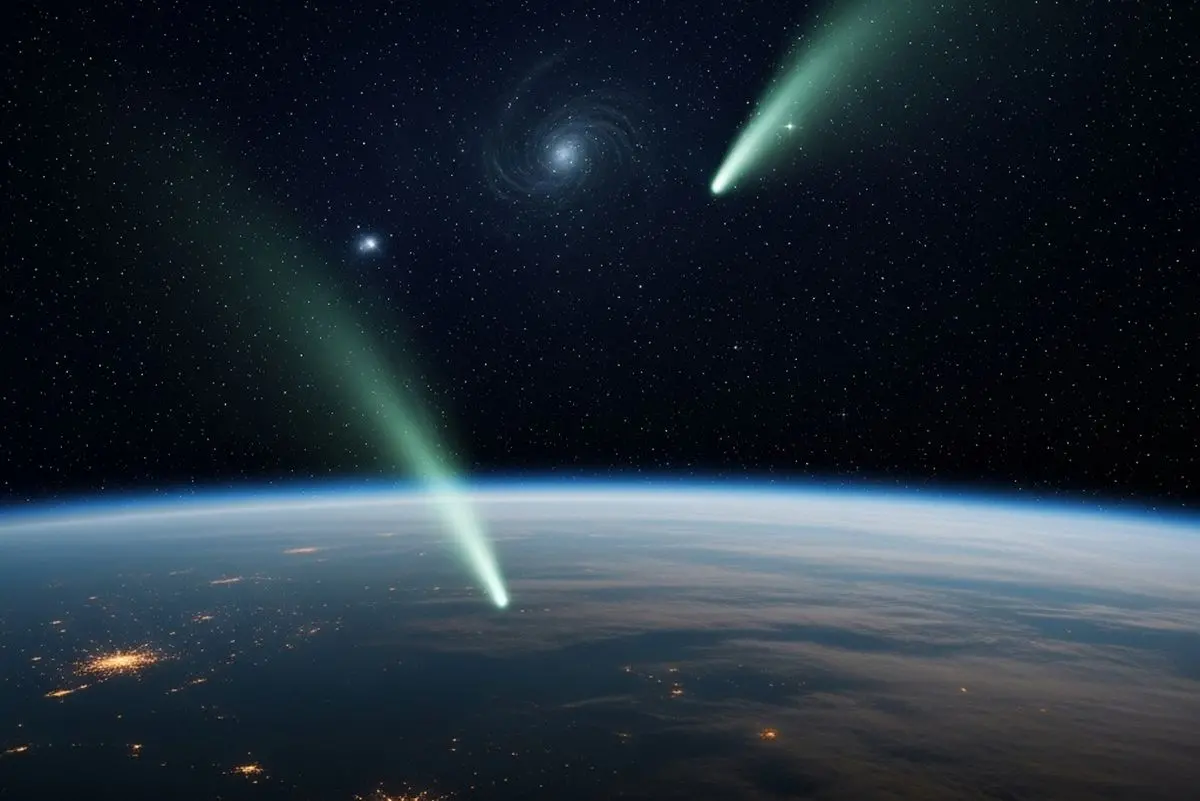
A newly discovered comet will make its closest approach to Earth on October 21, offering skywatchers a rare celestial spectacle visible through binoculars or small telescopes. Comet C/2025 R2 (SWAN) may even be faintly visible to the naked eye under perfectly dark skies.
The timing couldn't be better for observers. Monday marks a new moon, ensuring dark skies free from lunar interference, while the peak of the Orionid meteor shower adds to the astronomical show. Ukrainian amateur astronomer Vladimir Bezugly first spotted the comet on September 10 through imagery from the Solar Wind Anisotropies (SWAN) instrument aboard NASA's Solar and Heliospheric Observatory.
The comet will pass within 0.26 astronomical units (about 24 million miles) of Earth on October 20-21.
Since its discovery, C/2025 R2 has significantly brightened as solar heat causes frozen materials in its nucleus to sublimate directly from solid to gas, creating its characteristic glowing tail.
Rare double comet event
Adding to the spectacle, a second comet, C/2025 A6 (Lemmon), is simultaneously visible in the northwestern sky, making October an exceptionally rare month for comet enthusiasts. Comet Lemmon, discovered in January by the Mount Lemmon Survey in Arizona, is currently brighter at magnitude 4.8 to 5.2 and may be visible to the naked eye under dark skies.
The dual appearance marks the first time amateur astronomers can observe multiple comets since Comet Tsuchinshan-ATLAS appeared in October 2024. Both comets are moving away from the sun after their perihelion passages and will gradually dim in the coming weeks.
Will the comet be visible from India?
Comet C/2025 R2 (SWAN) will be visible from India during its close approach this week, especially in the evening sky after sunset.
The optimal time to observe is the hour immediately after sunset, when the comet will be low in the south-southwestern sky. The brightness is currently around magnitude 5.6–6.3, so it may be faintly visible to the naked eye only under exceptionally dark rural skies, but binoculars or a small telescope will make it easy to spot.
The comet appears as a diffuse greenish-blue glow; a thin, wispy tail may be visible through optics. Weather conditions, light pollution, and moon phase are important factors. The coming days are optimal, as moonlight is minimal and the Orionid meteor shower is at its peak, offering a bonus celestial show.
Look for clear skies and try to get away from city lights for best results. For exact current positioning, stargazing apps and online comet trackers can provide real-time coordinates. Comet C/2025 A6 (Lemmon) is also visible after sunset, providing a rare double comet event for observers in India.