PRL scientists capture rare images and spectra of interstellar comet 3I/ATLAS at Mount Abu
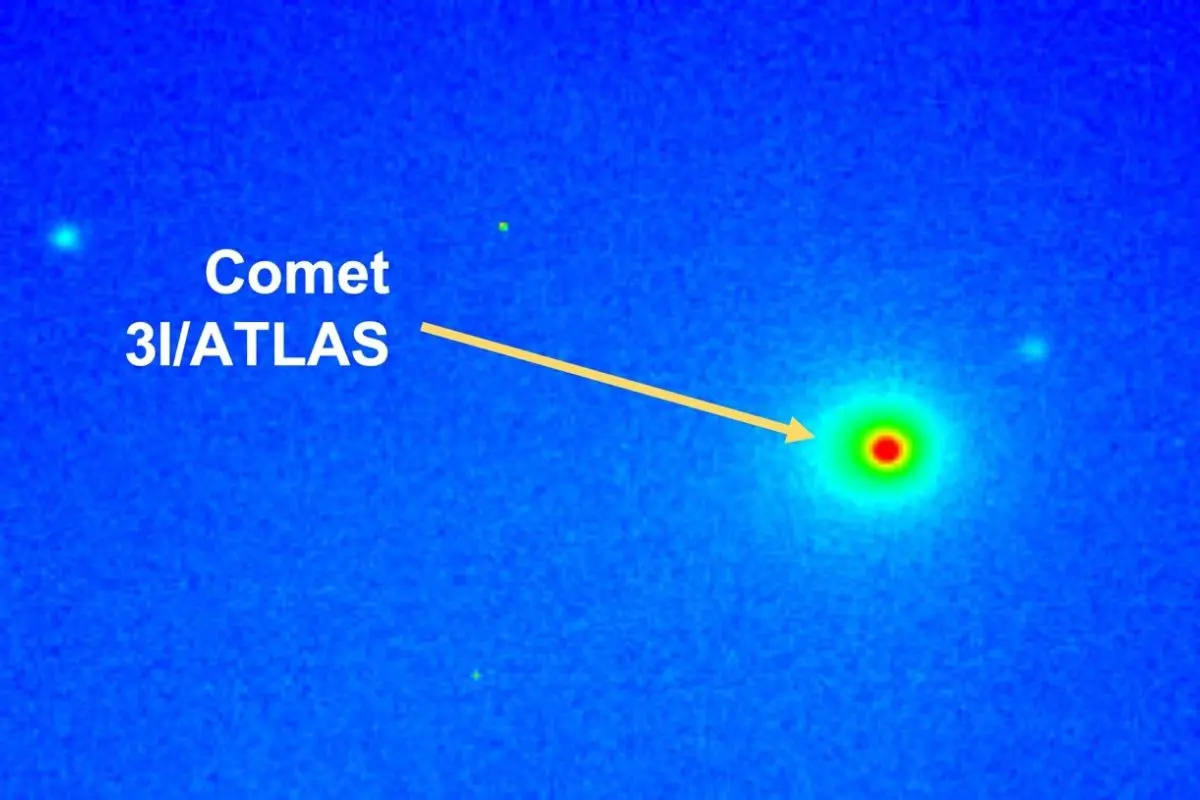
New Delhi: Scientists at the Physical Research Laboratory (PRL) in India have successfully captured detailed imaging and spectroscopic data of the interstellar comet 3I/ATLAS, currently on its trajectory out of the inner Solar System after its closest pass to the Sun (perihelion). These observations were carried out between November 12 and 15, 2025, using PRL’s 1.2-meter telescope at Mount Abu, a prominent ground-based facility renowned for its astronomical research.
PRL’s Advanced Imaging Reveals Coma Structure
The team utilised wide-area imaging in the red filter, producing false colour images that clearly display the comet’s near-circular coma—the glowing atmosphere of gas and dust that surrounds the nucleus. The coma is formed as solar heat causes frozen ices on the nucleus to vaporise, releasing gases and dust that expand into a diffuse cloud. Notably, the current viewing geometry indicates that any dust tail would be oriented away from the Sun and behind the comet, as seen from Earth, while deep multiband imaging is expected to reveal the ion tail.
Spectroscopic Analysis Confirms Solar System-Like Features
Prior to the start of morning twilight, PRL scientists obtained a flux-normalised spectrum of 3I/ATLAS using the LISA spectrograph. The analysis revealed prominent emission features typical of Solar System comets, including the CN, C₂, and C₃ bands at shorter wavelengths. These molecular signatures provide critical clues to the comet’s composition and behaviour as it interacts with sunlight.
Comet Activity Labelled as ‘Typical’
A key highlight of the study was the measurement of 3I/ATLAS’s production rates—the quantity of gas released from the nucleus each second. The comet’s emission for the primary molecular bands was found to be near 10251025 molecules per second, a sign consistent with ‘typical’ Solar System comets. Production rates fluctuate based on the comet’s distance from the Sun and its internal composition and are vital for assessing its activity level.
Ongoing Studies at Mount Abu Observatory
The PRL’s 1.2-meter telescope at 1680 meters altitude near Gurushikhar continues to serve as a pivotal facility for solar system and exoplanet research. Scientists plan to extend their observations as 3I/ATLAS moves into darker night skies, providing further insights into the nature of this rare interstellar visitor.