Trump leaves for China as AI chips, Taiwan and Iran war dominate Xi summit agenda
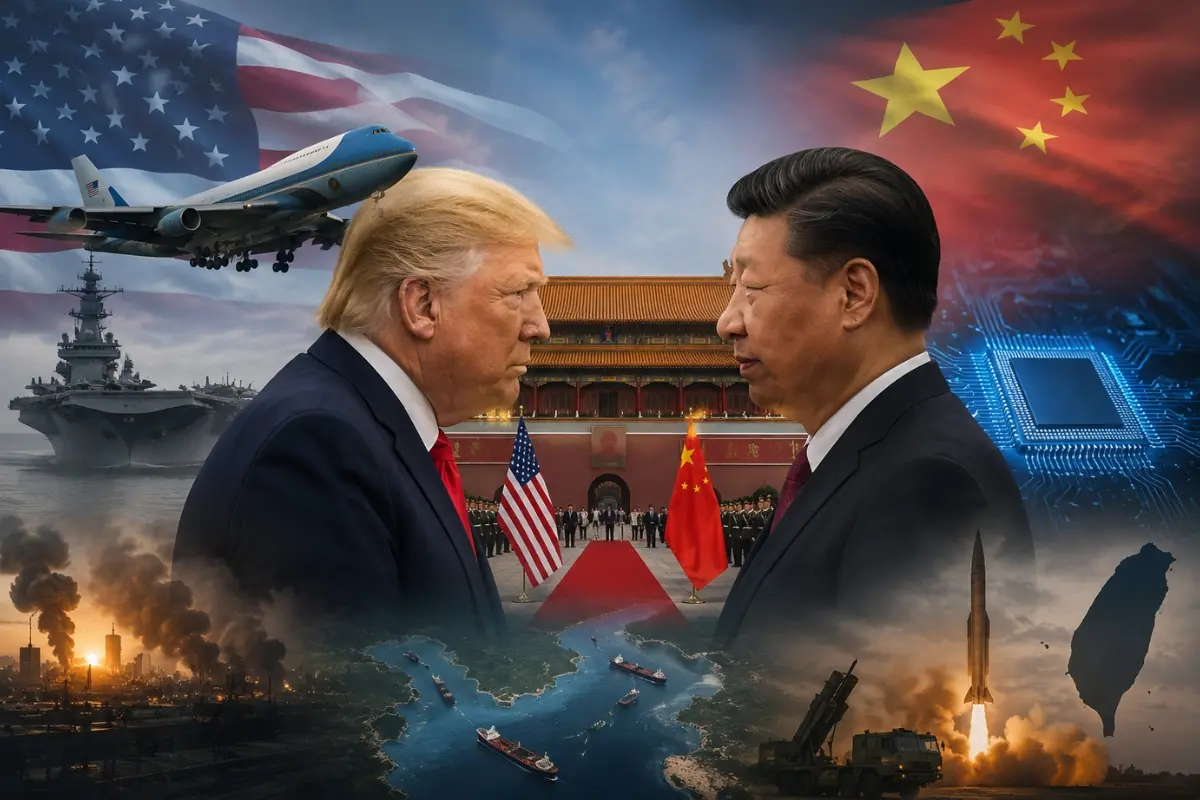
Washington DC: US President Donald Trump is visiting China for the first time since 2017, but the atmosphere surrounding the summit is vastly different from his earlier visit.
During Trump’s first presidential trip to Beijing nearly a decade ago, the relationship between Washington and Beijing was still largely centred around trade discussions and personal diplomacy with Chinese President Xi Jinping. In 2026, however, the relationship has transformed into a broader strategic rivalry involving technology, military tensions, sanctions and geopolitical competition.
The summit between Trump and Xi is expected to include discussions on trade, artificial intelligence, Taiwan, rare earth exports and the ongoing Iran conflict.
Iran war emerges as a key summit issue
The ongoing Iran war has unexpectedly become one of the biggest issues hanging over the Beijing summit.
China remains one of the largest buyers of Iranian oil despite US sanctions. Just days before Trump’s arrival, the US Treasury imposed sanctions on several individuals and entities, including some based in Hong Kong, accusing them of facilitating Iranian oil shipments to China.
Before departing Washington, Trump said he expected a “long talk” with Xi regarding Iran but insisted that the United States would prevail “peacefully or otherwise”.
At the same time, Beijing appears increasingly concerned about instability in the region. Chinese Foreign Minister Wang Yi reportedly urged Pakistani Foreign Minister Ishaq Dar to help mediate between Iran and the United States and contribute to preventing disruption around the Strait of Hormuz.
The development has highlighted Pakistan’s emerging role as a diplomatic intermediary in one of the world’s most volatile geopolitical crises.
Taiwan comments draw international attention
Trump’s remarks on Taiwan have also attracted global attention ahead of the summit.
The US president said earlier this week that he intended to discuss US arms sales to Taiwan directly with Xi, a statement viewed by analysts as a potentially significant shift in tone because Washington has historically avoided implying that support for Taiwan could be negotiated with Beijing.
Despite growing tensions, Trump expressed confidence that his personal relationship with Xi would help prevent military escalation involving Taiwan.
“I think we’ll be fine,” Trump told reporters before leaving the White House, adding that Xi understood he did not want conflict over the self-governing island claimed by China.
AI chips and rare earths likely to dominate talks
Technology competition is expected to dominate major parts of the summit discussions.
China’s restrictions on rare earth exports and ongoing US semiconductor controls have become central areas of conflict between the world’s two largest economies. Rare earth minerals are essential for electric vehicles, defence equipment and advanced electronics, while AI chips are critical to the rapidly expanding artificial intelligence industry.
In a major development, Nvidia CEO Jensen Huang joined Trump’s China delegation after reportedly receiving a direct invitation from the president following media reports about his absence from the trip.
Huang’s participation has intensified focus on semiconductor diplomacy and the future of AI chip exports to China.
The delegation also includes major American business leaders such as Elon Musk and Tim Cook, underscoring how heavily US technology companies still depend on Chinese markets and manufacturing despite years of political tensions.
China faces economic pressure at home
The summit also comes at a difficult time for China’s domestic economy.
The country continues to face sluggish consumer spending, a prolonged property sector crisis and slowing economic growth. Analysts believe Beijing may be seeking greater economic stability and improved investor confidence amid these ongoing challenges.
At the same time, security measures across Beijing reflected the sensitivity surrounding Trump’s visit. AFP journalists reported increased police deployment, stricter identity checks at metro stations and tighter surveillance around major intersections ahead of the summit.
The Trump-Xi meeting is now being closely watched around the world as a critical test of whether Washington and Beijing can prevent strategic competition from escalating further.
Unlike the trade-focused tensions of previous years, the relationship between the two countries is now shaped by interconnected disputes involving military strategy, energy security, artificial intelligence and global supply chains.
The outcome of the summit could influence not only US-China relations but also the wider geopolitical balance across Asia, the Middle East and the global technology industry.