₹1.8 lakh crore defence output: Is Make in India ready for the global battlefield?
India’s defence manufacturing sector is entering an important phase of growth, with Defence Public Sector Undertakings (DPSUs) being asked to move beyond their traditional role as government-owned manufacturers and emerge as globally competitive technology and defence companies.
The message was clear at the annual performance review of 16 Defence PSUs held in New Delhi. Defence Minister Rajnath Singh called for stronger indigenous production, lower import dependence, greater investment in research and development (R&D), higher defence exports and closer cooperation with Indian start-ups and micro, small and medium enterprises (MSMEs).
The review came at a time when India’s defence production has reached a record level.
The country produced defence equipment and systems worth approximately Rs 1.8 lakh crore in 2025-26, with DPSUs contributing around Rs 1.29 lakh crore to this output.
The numbers underline the growing importance of government-owned defence companies in India’s effort to build a more self-reliant defence industrial base.
₹3,951 crore dividend signals strong DPSU performance
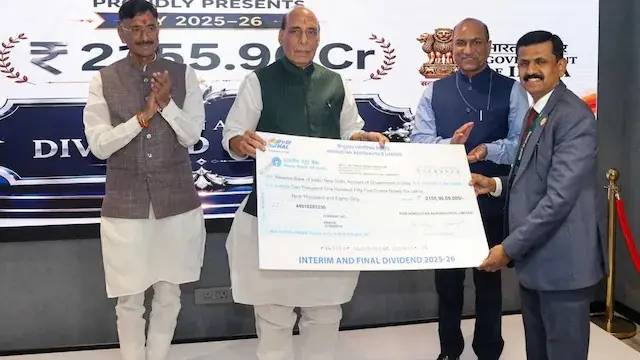
The performance review also highlighted the financial strength of several major defence PSUs. The chairmen and managing directors of seven companies presented dividend cheques totalling Rs 3,951 crore to the Defence Minister for the government’s equity holdings for FY2025-26.
The companies were Hindustan Aeronautics Limited (HAL), Mazagon Dock Shipbuilders Limited (MDL), Bharat Electronics Limited (BEL), Bharat Dynamics Limited (BDL), Garden Reach Shipbuilders and Engineers (GRSE), BEML and MIDHANI.
HAL made the largest contribution, presenting a dividend cheque of Rs 2,155.96 crore to the government.
The combined turnover of the 16 Defence PSUs increased by 15.4 per cent year-on-year, while their cumulative profit after tax rose by 15.6 per cent to Rs 23,136 crore.
These figures show that the Make in India strategy in defence is increasingly being supported by stronger industrial and financial performance.
However, the next challenge will be to convert this growth into deeper technological capability and greater global competitiveness.
From production to self-reliance
For India, ‘Make in India’ in defence is not simply about producing more equipment domestically. It is increasingly about developing the ability to design, manufacture, repair, upgrade and sustain critical military systems within India.
This distinction is important because modern defence capability depends heavily on secure supply chains. Aircraft, helicopters, missiles, radars, electronic warfare systems, naval platforms and other military equipment require a steady supply of critical components, spares and technologies throughout their operational lives.
Singh stressed this strategic dimension during the review, describing the progress of DPSUs as “not merely an economic or industrial necessity; it is a national security imperative.”
Recent conflicts around the world have demonstrated how quickly defence supply chains can come under pressure during prolonged military operations. Disruptions in the supply of engines, components, electronics, ammunition, critical materials and spare parts can directly affect the availability of military platforms.
For India, reducing such vulnerabilities is therefore becoming an important part of national security planning.
Also read | India launches ₹1 lakh crore mission to build next-generation Air Force transport aircraft
Reducing import dependence remains a priority
Despite the growth in domestic defence production, India continues to depend on overseas suppliers for several advanced technologies, components and systems. Singh has therefore asked DPSUs to accelerate efforts to reduce import dependence. This requires a broader approach than simply replacing an imported component with a locally manufactured version.
Indian companies need to develop the underlying technology, intellectual property, manufacturing processes and supply chains needed to sustain these products over the long term.
This is particularly important in aerospace and defence, where the development cycle for complex systems can take years and requires close coordination between manufacturers, research institutions, suppliers and the armed forces.
The objective should be to create an ecosystem in which an increasing share of the value of a defence product is generated within India.
R&D must deliver technology, not spending
Another major focus of the government is the need to make defence R&D more productive. Singh welcomed increased investment in R&D by DPSUs but said success should not be measured only by the amount of money spent. Instead, R&D performance should be judged by the technologies, intellectual property, prototypes and operational products that emerge from these investments.
The country has a large engineering talent pool and a growing technology ecosystem, but converting this capability into globally competitive defence products requires sustained investment, long-term programmes and closer cooperation between government organisations, industry, universities and start-ups. India also needs to identify areas where it can move from being self-reliant to becoming a technology leader.
Advanced avionics, unmanned systems, artificial intelligence, electronic warfare, sensors, propulsion, advanced materials, space-based defence technologies and cyber capabilities are among the areas where technology leadership could provide both strategic and commercial advantages.
Also read | Shakti Sharma makes history: First woman non-medical officer to become Air Vice Marshal
DPSUs need to go global
The government’s ambition extends beyond meeting India’s own defence requirements. Singh called on DPSUs to support the vision of “Make in India, Make for the World” and transform all 16 DPSUs into global giants.
This means Indian defence companies will increasingly need to compete for international customers based on technology, quality, reliability, delivery timelines and lifecycle support.
Defence exports have already become an important part of India’s aerospace and defence strategy.
However, sustained growth in exports will require Indian companies to develop products that are competitive not only in price but also in performance and after-sales support.
For DPSUs, this could also mean developing stronger global partnerships, establishing international service networks and providing long-term maintenance, repair and overhaul (MRO), upgrades and spare-parts support.
Supply chain resilience
A strong domestic defence industry cannot depend only on large DPSUs. It needs a broad network of private companies, MSMEs, start-ups and specialist suppliers.
Singh has therefore urged DPSUs to increase their support for start-ups and MSMEs.
This could become one of the most important elements of India’s defence manufacturing strategy. Large defence programmes require thousands of components and specialised services.
Smaller companies can bring innovation, flexibility and specialised technologies, while DPSUs can provide scale, established infrastructure and access to major defence programmes.
Creating stronger links between these two parts of the ecosystem can help India develop a more resilient domestic supply chain.
For the aerospace sector in particular, this could support the development of local capabilities in precision manufacturing, composites, electronics, machining, additive manufacturing, special processes and aircraft components.
Also read | India supercharges Su-30MKI with lethal 400km R-37M missiles
Quality to decide the next phase of Make in India
As India moves towards becoming a major defence exporter, quality will become increasingly important. Singh has called on DPSUs to ensure that their products meet global standards. This is essential because international customers will compare Indian defence products with offerings from established global aerospace and defence companies.
Competitive manufacturing therefore requires more than localisation. It requires consistent quality, certification, traceability, reliability and timely delivery.
For Indian aerospace and defence manufacturers, building this reputation could open opportunities across global supply chains, including the manufacture of components and systems for international original equipment manufacturers.
HAL gets a future-focused roadmap
The government also released a Modernisation Roadmap of HAL, aimed at transforming the company into a future-ready aerospace enterprise. A separate Indigenisation Roadmap of HAL was also released to support greater self-reliance in the aerospace and defence sector.
These roadmaps are significant because aerospace manufacturing is one of the most technology-intensive segments of defence production. India’s ability to strengthen indigenous aircraft manufacturing will depend not only on aircraft assembly but also on developing capabilities across the wider value chain- including engines, avionics, structures, materials, components, testing, maintenance and upgrades.
Greater localisation in these areas can create long-term industrial capability and reduce dependence on imported systems.
Building a defence industrial ecosystem
The performance of the 16 DPSUs shows that India has already established a significant industrial base for defence manufacturing. The next stage is about making that base deeper, more technologically capable and internationally competitive. The focus on indigenisation, R&D, exports, MSMEs, start-ups and quality suggests that the government is looking at Make in India as an ecosystem rather than simply a manufacturing target.
This approach could have a wider impact on the Indian economy. Defence manufacturing can create skilled jobs, encourage technology development and strengthen capabilities that can eventually find applications in commercial aerospace and other high-technology industries.
Also read | Nvidia-powered Russian AI drones can select targets without human control; why that's dangerous
Self-reliance to global competitiveness
India’s defence manufacturing journey is therefore entering a new phase. The first objective was to increase domestic production. The next is to ensure that more of the technology, intellectual property, supply chain and lifecycle support associated with defence platforms is developed within the country.
The ultimate goal is bigger: to build Indian companies that can compete globally.
The record Rs 1.8 lakh crore defence production in FY2025-26 demonstrates the scale that India has already achieved. The contribution of Rs 1.29 lakh crore from DPSUs shows their central role in this transformation. But production numbers alone will not determine the success of India’s defence industrial strategy.
The real measure will be whether India can develop globally competitive technologies, reduce critical import dependencies, build resilient domestic supply chains, support a strong network of MSMEs and start-ups, and create defence products that are trusted not only by the Indian armed forces but also by customers around the world.
That is where Make in India could evolve from an industrial policy into a long-term strategic capability strengthening both India’s defence preparedness and its position in the global aerospace and defence market.