Could El Nino weaken India's monsoon? IMD issues update
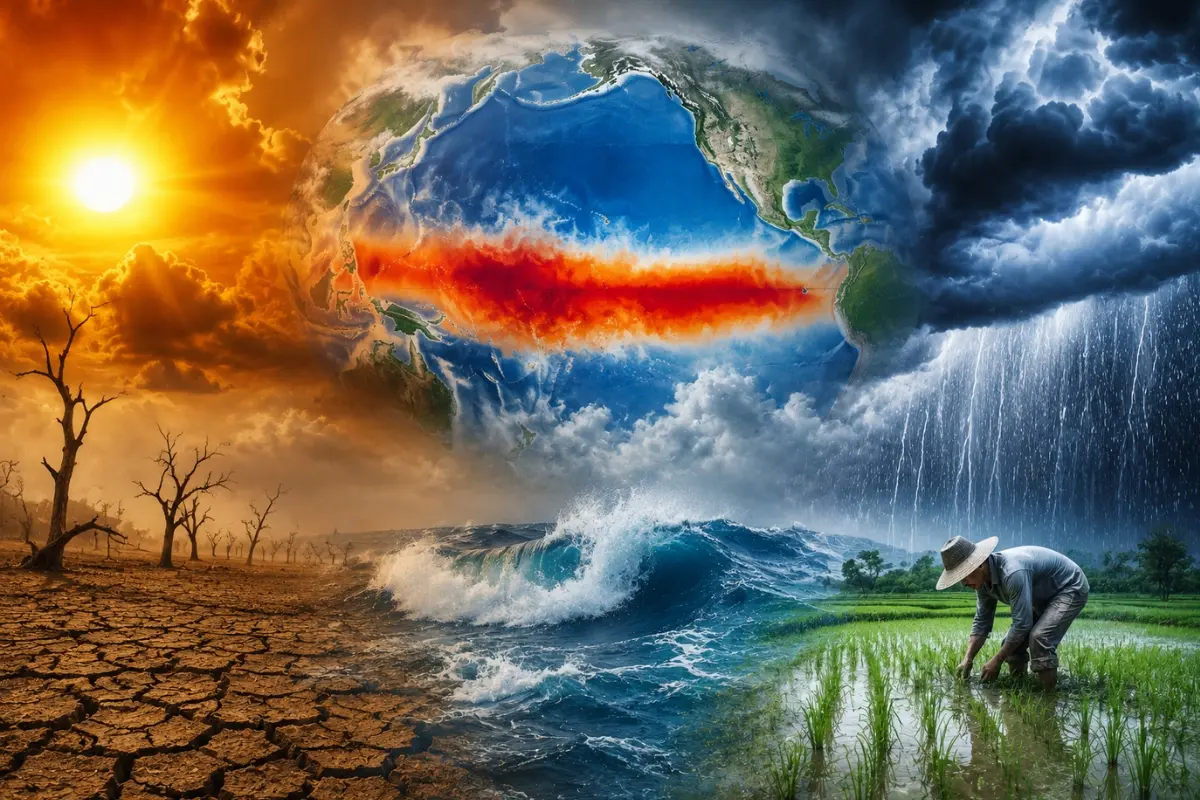
New Delhi: The India Meteorological Department on Friday announced that El Nino conditions are now present over the equatorial Pacific Ocean, marking a significant climate development during the ongoing southwest monsoon season.
According to the weather agency, warming sea surface temperatures have strengthened to a level where the coupled ocean-atmosphere system is exhibiting characteristics consistent with El Nino.
"The atmosphere has responded to the warming sea surface temperatures, and the coupled ocean-atmosphere system now exhibits characteristics consistent with El Nino conditions," the IMD said.
The department added that these conditions are expected to strengthen further during the monsoon season.
What is El Nino?
El Nino is one phase of the El Nino Southern Oscillation (ENSO), a climate phenomenon driven by changes in ocean temperatures and atmospheric conditions across the tropical Pacific Ocean.
The phenomenon typically causes warmer-than-normal sea surface temperatures in the central and eastern Pacific.
Its opposite phase, La Nina, is generally associated with cooler ocean temperatures and often brings increased rainfall to India. ENSO also includes a neutral phase when neither El Nino nor La Nina conditions dominate.
Why El Nino matters for India
El Nino is closely watched in India because it is often linked to weaker monsoon rainfall.
Experts say the development of El Nino this year could be one of the reasons India is expected to receive below-normal rainfall during the 2026 southwest monsoon season.
On May 29, the IMD forecast monsoon rainfall at around 90 per cent of the Long Period Average (LPA), with a model error margin of four per cent.
The seasonal LPA for India, based on data from 1971 to 2020, stands at 87 centimetres.
According to IMD classifications, rainfall below 90 per cent of the LPA is considered deficient.
Previous El Nino years
The last El Nino episode developed in 2023.
Since 2000, notable El Nino events have occurred in 2002, 2009, 2015 and 2023.
Several of these years were associated with below-average monsoon rainfall and drought concerns in parts of India.
Why the monsoon is crucial
More than 70 per cent of India's annual rainfall is received during the southwest monsoon season.
The rainfall supports agriculture, replenishes reservoirs and groundwater, supplies drinking water, and contributes significantly to hydroelectric power generation.
Any prolonged reduction in monsoon rainfall can affect crop production, food prices and water availability across the country.
Monsoon advances despite delayed onset
The 2026 southwest monsoon arrived later than usual, making its onset over Kerala on June 4, compared with the normal date of June 1.
Despite the delayed arrival, the IMD said conditions remain favourable for further monsoon advancement over the coming days.
The monsoon is expected to advance into additional parts of Maharashtra, Karnataka, Telangana, Andhra Pradesh and West Bengal, along with more areas of Odisha, Jharkhand, Bihar and Chhattisgarh within the next two to three days.
What lies ahead
With El Nino conditions now officially in place and expected to strengthen, meteorologists will closely monitor their impact on rainfall distribution during the remainder of the monsoon season.
While El Nino does not always result in drought or severe rainfall deficits, its development increases the risk of weaker monsoon performance and uneven rainfall patterns across different regions of India.
(With PTI inputs)